Table of Contents
There are few things that tug at the heartstrings more than the sight of a lost toy. That stuffed bunny lying on the footpath was almost certainly some child’s most treasured possession (I well recall my then-infant nephew’s distress when his favourite toy doggy fell over the side of a ferry: he still gets upset if anyone brings it up and he’s now in his 30s).
Maybe I’m just a sentimentalist, but I thought it was doubly sad, many years ago, to see a Roman toy dog recovered from a child’s grave in Serbia. I couldn’t help but imagine that the child was so attached to their catulus that their grieving parents made sure they were laid to rest with it. The same, with a straw doll recovered from the sands of North Africa. Imagine some distraught child bawling for their treasured dolly.
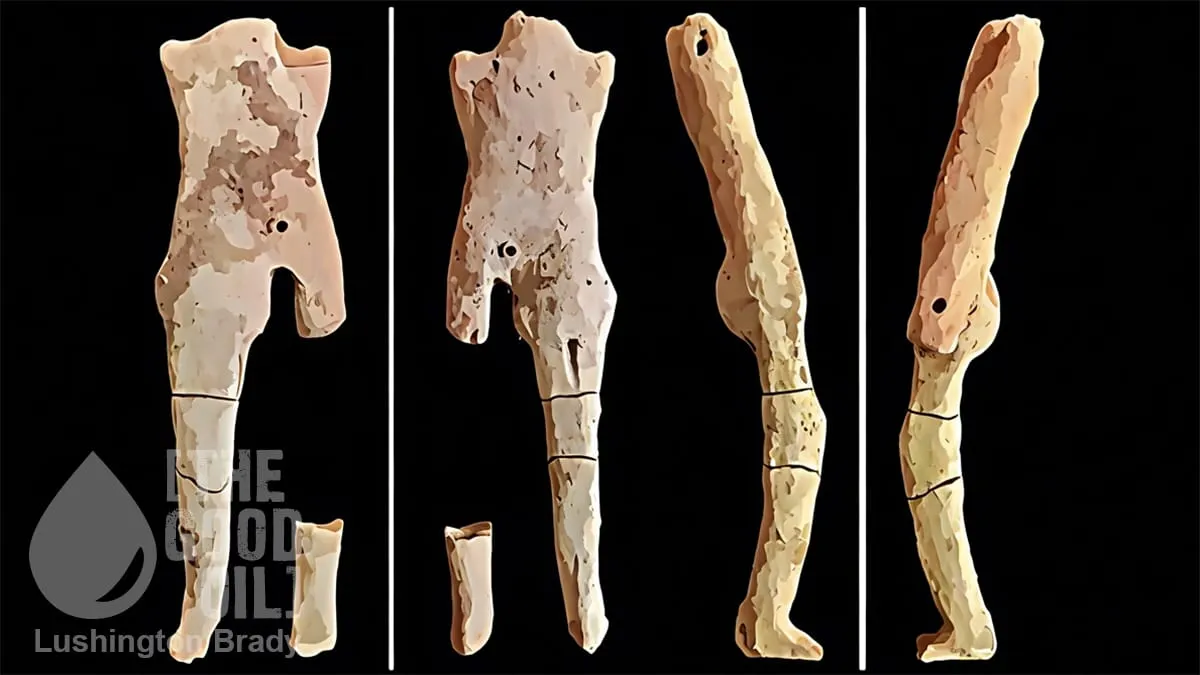
Or, indeed, a 1,500 year old terracotta doll recently unearthed at Torreparedones in southern Spain, the ancient Roman province of Hispania.
Discovered in the ruins of the site’s eastern baths by municipal archaeologist José Antonio Morena López, this doll is one of only a handful of such toys ever found on the Iberian Peninsula.
“This piece is of great interest due to the rarity of such artifacts, which are very scarce in Hispania, although a few notable examples are known,” wrote Morena López in his new report, published in the journal Antiquitas.
Like more modern porcelain dolls, the doll had articulated limbs.
The doll, which measures just over nine inches tall, was modeled in pale clay with a rough texture. Perforations in its shoulders and hips show that it once had movable arms and legs connected by wires or cords.
Along with the main doll, which was missing its head and arms, archaeologists recovered additional terracotta pieces likely belonging to other similar dolls: a right leg, a left foot, and an indeterminate limb with several holes for articulation.
These fragments were found in a large refuse dump built over abandoned baths between the third and fifth centuries CE. Based on this chronology, Morena López noted that the toys likely originated during that same period.
While it might seem obvious that toys and dolls were as common in ancient cultures as today (indeed, even modern primate young are drawn to play with sticks, or dolls, cars and trucks if they’re given them), for a long time, archaeologists tended to ignore the idea. As Morena López says, previous excavations rarely documented toy finds, preferring to interpret them as ‘ritual objects’.
Roman children are now known to have played with dolls, carts, balls, and miniature household objects. Girls in particular often used articulated dolls, ones that have movable limbs, sometimes dressing them in specially made clothing. These dolls, known as “pupae,” were typically made from fired clay, ivory, bone, or wood, though wooden examples rarely survive.
“They were instruments of play but also items bound up in rites of passage and memory,” Morena López explained in the study, referring to the dolls’ role as funerary offerings or votive dedications […] the doll provides evidence of something that is often overlooked: the lives of children.
“Children are very difficult to trace and find in interpretations of past societies,” Morena López noted in the study. “When they are mentioned it is as passive members of that society, perceived only in relation to adults and their activities.”
So, treat that find with more than usual curatorial care: it once meant the world to some long-ago child.