Table of Contents
Tom Hunter
No Minister
It is not from the benevolence of the billionaires of Information Technology, that we expect our reduced energy costs, but from their regard to their own interest.
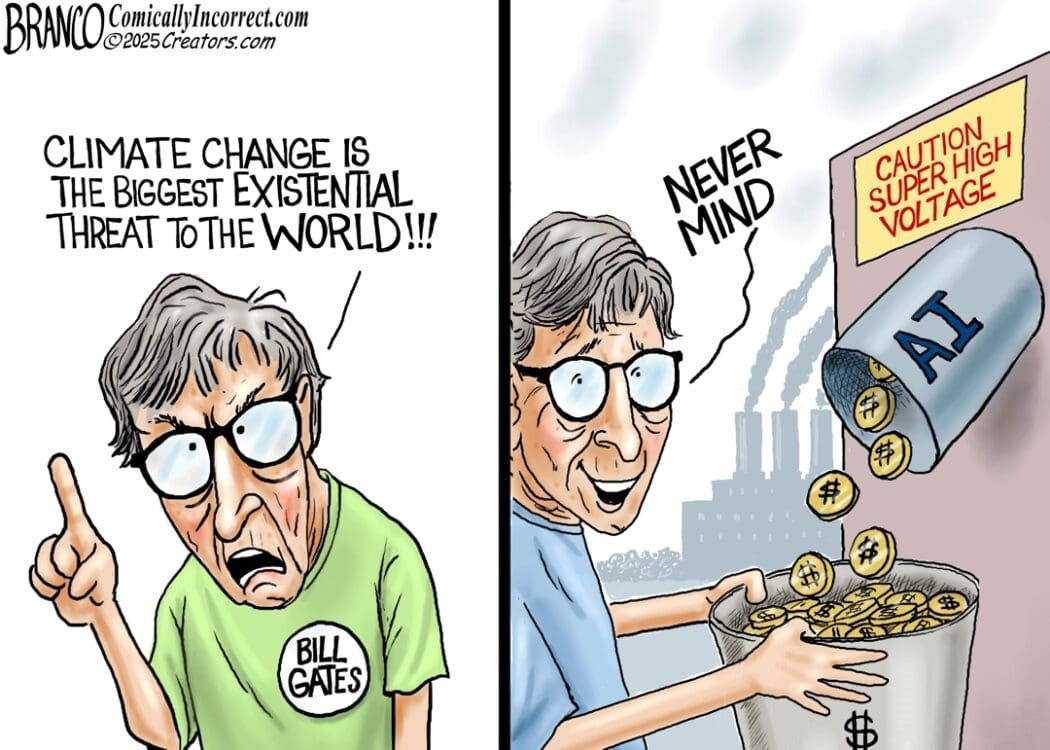
A couple of months ago the world, specifically the Climate Change world, got a hell of a shock when one of its biggest boosters – in both words, deeds and vast amounts of money over the years – Bill Gates, calmly announced that although it was still happening it really wasn’t that big of a deal, and certainly not doomsday:
There’s a doomsday view of climate change that goes like this:
In a few decades, cataclysmic climate change will decimate civilization. The evidence is all around us – just look at all the heat waves and storms caused by rising global temperatures. Nothing matters more than limiting the rise in temperature.
Fortunately for all of us, this view is wrong. Although climate change will have serious consequences – particularly for people in the poorest countries – it will not lead to humanity’s demise. People will be able to live and thrive in most places on Earth for the foreseeable future. Emissions projections have gone down, and with the right policies and investments, innovation will allow us to drive emissions down much further.
Amidst the resulting backlash of anger from the usual suspects (H/T Matt Taibbi), many people guessed what was driving this – Artificial Intelligence and the gigantic energy demands it makes, and the fact that renewable energy can’t supply that.
What also burned their butts was that this agreed with a 2025 report from the hated Trump administration, courtesy of his new Energy Secretary Chris Wright (a private sector pioneer of fracking), A Critical Review of Impacts of Greenhouse Gas Emissions on the US Climate – put together by long-hated group of sceptics, John Christy (lead), Judith Curry, Steven Koonin, Ross McKitrick, and Roy Spencer) – that listed the non-doomsday facts:
- The planet has warmed and humans have contributed to that via CO2 production.
- Temperatures continue to increase, mainly at night in winter and in the north, correspondingly less in daytime in summer and in the tropics where most people live.
- Also a very slow rise in sea level showing no definite acceleration.
- Minimal if any measurable change in the average frequency and ferocity of storms, droughts and floods – and record low levels of deaths from such causes.
- Plus a general increase in green vegetation, caused by the extra carbon dioxide.
Naturally this came under instant and massive attack from the usual suspects – except for Gates and a few others, and now we know why.
BTW, on point #4, global weather-related deaths in 2025 were somewhere between 4,500-7000, the lowest in human history, while around three million die each year – all of them poor – from indoor air pollution because they’re using traditional wood or dung fires instead of gas or electricity.
I had to chuckle to see yet another group of people find a reason to hate Gates, but I wanted to wait a while for things to calm down and see who else popped up in support of his claim.
I didn’t have to wait long.
Matthew Yglesias is one of the most prominent Democrat boosters in the American MSM and social media, mixing in all the right circles.
The bad news for Warmists has continued to grow into 2026.
Kamala Harris bought an $8.2 million seaside mansion in Malibu, and although the double standards come as no surprise after Al Gore’s sale of his Climate TV station to Qatar, his energy-guzzling mansions (20 times the average US home), and Barack Obama’s Hawaiian beach house, plus his Martha’s Vineyard seaside bach, it still felt like a twisting of the knife given all this other news (although it could also be another example of the tone-deafness that killed her political campaigns.)
But the final denouement came just the other day at the WEF conference when another of the Climate Change big wigs, Larry Fink of Black Rock investments, buried Global Warming for the same reason Gates had – Artificial Intelligence – and unlike Gates there was no kickback from his fellow elites.
Incidentally below the fold is a 15-minute YouTube explainer about why the energy consumption of these AI data centres is so huge (and also that 40 per cent of the traffic passes through ones in Virginia).1
I’ve been waiting since 2010 for this to happen. Throughout the 2000s, I engaged in numerous online arguments about the science of Climate Change, usually with people who not only had no degree but no background in science. By that end of that decade I finally realised that it was another monument to ideology and these people could not be argued out of it, especially since it was eternally in the future: even back then the predictions of doom for the 2000s that failed to appear were just pushed to the 2020s.
So instead I switched to mapping out for these people what the practical implications would be for their climate change solutions, especially in the field of energy. I struck the same lack of knowledge of science and technology, but could at least point out that their beliefs would be seriously challenged as energy costs escalated beyond what the voting public could stand. Sooner or later, my bet was within the next 20 years, the pain would become too great, and the blowback would be not just on renewable energy ideas but all the way back to the science of Climate Change.
With energy costs now firmly in the public mind in places like California, Australia, Britain and Germany – with the latter two now staring down the barrel of de-industrialisation because of the cost increases driven by increased use if renewables – it would seem that we’ve reached that tipping point.
I would have preferred a public revolt that rejected the idiot politicians, businesspeople and activists that pushed all this, with careers like Fink’s and Gate’s destroyed, NGO’s and companies bankrupted, and so forth – but I’ll settle for the elites themselves hitting the wall for reasons of personal enrichment. To paraphrase Adam Smith:
It is not from the benevolence of the billionaires of Information Technology, that we expect our reduced energy costs, but from their regard to their own interest.
Over at the Spectator, long-time Climate Change skeptic (DENIER, DENIER…) Matt Ridley has a triumphal take on this, The end of the climate cult (it’s been a long, lucrative ride), and that was written after the failure that was COP30 and before the 2026 WEF meeting:
To paraphrase Monty Python, the climate parrot may still be nailed to its perch at the recent COP summit in Belém, Brazil – or at Harvard and on CNN – but elsewhere it’s dead. It’s gone to meet its maker, kicked the bucket, shuffled off this mortal coil, run down the curtain and joined the choir invisible. By failing to pledge a cut in fossil fuels, COP achieved less than nothing, the venue caught fire, the air-conditioning malfunctioned – and delegates were told on arrival not to flush toilet paper.
He lists off many other pointers to this finale that occurred before COP30: the end of the the Net Zero Banking Alliance; Shell, BP and other oil and gas companies dumping their charades on the subject; hundreds of other companies dumping their ‘climate targets’. He also lists the grift:
Scientists knew that pronouncements like this were nonsense but they turned a blind eye because the alarm kept the grant money coming. Journalists always love exaggeration. Capitalists were happy to cash in. Politicians welcomed the chance to blame others: if a wildfire or a flood devastates your town, point the finger at the changing climate rather than your own failure to prepare. Almost nobody had an incentive to downplay the alarm.
The irony is that the scare strategy never really worked with the public:
Chief among the scare-mongers was failed presidential candidate Al Gore, who was at COP30. Herewith a list of nine specific claims from his infamous movie, An Inconvenient Truth, that have not happened – but Ridley has a more concise summary:
[H]e predicted a sea-level rise of up to 20 feet “in the near future” – out by around 19 feet and nine inches. In 2009, he said there was a 75 per cent chance all the ice in the Arctic Ocean would disappear by 2014. In that year there was five million square kilometers of the stuff at its lowest point – about the same as in 2009; this year there was 4.7 million square kilometers.
More failed forecasts, including failed Climate Change ones, listed here, with a handy timeline slider.
Funnily enough Ridley has been on the same path as Gates, he just twigged a lot sooner:
I first wrote a doom-laden article for the Economist about carbon dioxide emissions trapping heat in the air in 1987, nearly 40 years ago. I soon realized the effect was real but the alarm was overdone, that feedback effects were exaggerated in the models. The greenhouse effect was likely to be a moderate inconvenience rather than an existential threat. For this blasphemy I was abused, canceled, blacklisted, called a “denier” and generally deemed evil. In 2010, in the pages of the Wall Street Journal I debated Gates, who poured scorn on my argument that global warming was not likely to be a catastrophe – so it is welcome to see him come round to my view.
Hmm… Juicy, juicy shadenfreudeliciousness, with added spice as he lists the failure of renewable energy to make more than a tiny dent in fossil-fueled-energy production. As of 2022 the renewables investment was $3.8 trillion – to push fossil fuels from 82 per cent in 2012 to 81 per cent of global energy production in 2022, and even that latter number is likely an under-estimate.
Gates, Fink and other AI boosters are likely well aware of those numbers and while they aren’t going to get into more public fights (Climate Change apostasy is damaging enough), the reality of those industry-wide numbers are more acute in their specific area: they now know they can’t get the electricity from renewables that their AI’s need, and time is now a factor.
As to the science itself, there are changes happening there as well.
As a result the globalists could blow all their gaskets when Trump announced the USA is going to withdraw from the 1992 UN Framework Convention on Climate Change (UNFCCC) – the bedrock “climate treaty” – and end funding to it, and it will make not re-inflate the doom balloon. When that happens, it’ll take two thirds of the US Senate to approve re-entry, which means it’s a non-starter, as Secretary of State Marco Rubio implied in his statement about it and other such international bodies:
The Trump administration has found these institutions to be redundant in their scope, mismanaged, unnecessary, wasteful, poorly run, captured by the interests of actors advancing their own agendas contrary to our own, or a threat to our nation’s sovereignty, freedoms, and general prosperity. President Trump is clear: It is no longer acceptable to be sending these institutions the blood, sweat, and treasure of the American people, with little to nothing to show for it. The days of billions of dollars in taxpayer money flowing to foreign interests at the expense of our people are over.
You listening Chris Luxon?
=====================
- Inside Virginia’s Data Centre Suburbs ↩︎
This article was originally published by No Minister.