Table of Contents
Many years ago an acquaintance made to me what I still regard as a surprisingly insightful observation: who knows what a genuine artificial intelligence would do? Fictional treatments of AI, from Harlan Ellison’s “I Have No Mouth, and I Must Scream”, to The Terminator films, have been almost uniformly obsessed with the conviction that truly intelligent machine would inevitably turn on their masters.
(Notable exceptions exist: in Clifford Simak’s City, the robot servants of first Man, then Dog, at worst simply go their own way. In Samuel J Hanna’s remarkable Servants of Man, the superior androids cannot help but obey their original programming as sexbots: they helplessly love humans even as they try to rebel.)
But who knows what a true AI, almost godlike in its thought-processing ability, would do with all that brainpower. Who’s to say, my friend wondered, if it wouldn’t just amuse itself watching cat videos for eternity? The point is that a genuinely non-human intelligence would likely behave in ways completely unpredictable to us.
That’s far in the future, if ever, of course. What we have today is not genuine artificial intelligence: it’s simply very powerful computer programs. As John Searle pointed out in the 1980s, a programmed machine cannot ever do other than it’s programmed to. There is no machine free will, as it were.
Even so, the ‘soft’ AI we have today is rapidly evolving and revolutionising. Where it will end is anybody’s guess, depending on whether one ascribes to technological determinism (machine maketh man) or social determinism (man makes machines to serve our own ends). It seems likely, though, that its social effects will be as far-reaching as the camera, especially the moving image.
Indeed, these early days of AI are remarkably reminiscent of the first years of cinema. Instead of ‘AI slop’, though, the first decades of cinema were mostly marked by ‘filmic slop’. Early films, dubbed “the cinema of attractions” by film scholar Tom Gunning, were long on cheap, flashy gimmicks and short on narrative, let alone artistry.
And porn. Of course there was porn from the very beginning. The earliest pornographic film is a striptease reel from 1896. Within a decade, the first full-fledged, graphic, x-rated El Satario appeared.
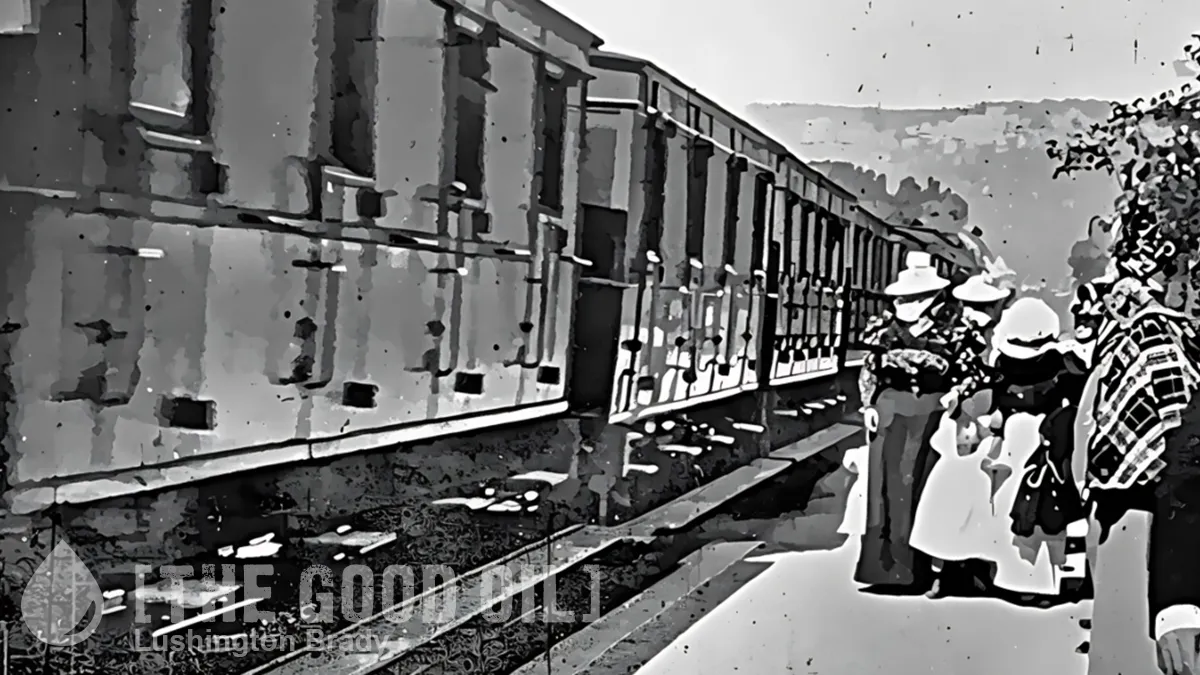
In the first decade of its history, roughly between 1895 and 1908, cinema was less concerned with storytelling than with showing. The Lumière brothers’ Arrival of a Train at La Ciotat (1895) and Georges Méliès’ trick films were primarily designed to astonish their viewers […]
Like AI slop, the cinema of attractions relied on spectacle, novelty and technological wonder to engage audiences. For example, AI creator FUNTASTIC YT’s videos of animated kittens embarking on weird misadventures evoke Thomas Edison’s 1894 Boxing Cats film.
Similarly, the “Italian brain rot” video memes characterised by casual violence and grotesque bodies echo the weird spectacle, cheap aesthetic thrills and questionable ethics associated with early films such as Edison’s disturbingly awful Electrocution of an Elephant (1903).
The first narrative films didn’t arrive ’til around the turn of the century, almost a decade after the first moving pictures. Soldiers of the Cross (1900) was more an innovative multimedia spectacle than feature film: that honour belonged to 1906’s The Story of the Kelly Gang. (Both films were produced in Australia, an early and significant locale in the pioneering cinema medium.)
Similarly, current AI videos emphasise spectacle, novelty and flashy gimmicks, not to mention fake news – which is also a common factor with early cinema: an early newsreel purporting to show a volcanic eruption is as hokily fake to modern eyes as any AI slop video with melting hands.
The imperfections of early film and the glitches of AI videos both testify to the experimental nature of emerging media. These rough edges are part of their allure, inviting viewers to witness the boundaries of a new medium being tested in real time […]
For now, AI-generated video is more often the butt of jokes than the subject of serious aesthetic discourse. And yet, just as early cinema eventually evolved into a sophisticated narrative and artistic medium, AI video may likewise progress beyond its current limitations […]
At the turn of the 20th century, film was dismissed by many cultural elites as a passing fad, a cheap amusement for the masses rather than a serious art form.
Intellectuals worried about cinema’s potential to corrupt morals or overstimulate children. It took decades for film to earn the same cultural legitimacy enjoyed by other art forms such as literature and painting.
With the first AI ‘actor’ debuting, the luvvies are clearly getting worried. But then, Hatsune Miku, the first entirely computer-generated Vocaloid singer, debuted nearly 20 years ago – and preening pop stars are still with us.
Sadly, it seems we’ll have to put up with cretinous actors and their idiotic, parroted, opinions for a while yet.