Table of Contents
In the ‘modun educayshun’ system, all manner of obvious absurdities are peddled as ‘truth’. Especially in the subject of history. In Australia, students are forced to study the ludicrous fiction of Bruce Pascoe’s Dark Emu, despite that its central claims have been as roundly debunked as Pascoe’s own claims to Aboriginal ancestry. In New Zealand, students are made to believe that Māori life before Captain Cook was a Rouseauian peaceful paradise. And don’t mention the Moriori.
Things are even worse in the United States. Libellous fictions are peddled about every great figure in American history, from Christopher Columbus to George Washington. But nothing attracts more cant, lies and utter bunkum, than the subject of slavery. American college students firmly believe, for instance, that the United States invented slavery. As if it hadn’t been a near-universal practice for almost the entirety of human history. Ah, but even its universality is lied about: the fiction is that only white people ever practiced slavery.
Contrary to the absurd fictions of The 1619 Project, the first slaves trafficked to America weren’t black Africans, but white Europeans. Mostly Irish. The Irish had been abducted and forced into slavery since at least the eighth century, at the hands of Viking raiders.
The subjugation of the Irish reached new heights during the English colonization of Ireland.
As England tightened its grip, the Irish were systematically uprooted and sold into servitude and slavery across the Atlantic.
During the Irish uprising against English rule, over 550,000 Irish were reportedly killed by English forces.
Another 300,000 were captured and sold as slaves.
These hundreds of thousands of Irish were sold to not just the Colonial United States, but to slave-owners in the Caribbean, Barbados and Montserrat. Half to two-thirds of Europeans arriving in Colonial America arrived in bondage.
Irish servants arrived in Virginia, the Carolinas and New England.
Many were children, often as young as 10.
One such child was Elizabeth Abbott.
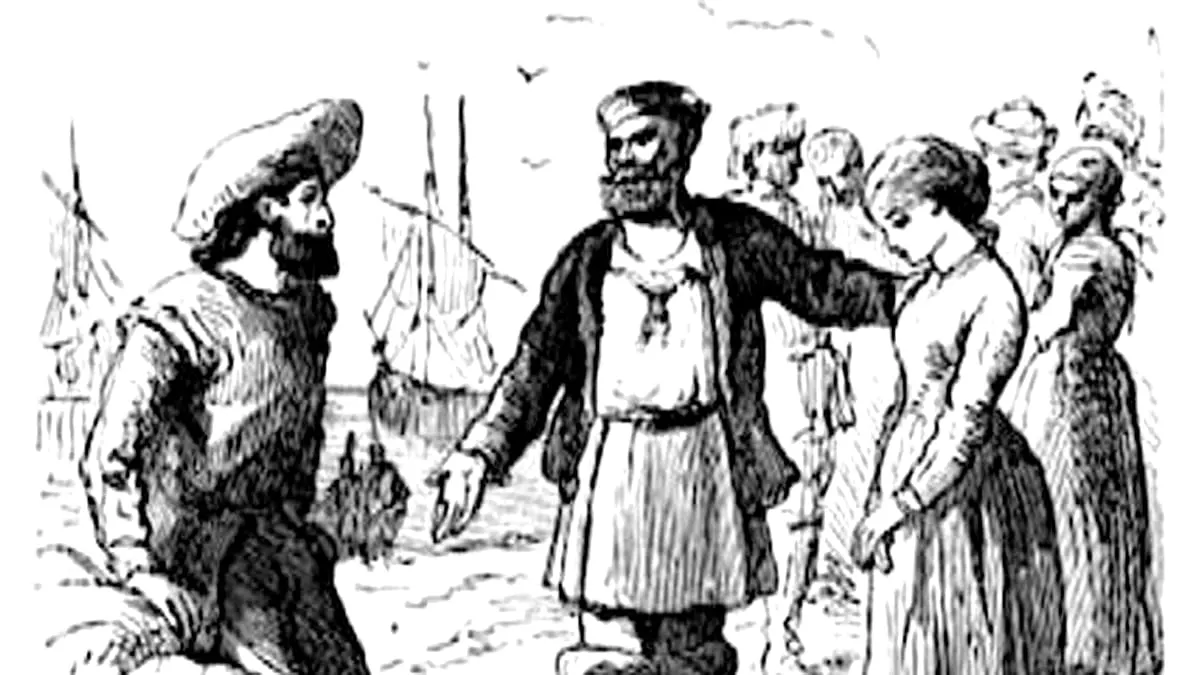
There was a girl, one of the first white children to be bundled up in 1618 and sent to America, supposedly for a new life, in fact, to be sold to plantation owners. She was called Elizabeth Abbott. And she was one of the few who survived the rigors of the first couple of years. Because of the first 300 of these children, only 12 survived, that we know about, more than three or four years. She was one of them. And a few years later, she was found dying because she’d run away too often, and her owner had ordered her to be given 500 lashes. The owner was never found guilty of anything.
As Elizabeth Abbott’s horrific example shows, the treatment of white slaves was little different to that of blacks. Apologists for the ‘official narrative’ of American slavery like to claim that the Irish were ‘indentured laborers’, rather than slaves. While this was true in some cases, for many it was not. Forcibly removed from their homeland as captives, they had no legal contract. Indeed, few contracts survive, calling into question the ‘indentured servant’ narrative.
Those which do survive, show that terms of indenture were up to 11 years. The lifespan of a white ‘indentured servant’ in the 1620s was around two years. There was no effective difference, then, between ‘indentured labour’ and lifelong slavery.
Even as indentured laborers, the Irish endured treatment no better than black slaves. An observer of a white slave sale in Boston in the early 18th century describes them as the most wretched human beings he had ever seen. Most were nearly naked and utterly filthy from the voyage. Just as black slaves were, they were beaten, overworked and denied basic freedoms. They were brutally punished if they tried to escape, as Elizabeth Abbott was. “They were beaten. They had red hot needles plunged through their tongues,” says Michael Walsh, author of White Cargo.
No doubt due to their mutual suffering, white and black slaves got along “surprisingly well”, says Walsh.
There was no sign or little sign of racial tension between the English servants – which we reckon were slaves – and the African servants, who were also called servants. They were treated in much the same way for many decades. They complained together, they ran away together, they rebelled together. There was a huge explosion of discontent in 1676, the Bacon Rebellion. That was black and white. And that terrified the plantation owners.
So much so that they applied a classic case of divide-and-rule. “A racial wedge was deliberately pushed between” the two classes of slaves, says Walsh. “The whites were made to feel superior. They were given a few rights, they still weren’t free.”
But they did mess with the modern ruling elite’s narrative. No wonder they’ve been assiduously expunged from the approved histories.