Anton Lang
PA Pundits – International
Almost 150 years ago, at around lunch time on Thursday the 15th of March 1877, the Australian batsman Charles Bannerman stood in the middle of the cricket ground in Melbourne and took his guard. The Englishman Alf Shaw came in and bowled the ball, and Charles played it gently back to him. Only around 1000 people were actually watching this happen on that morning and the crowd built up later in the day. This was the very first ball in what was later designated as the first ever test cricket match, and this match was played between what are now the two most storied teams in the history of world cricket, Australia and England, at what is now the famed Melbourne Cricket Ground, the MCG.
To this day, almost 150 years later, Charles Bannerman holds an Australian cricket record that has never been beaten.
The term ‘Cricket Tragic’ was popularised around 20 years ago when former Australian Prime Minister John Howard called himself just that. It basically means that the person in question loves the sport of cricket (the game they play in Heaven) deeply.
I would like to think of myself in exactly the same manner. I even mention it in my bio for our site here, at this link. I played the game of cricket at a competition level for 25 years, right up to my 40th birthday. For around 10 of those years, I played senior grade cricket, so this was not just playing around occasionally with friends, but competitive sport every Saturday in summer. I was an opening bowler for those earlier years in grade cricket, with the Raymond Terrace side, and as I got older, I let others do that hard work, as I moved into team captaincy, and then coaching roles in my later years, even though I still played at that competitive level. I still bowled, but not at the pace I originally bowled at, as my aging and aching knees would not allow too much of that. All of that (the actual playing of the game) ended back in 1992, 34 years ago.
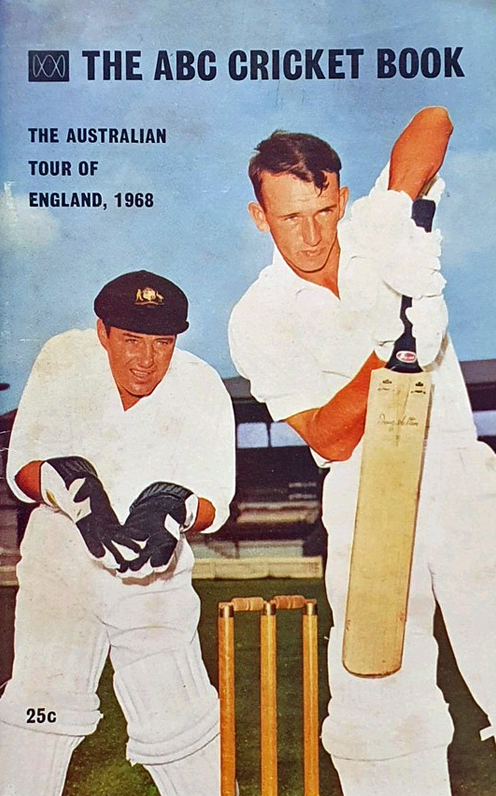
All I have done since is watch the game in all its many forms and read about it. Family were never at a loss to guess what I wanted as a gift for Christmas or birthdays, as cricket books were always on that gift list. That’s all I have now, reading about and watching the game on TV. I have around 30 books, and also an esoteric collection of those small ABC cricket magazines that are published every year, and I have every one of those since they started coming out with the covers in colour, and that first one with a colour photograph on the cover was for the UK tour in 1968. So, all up, I have 73 of those, religiously collected as soon as they are published, and then moved onto the bookshelf after being read carefully just the one time. That first magazine in my collection is shown above, showing a young Doug Walters batting, with wicketkeeper Barry Jarman the other cricketer on that cover in a day long before helmets became compulsory wear for batsmen. And here, note the cost of this small magazine, just 25 cents. When it comes to books, most of mine are those large ‘coffee table’ sized books. And here, I’m not much interested in memoirs of retired captains and players. I much prefer those books of a historical nature (particularly Australian cricketing history) and all but a couple of those cricket books I do have are just that, some of them a pictorial history as well.
So, I’m pretty much up to date with nearly all upcoming test cricket matches, and I have noticed the upcoming Australian Test Cricketing itinerary where our national team plays around 20 tests in the next year or so, with the two tests against the touring team from Bangladesh now completed. One of those upcoming matches is a one-off test against England, in March of 2027, a day-night test at the Melbourne Cricket Ground to commemorate 150 years of test cricket, celebrating that very first test back in 1877. In what was a major upset result, Australia won that very first test by 45 runs, and in a case of wonderful irony, Australia also won the centenary test, played at the MCG in March 1977, also winning by that same margin, 45 runs.
So, Charles Bannerman’s record then.
This was the fourth time a touring cricket side from England had visited Australia. The English team was captained by James Lillywhite and for the match to be played against Australia they were the almost overwhelming favourites. The Australian team was captained by Dave Gregory, a team made up from six players from New South Wales and five players from Victoria.
Charles Bannerman played the first ball in test cricket. He scored the first run in test cricket (from the second ball of that first over). He hit the first boundary (four runs) in test cricket. He scored the first 50 in test cricket. He scored the first century (100 runs) in test cricket, and that happened late in the afternoon on that first day. On the second morning of that test, whilst still batting, he was hit on the finger by a ball and it broke that finger. So Charles had to ‘Retire Hurt’. This was not considered to be actually out, as it was not a cricketing shot which led to him actually being dismissed (given out), not being able to bat any more. His score at the time was 165, so in effect he was 165 not out, but he had to retire from batting with that broken finger.
That score of 165 retired hurt is the highest score on debut by an Australian batsman, and to this day, almost 150 years later, it has never been beaten by ANY other Australian batsman. That makes it the oldest Australian test cricketing record and it might arguably be said that it could in fact be the oldest Australian sporting record.
So then, lets put this record into some sort of perspective.
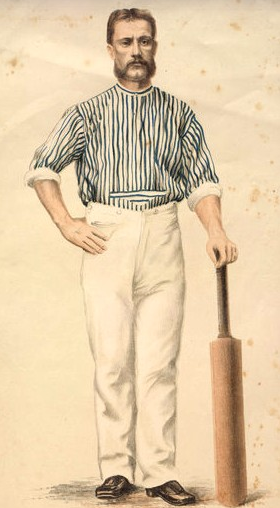
Charles Bannerman was player number one in the history of Australian test cricket. That player numbering was first introduced by England in 2001, with the number being embroidered on the cap each player was presented with on their debut test, and this practice was then quickly introduced into Australian cricket. Player numbers on their playing shirts was introduced in 2019. Player numbers were then retrospectively introduced for all test cricketers, So, Charles Bannerman, being the first man to face a ball playing for Australia, was designated as test player number one. (Umm! It also fortuitously helped that his name began with the letters Ba, as that first test 11 were given their test numbers in alphabetical order.)
There has now been 473 men to play test cricket for Australia, and only 16 of those men have scored a century on their test debut, their very first match (so, only 3.4 per cent of batsmen achieving this feat). So here, Charles is in a very select group, and he sits right at the top of that group.
To place an even finer point on this, Australia has played in 884 test matches since that first test match and no one has beaten that score of his from the very first test match.
The Australian batsmen who have gotten closest are as follows:
Archie Jackson – 164 – 1929 v England
Kepler Wessels – 162 – 1982 v England
Doug Walters – 155 – 1965 v England
Michael Clarke – 151 v India
(and these are the only Australians to score 150 or more on their debut)
On the overall world stage, there have been 15 higher scores than this on debut, and the highest scores on debut are as follows (and here I have listed just those batsmen who scored 200 or more on debut):
The Englishman Reg Foster – 287 – 1903 v Australia
The South African Jacques Rudolph – 222 not out – 2003 v Bangladesh
The West Indian Laurence Rowe – 214 – 1972 v New Zealand
The New Zealander Matthew Sinclair – 214 – 1999 v West Indies
The West Indian Kyle Mayers – 210 not out – 2021 v Bangladesh
The Sri Lankan Brendon Kuruppu – 201 not out – 1987 v New Zealand
The New Zealander Devon Conway – 200 – 2021 v England
That Jamaican batsman playing for the West Indies, Laurence Rowe, went on to score 100 not out in second innings of his debut Test to score most runs on debut in a test, his total amounting to 314.
In total, there has been 2628 test matches played by 3892 players, and only 120 of them have scored a century on debut (so, only 3.1 per cent of batsmen achieving this feat, an even smaller percentage than the Australian figure).
On the overall world standing, that 165 from Charles Bannerman is only the 16th highest score on debut.
Right from when I first became interested in cricket (far and away my favourite sport) back in late 1960, when I was only nine years old, I knew of this amazing record, and over the intervening 67 years, I have watched as so very few Australian batsmen even got close to breaking this record, and it has never happened.
I feel certain that this record of Charles Bannerman will play some part in that upcoming 150th anniversary test match at the MCG, but I have some doubts that it will be given the significance it actually deserves, considering the long lists of records I have shown here.
After all is said, this is still the longest existing record in the very long and storied 150-year history of Australian (and world) test cricket, and probably the longest still existing record for ANY sport here in Australia.
Charles Bannerman only played three tests for Australia, but it’s he who still holds that record. Charles Bannerman passed away in 1930, at the age of 79.
In an age when sporting records are broken on a relatively regular basis, this one record stands the test of time.
Oh, and please excuse me here for only mentioning men’s cricket, as it has the much longer history.
This article was originally published by PA Pundits – International.