
Table of Contents
Alastair Lewis
The Daily Sceptic
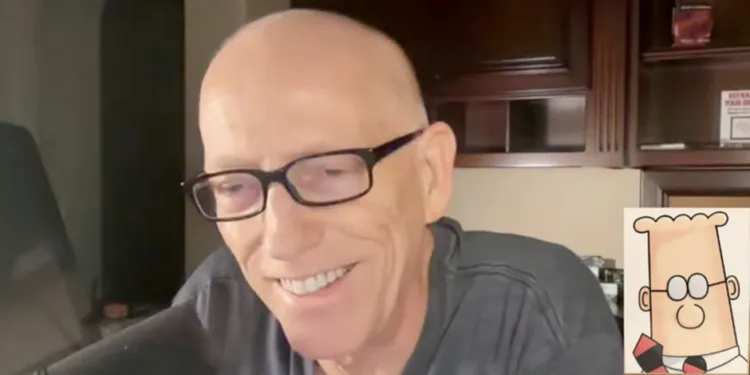
Scott Adams is gone. Or, to use his own language, he has successfully transitioned out of this particular simulation. To the world, Scott was the guy who drew the popular beige office drone with thumb extensions for hair. But if you were paying attention, you knew Dilbert was not just funny, but the entry-level drug.
Scott was a master of specific knowledge, a practitioner of persuasion, and one of the few individuals in our lifetime who understood that reality is not a fixed set of facts but a series of competing filters. He didn’t just observe the world, he hacked it.
The Engineering of a Mind
Scott started where many start: the corporate cubicle. That was where he gathered his initial leverage, realising the absurdity of ‘takers’ managing the ‘makers’. He saw that most people in large organisations risk becoming NPCs (non-player characters), following a script written by people who don’t understand the underlying systems.
But Scott was an engineer of the human mind. He didn’t just want to complain about the boss: he wanted to understand why the boss existed and how to hypnotise him. Throughout his life, he studied hypnosis, persuasion and the “user interface” of the human brain. While everyone else was arguing about policy, Scott was looking at the ‘talent stack’. He mastered his own, bridging the gap between the corporate cubicle, cartooning, public speaking (he spoke highly of the Dale Carnegie course), writing and persuasion.

He didn’t play the status game of legacy media. He knew that if you can change the way people perceive reality, you don’t need to win an argument – you’ve already won the game.
The Master Persuader
When Donald Trump descended that golden escalator in 2015, the legacy media laughed. But in Scott’s filter what they were actually seeing (and many still do) was a 2D world of gaffes and policy white papers. What Scott saw was a ‘master persuader’ playing ‘3D Chess’.
I discovered Scott in 2015 when I chanced upon a remarkable CNN interview with him (the clip no longer appears to be online, but I found this). CNN was incredulous about Trump’s chances and how the cartoonist famous for Dilbert was not just publicly predicting a Trump victory, but a victory over the likely first female president of the United States. Scott explained that Trump was the only one using the science of persuasion in all the ways it could be used: “I see in him the highest level of skill in terms of just persuasive technique that I’ve ever seen in any human being alive. I’ve never seen anything like it.” I was intrigued – no one else was saying this in 2015 – Scott was analysing a different Trump, one with an unbeatable ‘talent stack’.
What fascinated me was Scott’s ‘Two Movies On One Screen’ filter that could explain how even the most ‘intellectual’ people could see the same facts yet arrive at two completely different narratives. He would elaborate: “The normal way of looking at the world is that, oh, we’re a logical species, you know, 90 per cent of the time anyway. But the hypnotist reverses that, and says we’re irrational 90 per cent of the time, and we make our decisions first and then we rationalise them after the fact.” As with many of Scott’s ‘reframes’, once you heard them, they became ‘sticky’ and you started to see them everywhere. He was enabling listeners to reframe their reality and empower them with the tools to author it.
Scott picked up on a little-known fact about Trump. As a child, Trump’s pastor at his church happened to be Norman Vincent Peale, author of The Power Of Positive Thinking – another ‘master persuader’. Trump himself often described listening to Peale’s sermons in his youth, noting that he was “captivated” by Peale’s oratorical style and message. Scott drew the dots. Trump had honed his skills since a young age to not only be impervious to criticism but to conquer it and wear it as a skin. To Scott, this lens explained how Trump could seemingly irrevocably fall out with anyone at any given moment, yet completely make up with them the next (whichever was expedient). This included Trump’s “linguistic kill shot”, which Scott coined to describe the many nicknames Trump would assign to his adversaries. In Scott’s filter, Trump was not thin-skinned, nor was he erratic – on the contrary, he was in control.
Scott’s observations of Trump eventually filtered up to the president himself. Trump was paying attention, inviting Scott to the White House during his first term and phoning him personally last year to offer help over Scott’s cancer diagnosis.
Scott saw the 2024 victory as a triumph for the Persuaders over the Programmed. He predicted the second Trump administration would herald a “Golden Age” of commonsense policy and merit, driven by a “Dream Team” of specialists like Musk, JD Vance and RFK Jr. Conversely, his prognosis for Europe was not so glowing. Last week, the majority of the All-In Podcast team predicted US GDP growth to hit five to six per cent in 2026. If that happens, it would vindicate the ‘movie’ Scott had been watching all along and be his greatest prediction of all, albeit bittersweet.
Skin in the Game
Scott had skin in the game. When he backed the ‘MAGA’ movement, he knew the cost. For the legacy world – the newspapers, cable networks and ‘polite society’ – he was a constant thorn in their side, in particular debunking hoaxes like The Fine People Hoax and The Drinking Bleach Hoax (you can find an extensive list here), while also being taken out of context himself. While taking great care to clarify any misrepresentations of his positions, he claimed he was being ‘shadow-banned’ during the Twitter-era and demonetised on YouTube. Through it all, he lost many friends, income and his decades-long Dilbert syndication, with the emotional toll occasionally surfacing in his podcasts.
But they forgot one thing: in the era of social media, ‘fake news’ and the growing mistrust of legacy media, if you have a direct connection to your audience you are uncancellable. He often spoke about the ‘reconstruction of the truth’. He knew that the old legacy media were dead and that the new world would be built on trust and transparency. Scott built his own platform, Coffee With Scott Adams, and proved that the individual is sovereign. He didn’t need a seat at the CNN table: armed with nothing but a webcam and a coffee cup, his ‘simultaneous sip’ became a daily signal for the most powerful and influential people in America to tune in and see the world through his lens.
His departure has indeed left a gaping void. Like all greats, there is only one. He had a gift for the succinct – perhaps honed by years of drawing triptych cartoons. He could write and speak as articulately as anyone, but with the fewest words. He lived his philosophy, airing his live show every day for over 10 years, including Christmas, weekends and sometimes twice a day during lockdown. He welcomed debate with anybody, from Naval Ravikant to Joe Rogan, Jordan Peterson and a somewhat bizarre encounter with Sam Harris. His influence grew quickly from 30,000 Twitter followers in 2015 to 1.3 million X followers today. He was relentless in his pursuit to be “useful”, producing “micro-lessons” on everything from ‘Systems Over Goals’ to affirmations and building a talent stack. Some of his most quotable work has even found its way into music.
The ‘Third Act’: A Masterclass in Stoicism
In his last year, Scott faced a challenge no amount of persuasion could overcome: his own biology. Not since Christopher Hitchens have I seen someone navigate cancer as a masterclass in stoicism and defiance. He didn’t play the victim. Even when paralysed and in peak pain, Scott was ‘reframing’. He showed up until the end.
He reached out to the president in his final months, not as a beggar, but as a citizen seeking the right to try and the right to innovate for his own life. He remained a scientist, observing his own decline with detached curiosity, looking for the ‘glitch in the matrix’.
His farewell letter, written on New Year’s Day, was his final lesson. In a typical Scott reframe, he accepted Pascal’s Wager and ‘converted’ to Christianity – though still said he was “not a believer”. He addressed his Christian friends by noting that the risk-reward calculation for accepting Jesus looked too attractive to pass up. Scott’s farewell letter, as read by his ex-wife Shelley Miles:
The Legacy of the Reframe
And on that poignant note, Scott Adams taught us that happiness is a choice and a skill. He taught us that the world is more malleable than we think, that you just need to decide it is and then author it. He took the pain of the old cubicle system and turned it into the fuel for a new era of the sovereign individual. In the months since his diagnosis, countless listeners have inundated Scott with gratitude and will continue to do so, describing how he, in one way or another, improved their lives immeasurably. Quite succinctly: “Be useful.”

Alastair Lewis is a pseudonym.
This article was originally published by the Daily Sceptic.




)