Table of Contents
Bob McCoskrie
Founder and chief executive
There have been many “Christian” or social-conservative parties since 2002 – including Christian Heritage NZ, United Future, Conservatives (formerly New Conservatives), Destiny (then Family Party, then Vision NZ, then Freedoms NZ), Leighton Baker Party, Democracy NZ, Kiwi Party, NewZeal, and others.
In 2023, there was quite a line up of social conservative/Christian parties to choose from – NewZeal, Freedoms NZ, Democracy NZ (Matt King), New Conservatives, and the Leighton Baker Party.
- The harsh reality
Despite the optimism, the significant effort of time and expense, the passion and the utter hard slog (and prayer!), the results were:
NewZeal 0.56 per cent,
Freedoms NZ 0.31 per cent,
Democracy NZ 0.24 per cent,
New Conservatives 0.15 per cent,
Leighton Baker Party 0.08 per cent,
Under 40,000 votes in total.
A total of 1.34 per cent – well short of the five per cent cut-off.
Here’s the total vote for Christian parties over the past eight elections. From the dizzying heights of 2002 when Peter Dunne “turned the worm” in the television debate for United Future, and there was a remnant of support for Christian Heritage Party (total vote of 8 per cent for both parties!), to Dunne losing his way and the vote transferring to the Conservative Party but never going beyond the four per cent or thereabouts mark and, in the last three elections, never more than two per cent.
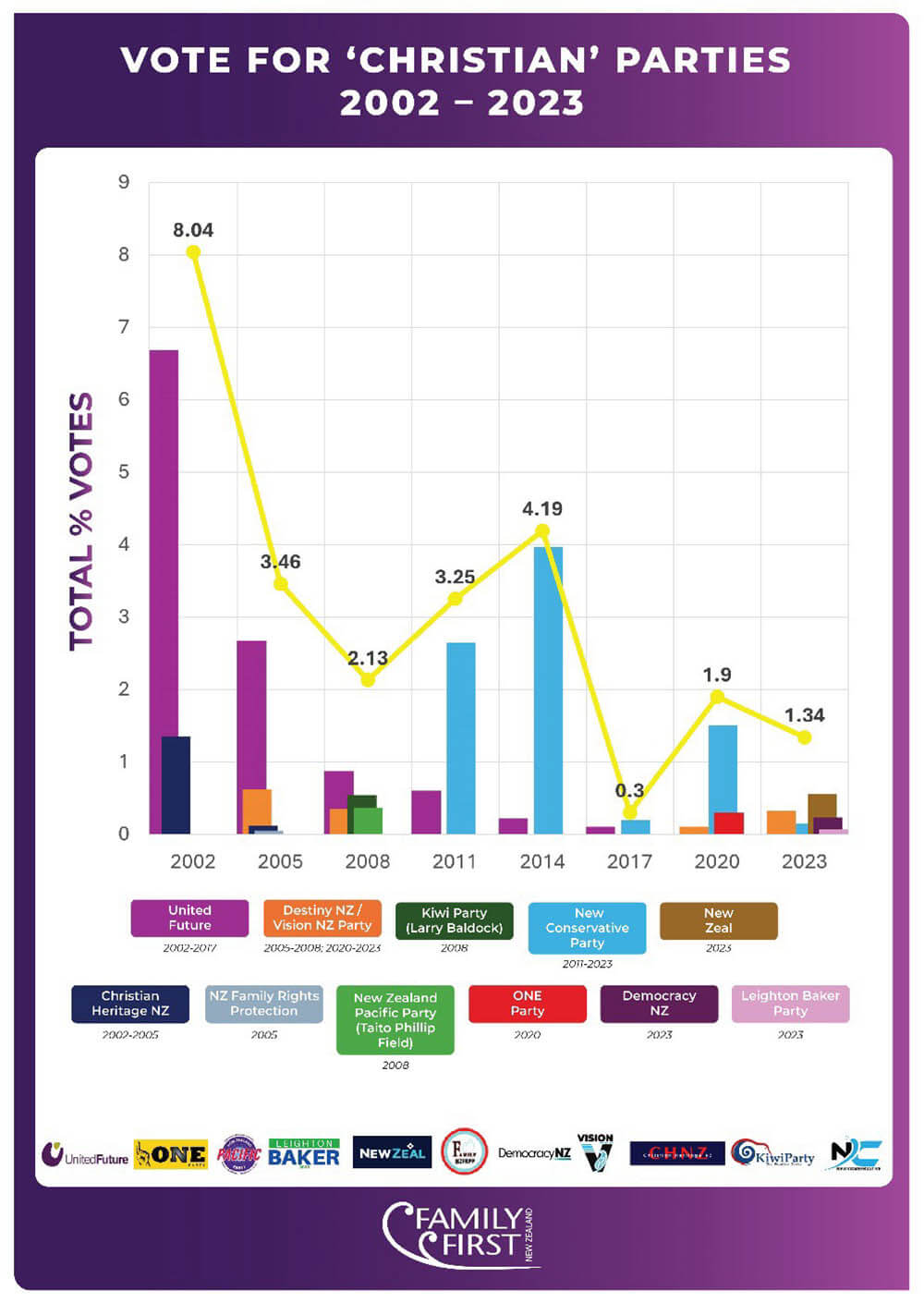
Well short of the five per cent mark – and no likelihood of a Christian party candidate even getting a sniff at winning an electorate seat since Peter Dunne retired from politics.
In the last seven elections, the vote for Christian parties has averaged less than 2.4 per cent.
Five per cent is the pass mark.
Some people won’t like me mentioning these facts. I don’t take great pleasure in mentioning it either.
It’s not pleasant to see, is it, after so much effort and time and resource and energy and sweat and financial investment.
Politics is a brutal sport. I’ve commentated on it for the past 21 years.
It has a harsh reality to it.
2. We all agree on many things.
Currently, apart from a handful of MPs, the House of Representatives fails to represent the voice of social conservatives. Parliament has gradually become more and more socially liberal – even amongst the so-called ‘centre-right’ parties.
A parliament that votes for:
- one of the most extreme abortion laws in the world;
- an anti-smacking law which criminalises good parents but does nothing to stem the flow of rotten parents killing and abusing their children;
- a prostitution law that rewards pimps and brothels but damages vulnerable women through sexual exploitation and violence;
- ‘same-sex’ marriage which destroys the definition and ignores an institution which protects children and strengthens natural families, and allows same-sex adoption, which deliberately denies a child a mother or father;
- a ‘conversion therapy’ law which criminalises parents, counsellors, pastors and medical professionals for affirming young people as their biological sex and criminalises the actions of adults who want to deal with unwanted sexuality and gender issues and live according to their own convictions and conscience;
- euthanasia which threatens vulnerable people who have a terminal illness, including the disabled, elderly, depressed or anxious, and those who feel themselves to be a burden or who are under financial pressure;
…is clearly not doing their job correctly, and needs new and better voices.
Even more telling is a parliament which unanimously votes to allow gender on a birth certificate to be based on ‘self-identity’ rather than biological fact, proving just how liberal and woke the whole institution has become.
New Zealand desperately needs more social conservative voices in parliament. We need voices in parliament who will speak boldly and unapologetically for the unborn child; oppose radical sexuality and gender ideology, divisive critical theory, and climate alarmism targeted at young children; and protect vulnerable young people from sex rejecting procedures which lead to chemicalisation (puberty blockers) and genital mutilation.
We need voices in power who will promote and protect the institution of marriage; who will respect the role of parents rather than attempt to exclude them from important issues such as abortion and gender dysphoria; politicians who will protect the elderly and vulnerable from seeing assisted suicide as a solution.
We need voices who will seek to protect our communities from drug use and normalisation and the ‘Russian roulette’ of the flawed drug testing.
We need voices who will respect freedom of conscience for New Zealanders who oppose euthanasia, abortion, compulsory vaccination and other health-related mandates.
We need voices who will protect freedom – religious freedom, freedom of conscience, and free speech, amongst others – and who oppose ‘hate speech’ laws (which supporters never want to clearly define in advance).
[It is important to note that as a result of the last election, a few existing and new social conservatives were present in some of the political parties that made it into parliament and we (Family First) developed a working relationship with these MPs where we could support them, provide resources and research, in order to help stiffen their spine against the onslaught that they faced in the parliamentary environment, and to regularly pray for them. But they are in the minority.]
3. We must turn up to the debate
I believe we should applaud these minor political parties for being willing to get involved and entering the debate.
By being candidates, they are able to be at the political meetings and the meet-the-candidate meetings. They have the opportunity to promote policies which strengthen families and protect communities.
They can be seen and heard at a time when the future political policy direction of the country is being debated.
As I often say – we won’t win every battle, but we’ll definitely lose every battle that we don’t even show up to.
But how do we maximise our message most effectively?
And is it via a political party/s?
Or is it social conservative candidates in existing major parties?
Or is it social conservative lobby groups and think-tanks speaking into the public debate and providing credible research and policy?
As I said earlier, in the last seven elections, the vote for Christian parties has averaged less than 2.4 per cent.
This leads to my key point.
4. Synergy
When I spoke at a major church leaders’ gathering in 2023 (when the last general election was held), I shared the significance of the word “synergy”.
Synergy is the cooperative working together of two or more people or organisations, when their combined effect is greater than the sum of their individual efforts.
You don’t need to be a seasoned political analyst to see that three to five parties all seeking to attract the same type of voter is going to fail.
It will simply split the vote.
In 2023, what we saw was five parties all seeking to attract a similar type of voter.
I argued at the time that it was going to fail. It would simply split – or alienate – the vote.
I truly wished I was wrong. But sadly, I was right.
This is the harsh reality of politics.
And any political party will tell you that a lack of unity is a killer. Voters don’t like disunity.
Remember how National was punished in 2020 when they went through three leaders in a very short space of time, and lots of leaks and disunity within the party. Te Pāti Māori are facing the same dilemma – and it’s showing in the polls.
In fact, the only times the ‘Christian’ vote has got above or close to the five per cent is when social conservative voters united in behind United Future (2002) and then the Conservative Party (2014).
Even worse, the ‘wasted vote’ will be apportioned to parties who do make it to parliament – the very parties which are failing to represent our voice currently.
That’s not my opinion. That’s the way the system works.
In 2017, 4.4 per cent of votes didn’t count because individual parties either couldn’t win an electorate seat or couldn’t get more than five per cent of the total vote. In 2020, eight per cent of votes didn’t count. In 2023, 5.5 per cent of votes didn’t count.
Watch the presentation on the wasted vote:
That’s a fault of the MMP system – whether we like it or not – that these votes are discarded and have no representation in our parliament.
But – we need to understand and play by the rules.
We actually have no option but to play by the rules.
5. Heading into 2026
As Albert Einstein said,
“The definition of insanity is doing the same thing over and over and expecting different results.”
For all these minor parties putting huge effort and resource and energy and financial investment with the desire of adding a conservative voice in parliament, to even have a remote possibility of breaking the five per cent threshold, all these minor parties need to unite – as one party and as one voice.
United, they stand as a possible option.
Possible.
Divided, they will continue to fail and fall well short.
I would challenge all these parties to come together.
Sort the leadership issues. True leadership involves putting aside their own agendas and desires for the greater good. And the greater good is unity, representation and impact.
Especially in the political sphere.
Even then it’s going to be an uphill battle. Building credibility and being seen as a viable option takes time.
Credibility is also easily lost, and even harder to rebuild.
But now is the time to unify.
Otherwise, I’ll be updating the graph to include 2026 and writing a similar McBlog in 2029.
This article was originally published by Family First New Zealand.