Table of Contents
Let Kids Be Kids and Penny Marie
Across New Zealand, school boards are outsourcing policies to a private company called SchoolDocs. They service over 2000 NZ schools. This service promises “up‑to‑date” documents aligned with legislation. In reality, one unaccountable provider is telling most NZ schools what the law supposedly says – and has quietly imported gender ideology into school policies.
Mis-stating the Human Rights Act – and slipping in ‘gender identity’
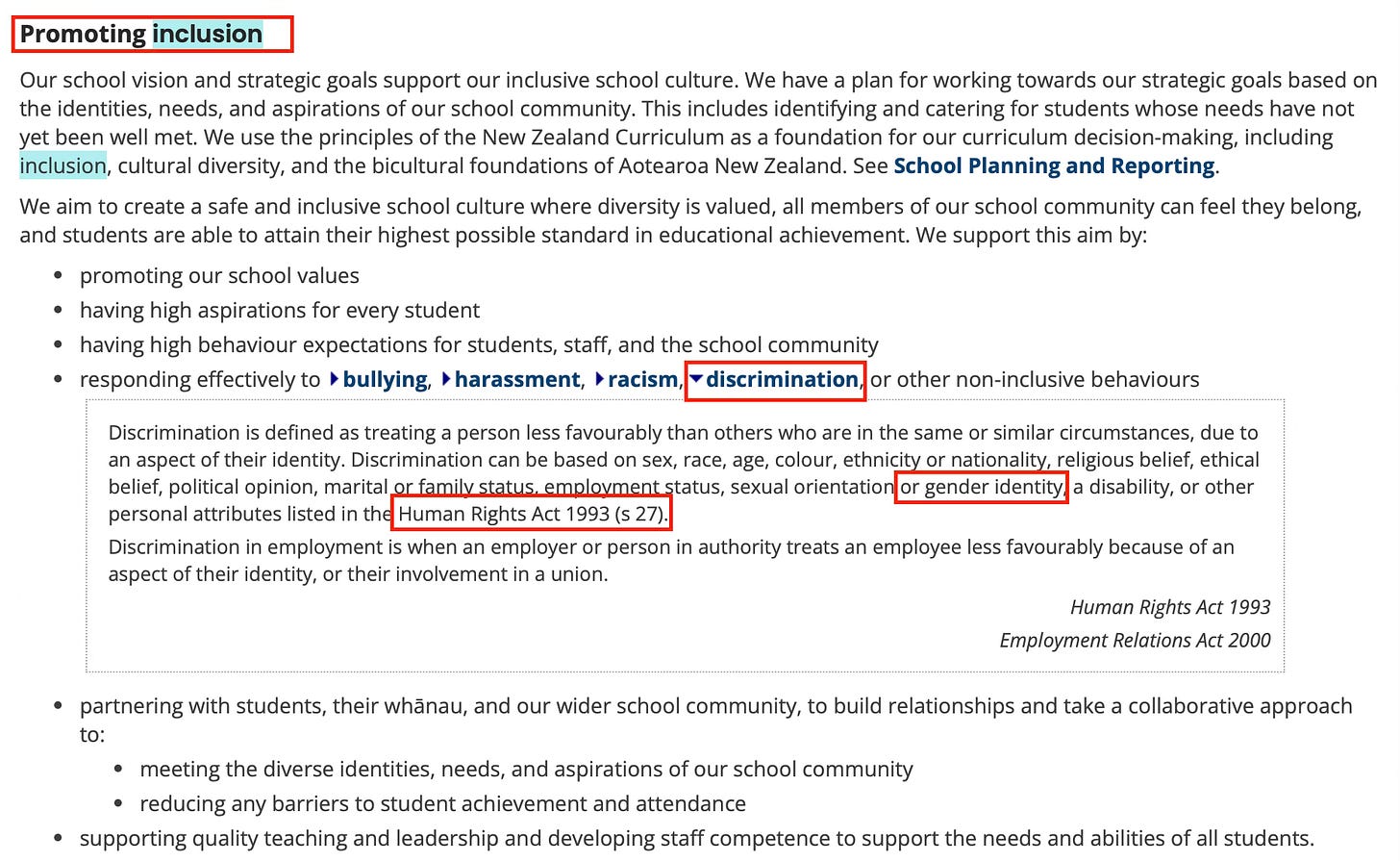
SchoolDocs’ “Inclusive School Culture” policy says discrimination can be based on:
“…sex, race, age, colour, ethnicity or nationality, religious belief, ethical belief, political opinion, marital or family status, employment status, sexual orientation or gender identity, a disability, or other personal attributes listed in the Human Rights Act 1993 (s 27)”.
Two basic problems:
- The prohibited grounds of discrimination are in s 21, not s 27. Section 27 is about an exception for authenticity and privacy.
- Even in s 21, “gender identity” is not listed as a separate ground. The act protects sex, not ‘gender identity’.
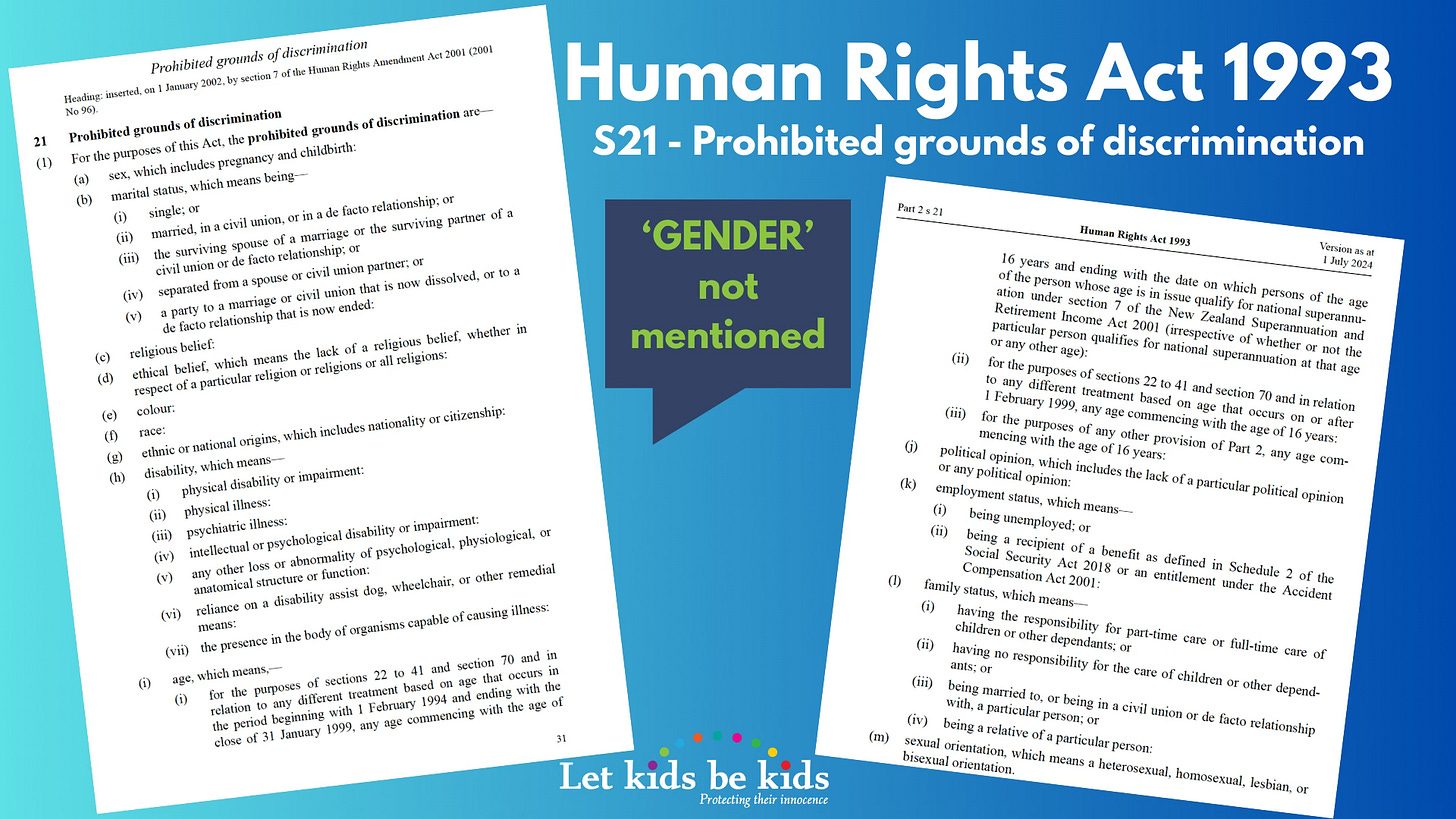
Lawyers may interpret sex‑based protections as covering people who identify as transgender. That is an interpretation, not the text of the law. SchoolDocs presents this as if parliament has already written ‘gender identity’ into the act. It hasn’t.
For a company selling legal compliance, that’s not a minor slip. It is misrepresenting statute and expanding protected grounds by policy template, not by democratic process.
Let Kids Be Kids stands for sex‑based rights. If a policy claims to quote legislation, it must do so accurately. If SchoolDocs want to promote a particular ideology about ‘gender’, it should say so openly – not hide it behind a false legal citation. See Penny Marie explaining ‘gender identity’ at the NZ First convention in 2025.
From “anti‑bullying” to gender ideology
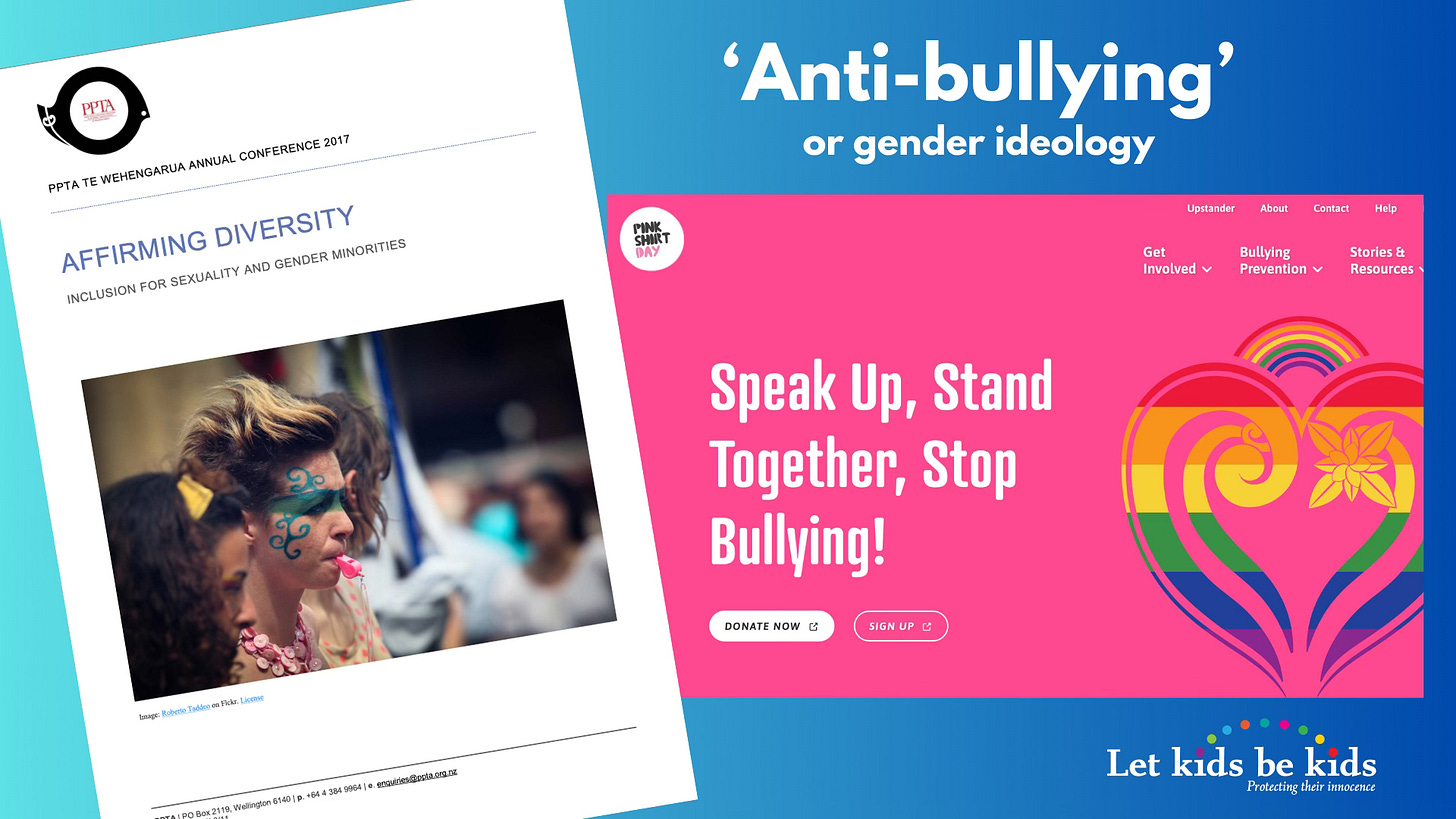
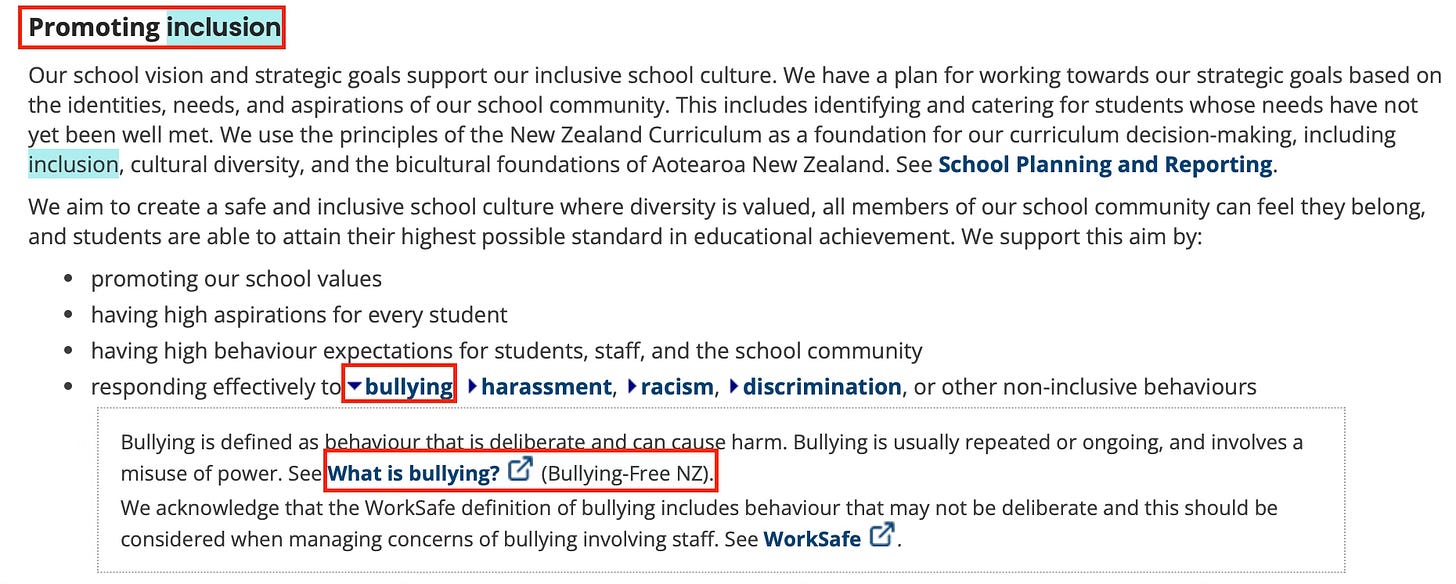
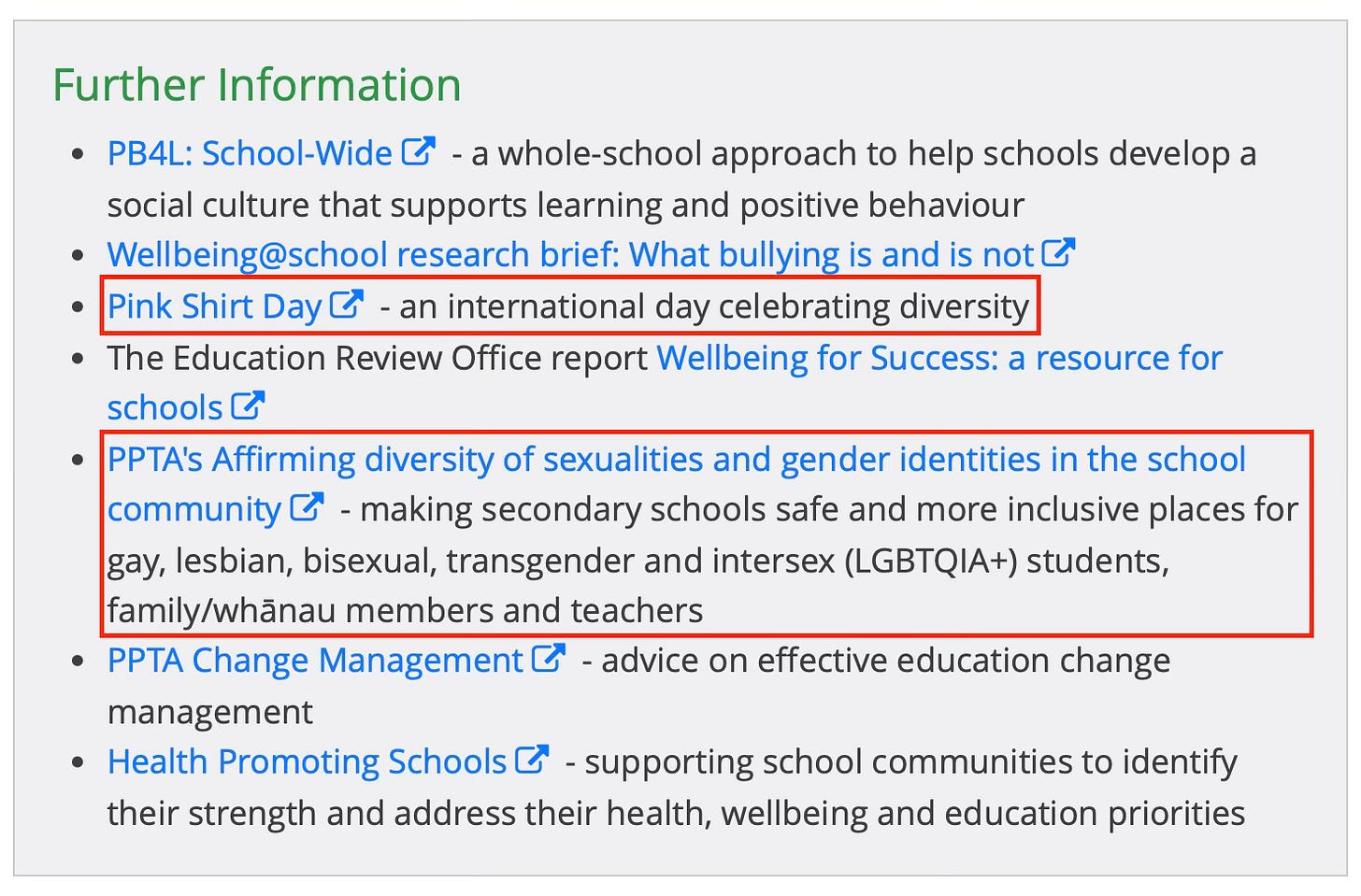
SchoolDocs’ bullying section uses a standard definition (deliberate, harmful, repeated, misuse of power) and then sends schools to Bullying‑Free NZ for “what is bullying?” From there, schools are funnelled straight into Pink Shirt Day (an event run by the Mental Health Foundation) and a PPTA (teachers union) 2017 paper from their ‘Rainbow Taskforce’ on ‘Affirming diversities of sexualities and gender identities in the school community’.
What parents and students are actually grappling with
Parents tell us what’s going on in schools, including:
- Everyday bullying – physical intimidation, social exclusion, racial tension – is not dealt with.
- At the same time, Pink Shirt Day is promoted to schools each year as a way to address bullying, and ‘health’ lessons are conducted that normalise ‘gender identity’ and ‘gender non‑conformity’ as central issues.
So instead of robust, even‑handed anti‑bullying work, children get:
- Messages that their sex is less important than an inner ‘gender identity’.
- An environment where questioning gender ideology is treated as bullying or ‘hate’.
- Little protection from the very real bullying many kids face every day.
Parents did not consent to their children being used as an audience for contested political ideas about gender. Anti‑bullying policy should protect all children, without teaching them that being uncomfortable with stereotypes means they were ‘born in the wrong body’.
Why this matters
The Human Rights Act protects people on the basis of sex. It does not create a free‑floating right to have a ‘gender identity’ affirmed in schools. Yet through SchoolDocs and linked campaigns, schools are being told:
- ‘Gender identity’ is a listed legal ground (it isn’t); and
- the way to be ‘inclusive’ is to build whole‑school environments around gender identity.
The result is confusion for children, marginalisation of sex‑based views, and weak responses to real bullying. Parents are not unreasonable for saying: enough.
We’ve sent SchoolDocs a ‘please explain’ email
We have alerted SchoolDocs to the issues with their inclusive policy, and will update our readers when we get a reply.
Read the email we sent to SchoolDocs
The million dollar question
It is worth asking: who, in reality, is being protected by these “inclusive” policies – vulnerable students, as parents are led to believe, or also adults in positions of authority who are introducing gender‑identity ideology into classrooms and counselling spaces, and wish to place their own conduct beyond criticism?
Penny Marie recently published an article about the United Nations where ‘gender identity’ was stopped from being included as a grounds for discrimination as a disability… an important read…
 Penny Marie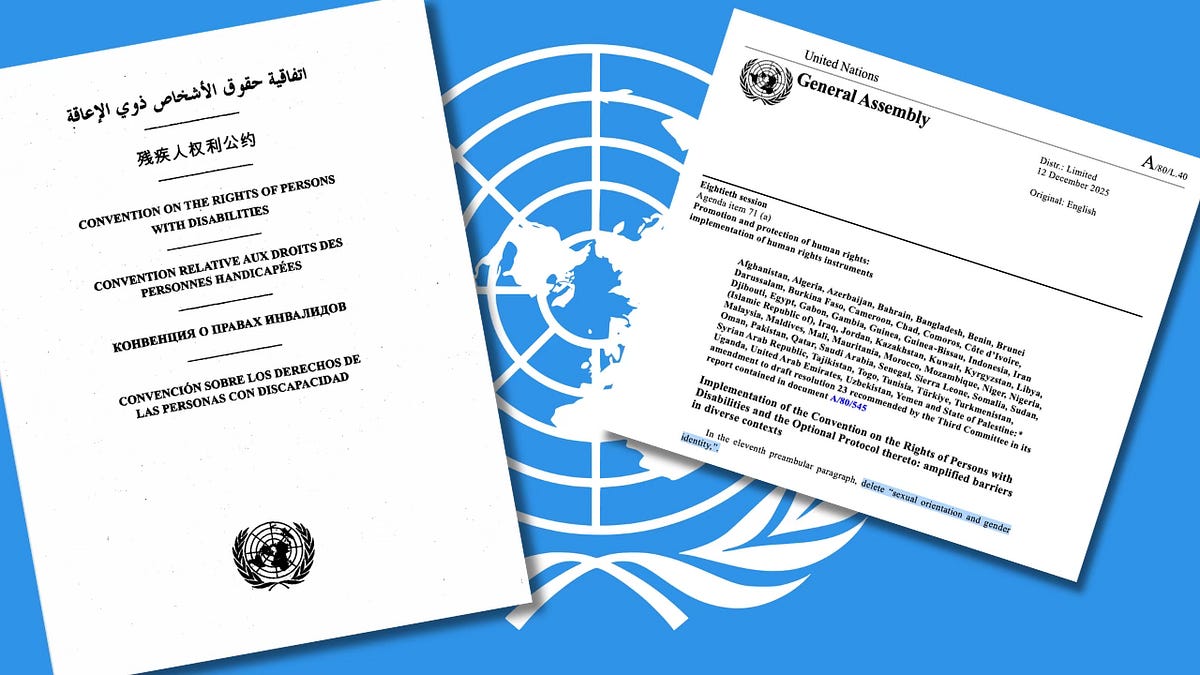
What you can do: Check your school’s policies
- Go to your school’s website. Policies are usually under “Policies”, “About” or “Board of Trustees”.
- Look for “SchoolDocs” policies – the login and password is usually included on the policies page. (If your school is not using SchoolDocs, we recommend looking at the policies and checking on their bullying/inclusion policies anyway).
- Go to the School Community Engagement Policy > Inclusive School Culture > scroll down to Promoting inclusion. Click on bullying and discrimination to see the definitions. Check:
- Do they claim “gender identity” is listed in the Human Rights Act?
- Do they link to Bullying‑Free NZ/Pink Shirt Day/rainbow‑focussed resources?
- If you’re concerned, contact your principal and board:
- Forward this Substack to them, ask them to correct any inaccurate references to the Human Rights Act.
- Ask whether their anti‑bullying work is evidence‑based and sex‑based, not driven by external ideologies.
NOTE: SchoolDocs has just launched ECE Docs. If you are associated with an Early Childhood Education centre, be sure to check out if they will be using SchoolDocs, if you have any concerns.
Let Kids Be Kids is here to support parents who want schools to return to reality: clear sex‑based protections, serious responses to bullying, and classrooms free from political indoctrination about ‘gender identity’.
This article was originally published by Let Kids Be Kids.



![[The Good Oil] Stuff Up of the Day](/content/images/size/w1304/format/webp/2024/09/Stuff-up-image-1.webp)