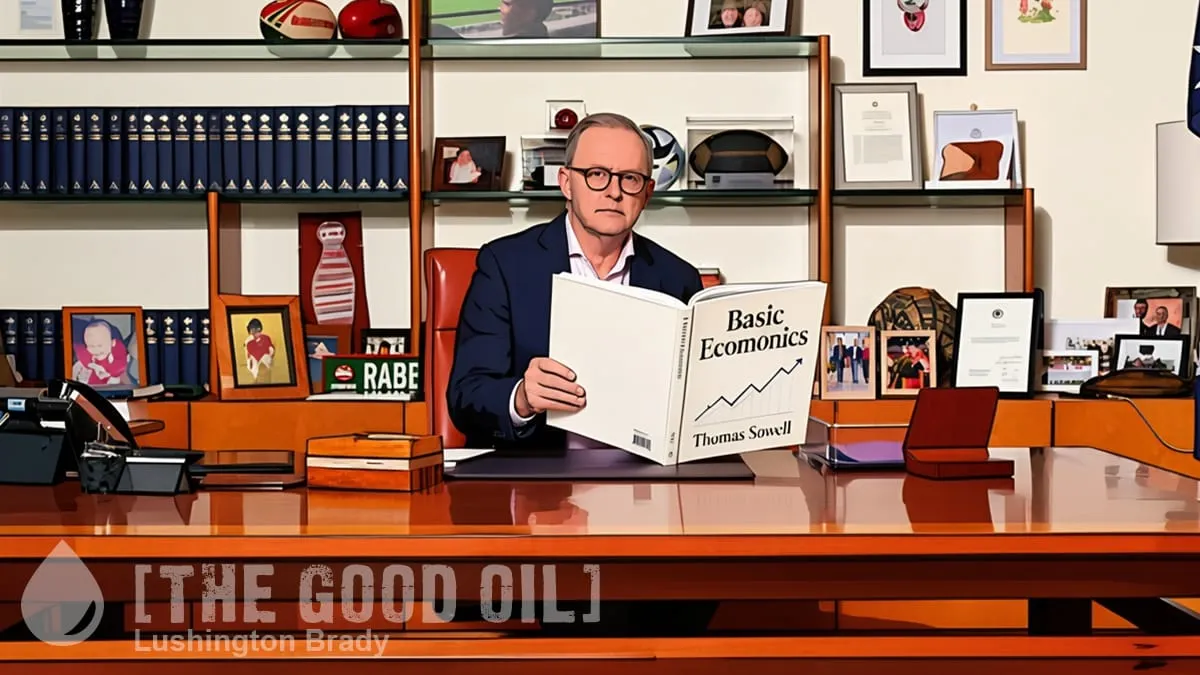
As Good Oil readers are only too aware, their unlamented Dear Leader Jacinda was a student socialist. Oops, not was: she never stopped being one.
There’s the thing: I doubt few of us didn’t flirt with socialism in our callow youth. Then we grew up. Unfortunately for people like Jacinda Ardern, they may grow older, but they never grow up. Case in point: Australia’s semi-masculine mirror of Ardern, Anthony Albanese.
To spend one’s formative years embroiled in the tempestuous theatre of student union politics is no doubt exciting and flattering to the ego as the years roll on and the waistline expands while the hairline recedes. It’s also no doubt a demanding vocation in its own way. All those placards to paint, all those talking-points and slogans to commit to memory and recite with parrot-like monotony. And those windows aren’t gonna smash themselves.
All that exciting stuff leaves precious little time for the dry, unglamorous pursuits of an undergraduate curriculum, such as attending an introductory economics lecture and grappling with the rather inconvenient concept of opportunity cost.
For the uninitiated, which apparently includes the entire Albanese cabinet, opportunity cost is the elementary notion that choosing path A means forfeiting the value of path B; resources are finite, trade-offs are absolute, and one cannot simply have everything by sheer force of righteous intention. Yet our dear prime minister appears to have entirely bypassed this foundational truth during his so-called political economy studies. Instead, he imbibed the intoxicating nectar of the magic pudding economics peddled by the likes of Thomas Piketty: the comforting leftist fairy-tale wherein the state treasury magically reconstitutes itself, no matter how many times ravenous bureaucrats carve off another slice. Or, to put it another way: there’s always plenty of other peoples’ money for feckless socialist politicians to flush.
Mr Albanese recently treated the electorate to a veritable buffet of economic illiteracy, breathlessly insisting that sundry government schemes, variously labelled as ‘free’ TAFE, ‘free’ healthcare and heavily subsidised childminding, are masterstrokes of fiscal prudence. To describe any of these ventures as ‘free’ requires a heroic detachment from reality. They are merely gratis for the immediate consumer, while the bill is either unceremoniously dumped onto the taxpayer or added to a national tab destined to crush our children and grandchildren.
As any genuine economist will attest, there is no such thing as a free lunch. When taxes must be inflated to feed these boundless government appetites, the economy suffers under crushing compliance costs. These frictions distort incentives to work, save and invest, quietly siphoning off up to 20 per cent of the total revenue collected before a single public servant has even sharpened a pencil.
As Productivity Commission deputy chair Alex Robson recently observed regarding the proliferation of marginal government programs:
“Unproductive spending … may deliver real value – perhaps more than a dollar for every dollar spent – but not enough to clear the bar once the cost of raising the revenue is counted. That bar is not fixed. It rises as spending and taxes rise: every additional program has to clear an ever-higher bar, delivering more than a dollar of value for each dollar it spends.”
With that in mind, let us examine the prime minister’s pet projects through this very lens, beginning with his beloved ‘free’ TAFE initiative. Completion rates hover around a dismal one-third. As my father always said, if you get it for nothing, it means nothing to you. When participants invest nothing save for their own idle time, accountability evaporates, drop-out rates skyrocket and cash-strapped state governments deliver substandard training devoid of meaningful employer engagement. It is the textbook definition of unproductive expenditure.
Then we have the multi-billion-dollar crusade to resurrect bulk billing and construct urgent care clinics. Pumping a billion dollars into bulk billing has proven to be an extraordinarily inefficient mechanism of middle-class welfare. High- and middle-income earners waltz into GP surgeries for gratis consultations they are perfectly capable of funding themselves, while doctors pocket the windfall. The resulting service is frequently reduced to a hurried, six-minute transaction utterly unsuited to managing chronic health conditions. As for the ubiquitous urgent care clinics, they swallow hundreds of dollars per consultation while doing precious little to alleviate the crushing queues in public hospital emergency departments.
And finally, we arrive at the holy grail of progressive interventionism: subsidised childcare. The childcare-industrial complex assures us this is an indispensable engine of long-term productivity, rather than as giving up the incalculable reward of experiencing your children’s fleeting formative years in exchange for a few more years’ grind in the soulless cubicles of the modern corporate state.
Yet rigorous empirical data, particularly from Canada, suggests no real long-term scholastic dividends for the children palmed off to the state nanny, pointing instead to the sustained psychological toll that prolonged institutional custody can inflict upon young children. Worse still, while targeted intervention for genuinely disadvantaged families might have merit, this universal subsidy showers taxpayer funds upon households pulling in upwards of half a million dollars annually, bypassing the very children who might actually benefit.
Mr Albanese’s economic philosophy remains trapped in the naive enthusiasm of a campus union meeting. He continues to mistake expenditure for achievement, ignoring trade-offs, compliance burdens and the basic arithmetic of reality.
Until our political class relearns the lessons of Economics 101, the rest of us will simply be left footing the bill for their eternal student union excursion.