Table of Contents
Ani O’Brien
Like good faith disagreements and principled people. Dislike disingenuousness and Foucault. Care especially about women’s rights, justice, and democracy.
The confrontation that occurred during a Sikh religious procession in South Auckland a few days ago has ignited condemnation and raised questions about protest, imported political conflicts, and national identity. While the incident itself was brief and not violent, it has alarmed many who do not want to see the cultural and religious disharmony that is rife overseas playing out in New Zealand. Anxiety over immigration levels and the challenges of multiculturalism have become more pronounced globally and this is creating tensions over public expressions of culture and belief.

I reacted to the news that Brian Tamaki’s group had staged the protest in horror at what I perceived to be an attack on a community peacefully going about their business. This generated a substantial response and much of it was in support of Tamaki and critical of the Sikh community.
I’m just catching up that Brian Tamaki’s group protested a gathering of Sikhs in Auckland.
— Ani O'Brien (@aniobrien) December 21, 2025
This is so wrong. They weren’t harming anyone. They were doing their own thing. I said that I’d be the first to condemn Tāmaki if he started impinging on the rights of religious minorities…
The strength of feeling on all sides got me thinking about how New Zealand defines extremism, protest rights, and acceptable conduct in shared public spaces. In my view, we are heading toward a flashpoint if we do not grapple with the tensions and underlying anxieties that are making it more difficult for us to live along side each other peacefully. Understanding what happened requires careful separation of established facts, community response, and claims that remain contested. I have tried my best to do this as even-handedly as possible.
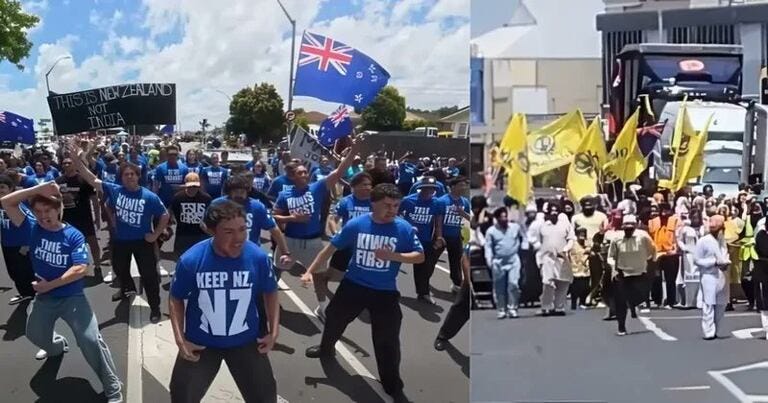
On 20th December, members of Auckland’s Sikh community held a Nagar Kirtan procession in South Auckland, marking the birth of Sikhism’s first guru. Nagar Kirtans are traditional religious parades involving prayer, music, and the public display of Sikh symbols. According to Sikh community leaders and media reporting, the procession was fully authorised by Auckland Council, police, and traffic management authorities. A 2022 article in the Indian Weekender reported that the Auckland Sikh community was celebrating its 27th annual celebration that year. I can find no record of any other protest or interruption taking place at previous parades.
During the procession, a group calling itself True Patriots of NZ, publicly linked to Brian Tamaki and Destiny Church, positioned themselves in front of the march on Great South Road. The group displayed banners such as “This is New Zealand, not India” and wore clothing with slogans including “Kiwis First” and “Keep NZ NZ.” Members performed a haka and chanted Christian slogans.
Police intervened to keep the groups separated and escorted the Sikh procession so it could continue. No arrests were made and no physical violence was reported.
The incident prompted swift condemnation from political figures and community leaders. National MP Rima Nakhle visited Sikh gurdwaras in Manurewa and Takanini the following day, publicly thanking the Sikh community for what she described as “tremendous restraint” in the face of intimidating behaviour.
In a public statement, Nakhle emphasised that the Sikh procession had complied fully with New Zealand law and that attempts to obstruct it were unacceptable. She highlighted the Sikh community’s long-standing contributions to South Auckland and New Zealand more broadly, including extensive charitable work, Covid-era food distribution, fundraising for the Christchurch mosque attack victims, support for community patrols, and ongoing donations to health and social services. As a Christian, she said she explicitly rejected the idea that faith justified targeting a peaceful religious minority.
The NZ Central Sikh Association also issued a statement urging calm. The association stressed that the parade was lawful, they believed the obstruction by Tamaki’s group was irresponsible, and that the Sikh community remained committed to peace and restraint. Community leaders asked members not to escalate tensions online.
Civil liberties advocates also weighed in. The Free Speech Union defended the right of Tamaki’s group to protest in principle, but drew a clear distinction between protest and obstruction, arguing that deliberately interfering with a permitted religious event undermines others’ lawful rights.
Brian Tamaki has rejected characterisations of the protest as aggressive or unlawful. He maintains that his group acted peacefully and within the law, and that their actions were motivated by concerns about Khalistan symbolism present at the march.
Khalistan refers to a Sikh separatist movement advocating for an independent Sikh homeland in the Punjab region of India. The movement has a complex history to say the least. In the 1980s and early 1990s, some Khalistan-aligned militant groups engaged in violence, including assassinations and bombings, and were designated terrorist organisations by the Indian government. These historical facts appear to form the basis of Tamaki’s argument that Khalistan is not merely a benign political cause, but a movement with a documented terrorist lineage.
There is documented Sikh separatist activism in parts of the diaspora, particularly in countries with large Sikh populations, such as Canada, the United Kingdom, the United States and, to a much smaller extent, New Zealand. This support is typically expressed through political rallies, flag displays, symbolic referenda, lobbying, and online advocacy. These activities are generally non-violent and are treated under Western law as protected political expression, even when they are controversial or diplomatically sensitive. It is also important to note that Sikh communities are far from unified on Khalistan, with many Sikhs opposing separatism outright; others favour greater rights within India rather than independence, and some actively resent Khalistan activism because it attracts suspicion and imports foreign political conflicts into their daily lives.
In countries like New Zealand there is no public evidence that Sikh separatist activism has translated into organised violence or terrorist activity. The tension, therefore, lies less in an immediate security threat than in how democracies balance freedom of expression, religious and cultural practice, and public unease when overseas political conflicts are expressed in shared civic spaces.
From Tamaki’s perspective, the public display of Khalistan-associated flags or symbols represents an imported political conflict being played out on New Zealand streets. He argues that New Zealand authorities and politicians are inconsistent in how they respond to such symbolism, and that similar behaviour by Christian or nationalist groups would attract far harsher scrutiny. His protest is framed as a warning about double standards, national sovereignty, and what he sees as political unwillingness to confront foreign-linked extremism.
Tamaki also situates the protest within a broader “Kiwis First” worldview, arguing that New Zealanders are increasingly discouraged from asserting national identity, while being expected to accommodate overseas political causes. In engaging with online criticism about the incident, he has strongly defended his personal record of decades-long community and charitable work, including social rehabilitation programmes and food distribution, and rejects claims that his actions were motivated by racial or religious hostility.
He directly replied to my tweet defending the actions of the protestors:
Nothing like your saying Ani..read my first post it’s very clear what and why! We attacked nobody,we were peaceful and lawful..
— Brian Tamaki (@BrianTamakiNZ) December 21, 2025
There were Khalistan Terrorists in that March.
The Indian Govt has declared that for sometime.
Thats what you should be jumping up and down about (How…
However, at the same time, several key distinctions matter.
While India designates multiple Khalistan-linked groups as terrorist organisations, support for Khalistan as a political idea is not illegal in New Zealand, nor is it automatically classified as terrorism. Under New Zealand law, terrorism requires either formal designation or credible evidence of violence, terror financing, or active plotting.
In diaspora communities, Khalistan symbolism is often used as a form of political expression rather than advocacy for violence. Crucially, in this case, no evidence was presented by Tamaki, police, or reported by mainstream media that showed the Sikh parade involved members of designated terrorist organisations or any advocacy of violence. This does not mean that concerns about extremism should be dismissed out of hand. It does mean that allegations of “terrorists” carry a high evidentiary threshold – one that is not met in relation to the South Auckland procession.
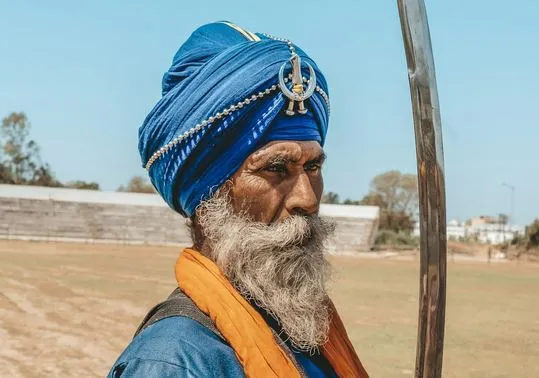
Some supporters of Tamaki have pointed to footage and photos of Sikh participants carrying what appear to be swords or knives as evidence that the procession was inherently threatening. In Sikhism, however, the ceremonial carrying of a kirpan, a small sword or dagger, is a longstanding religious practice and one of the five articles of faith observed by initiated Sikhs. The kirpan is a symbolic reminder of the duty to stand against injustice and protect the vulnerable, not a weapon carried for the purpose of violence. In New Zealand, the carrying of kirpans for religious purposes has long been accommodated in law and practice, including in schools and public events, provided they are carried responsibly and without intent to harm. While images of blades in public spaces can understandably unsettle those unfamiliar with Sikh customs, there is no evidence that the kirpans carried during the Nagar Kirtan were used threateningly or in breach of the law, and no injuries or arrests resulted from their presence.
The clash, therefore, appears to be less about a single parade than about unresolved tensions New Zealand has yet to fully confront. It raises difficult questions about how in the current climate of global tensions, there might be fear and anxiety about overt expressions perceived to be related to overseas political issues. It exposes ongoing uncertainty over where the legitimate right to protest ends and where intimidation or obstruction begins, especially when a lawful religious event is involved. It also highlights persistently expressed concerns about whether cultural and political standards are being applied evenly across different religious communities, or whether some groups are granted greater tolerance than others. Finally, it underscores the challenge of how fears, whether well-founded or overstated, can be acknowledged and addressed in a way that reduces tension rather than deepening division in an increasingly plural and politically charged society.
For the Sikh community, the protest felt like an unjustified targeting of a peaceful religious celebration that has complied with every legal requirement for three decades. For Tamaki and his supporters, it felt like a necessary act of resistance against what they perceive as political complacency and unequal enforcement of standards.
Ultimately, what happened on Great South Road was not a terrorist incident, nor was it a riot. It was a lawful religious procession met by a lawful but confrontational protest, managed by police before it escalated. It seems to have been handled appropriately by authorities.
Claims that terrorists were present remain unsubstantiated. Yet the protest itself did not arise in a vacuum. It reflected genuine anxieties about extremism, national identity, and perceived double standards, even if those anxieties were expressed in a way many found inappropriate or distressing.
If New Zealand wishes to avoid similar confrontations in the future, we will need more than condemnation or defensiveness, because ignoring or scorning these tensions will not make them disappear.
This article was originally published by Thought Crimes.