
Tom Hunter
No Minister
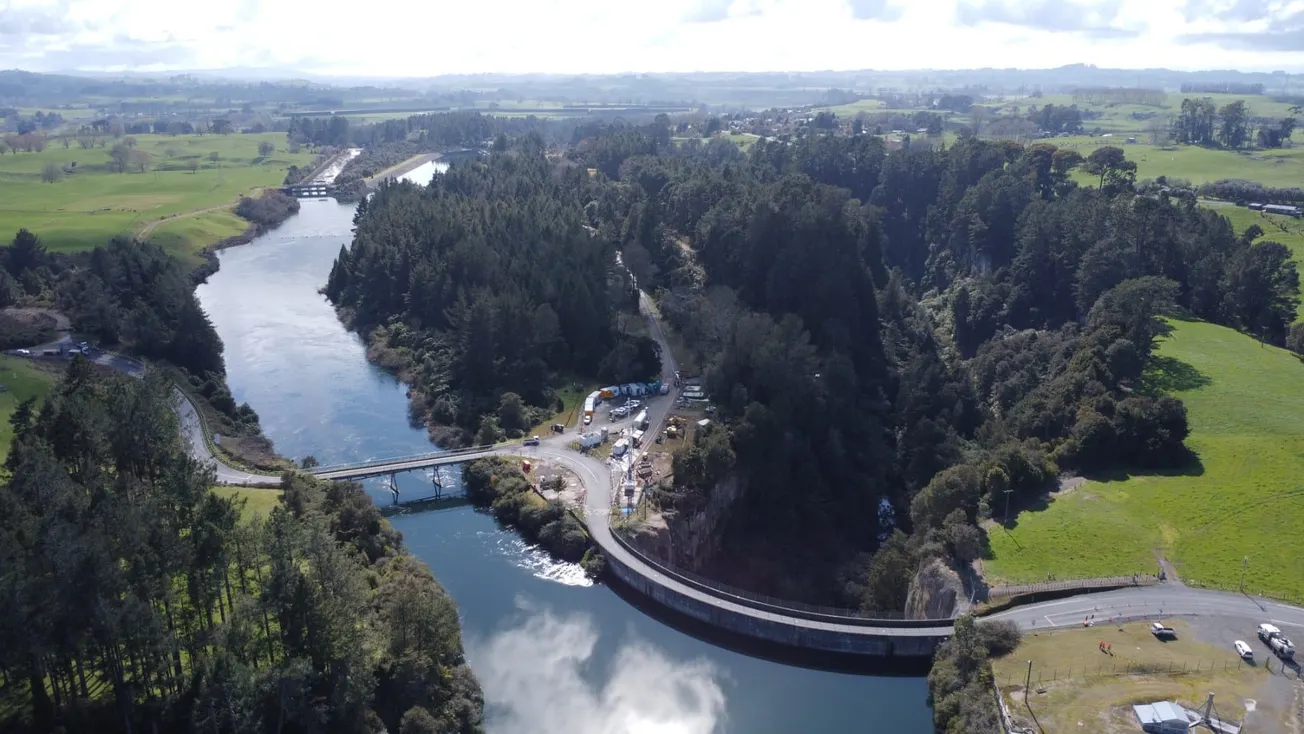
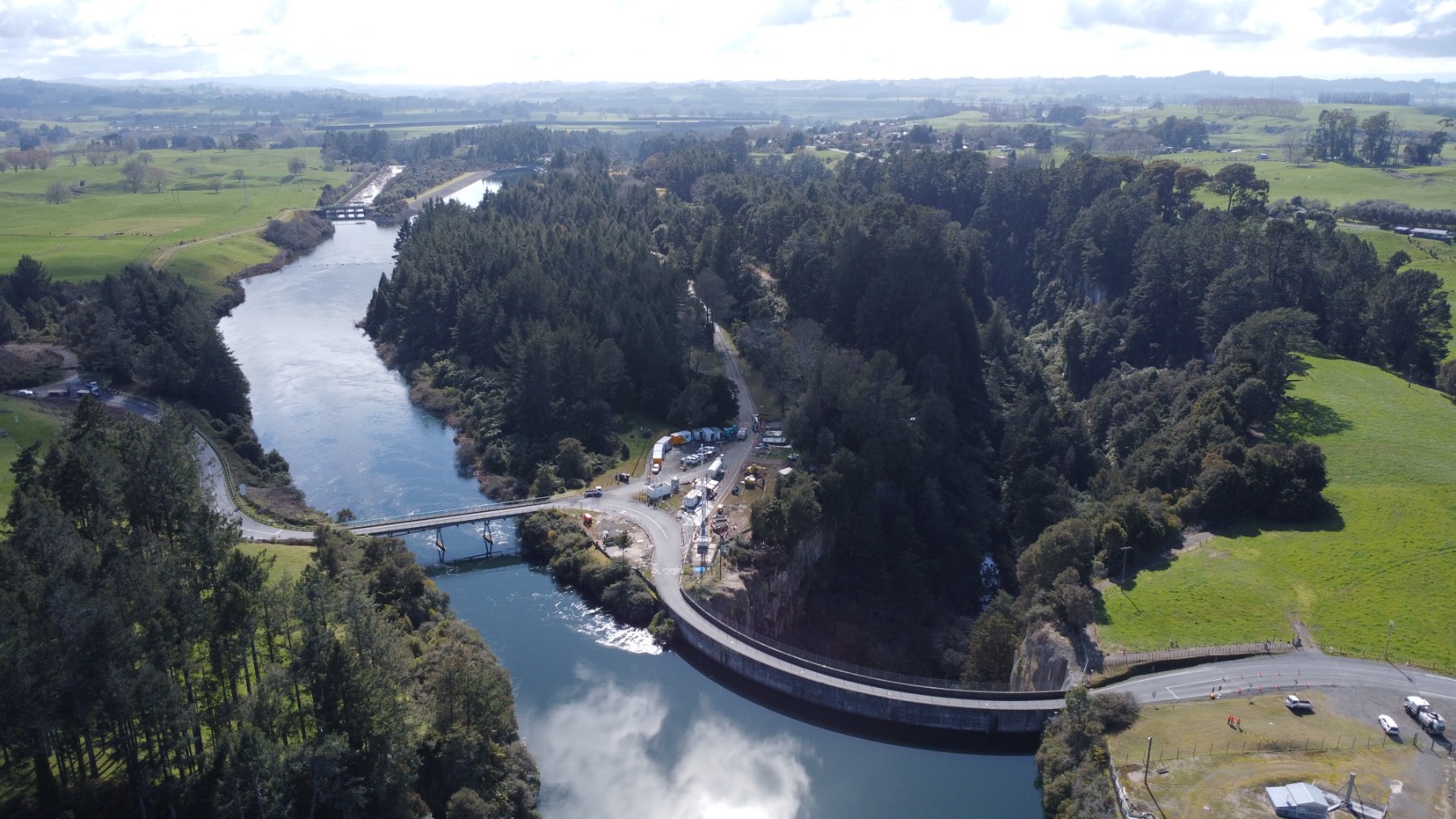
Over the last year there’s been some big equipment at work on the old Arapuni dam, focused on drilling beside the left side of the dam (as viewed from the lake).
Questions arose as to what was going on, and a month ago we got the answer from the South Waikato District Council:
From 9am on 1 September 2026, Arapuni Road across Arapuni Dam will be closed for 24–36 months. This project is managed by Mercury, who will carry out major repair work on Arapuni Hydro Dam.
Closed for two to three years? AYFKM?
Anyhoo, the Mercury website had more details as to what was going on and why:
Engineering studies show the dam is safe to operate, but extra protection is needed in one area called the left abutment (where the dam joins the valley wall) to protect it from water seepage. Small amounts of seepage is natural, but too much over time can weaken the dam.
Changes in seepage patterns were noticed after distant earthquakes in 2016, so Mercury is taking proactive action to improve the left abutment.

Now that is interesting. It’s not often thought of, but dams are almost living structures, or at least the land around them is, no matter how solid the rock is that all that concrete is connected to. Water not only seeps around a dam but through it, albeit in tiny amounts and – as long as the route is not direct – not in ways that damage the structure.
But the seepage around a dam is another matter all together and earthquakes speed the process up, including that thumper in the area back in early August that woke me up at 4:51am. So as a result they’re effectively going to build an underground dam right beside the old one:

A technique called jet grouting will be used to form a row of pillars under ground, to protect a middle layer of sediments from seepage.
A series of overlapping concrete piles will then be drilled to form a cutoff wall about 70m–80m deep and 57m long.
Okay, I can see why this might take two to three years. We’re talking big holes in the ground through which to pour concrete. I wonder if they’re embedding rebar as well? A similar project was conducted 20 years ago on the right side of the dam, which I’d forgotten about, probably because that didn’t close the dam for cars.
The document has a cool photo from a perspective the public never sees, with a bunch of engineers and staff at the base of the old dam, where the Waikato River once flowed.

The repairs should make the dam good for another century. The powerhouse, turbines, generators and penstocks of the powerhouse were already upgraded back in the 1990s. Arapuni is a “run-of-river” diversion type hydro dam (H/T C James), meaning that the river is diverted by the dam down a long channel to the intakes at the powerhouse, which is why you don’t see one at the base of the dam, as is the case with all the other Waikato River hydro dams.

Lastly, a photo of the the ropeway that was built in the 1920s to cart crushed rock from a quarry nine miles distant to the south. There were 170 of these towers, all built from hardwood and sunk four-and-a-half feet into the ground. The ropes carried 360 iron buckets filled with metal, and they must have travelled at a fair pace because they delivered 300 cubic yards of rock per day.

Some 20 years ago I recall talking with a couple of men who’d worked on the site, and they actually lived in the district where the quarry was located rather than at the work camp – which meant on more than one occasion they simply ‘rode the buckets home’ when they missed their ride. This tall story was corroborated by an even older guy who’d been a manager at the site.
WorkSafe New Zealand, what’s that?
More information here, along with a modern-day look inside the powerhouse, which is an art-deco structure that doesn’t look industrial at all. More power to the 1920s I say!
This article was originally published by No Minister.