Table of Contents
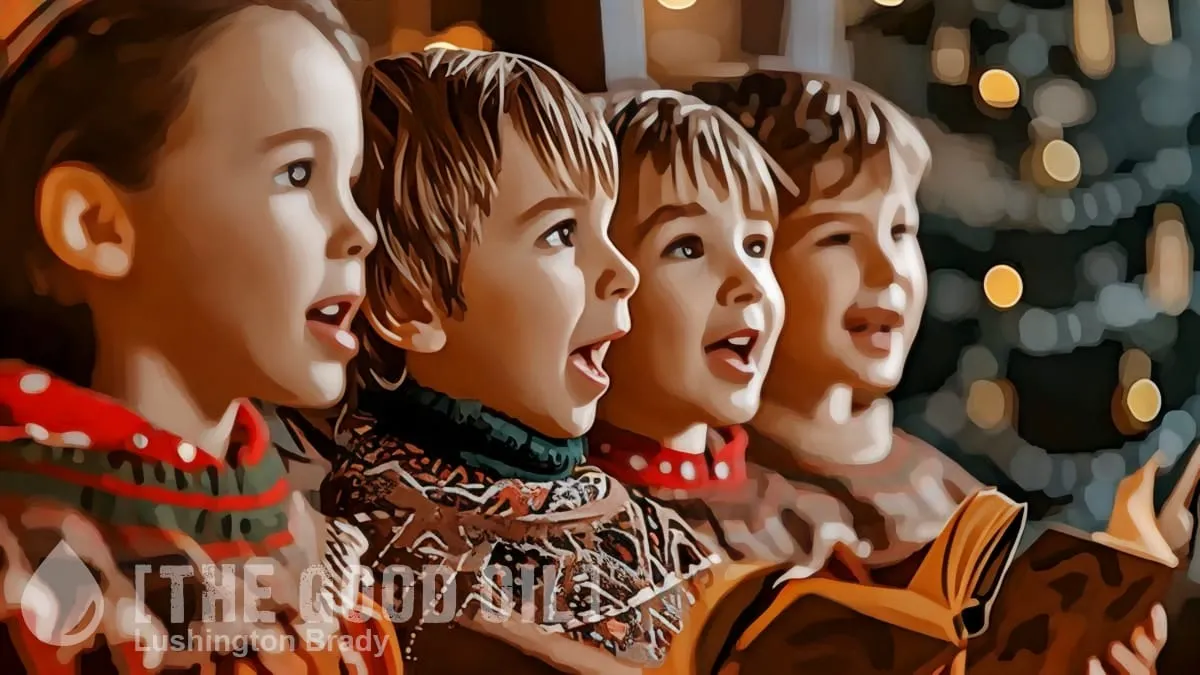
Christmas songs: love them or hate them, at this time of year, you just can’t escape them. Whether it’s the particular horror of Mariah Carey or some kid painfully sawing away at “The 12 Days of Christmas” at your local shopping mall, Christmas songs are a long-standing tradition. Indeed, achieving the Christmas number one in Britain is an annual battle.
Christmas songs are not all terrible. In fact, some are deservedly classics. Here are just a few of (according the me) the best.
As Australia endures a Christmas season marked by horror and grief, it’s worth noting that some of the best Christmas songs emerged in dark times. Including perhaps the biggest Christmas hit of all time.
White Christmas
Irving Berlin first wrote “White Christmas” at the tail-end of the Depression. Yet, despite supposedly telling his secretary, “Grab your pen and take down this song. I just wrote the best song I’ve ever written – heck, I just wrote the best song that anybody’s ever written!” he stowed it away for a couple of years. He finally pulled the song out of the trunk in 1942, for the Bing Crosby/Fred Astaire film, Holiday Inn.
It wasn’t just the shadow of the Depression that inspired “White Christmas”’s wistful atmosphere. As a Jewish kid in Brooklyn, young Israel Beilin experienced Christmas as an outsider. But the adult Irving Berlin loved Christmas with his family. Still, the death of his first son, just one month old, on Christmas Eve 1928 tinged the holiday season with sadness, as did missing Christmas with the family due to his work commitments in Hollywood.
As it happened, Holiday Inn was in production when America was shocked by news of the unprovoked sneak attack on Pearl Harbour, just weeks before Christmas. Bing Crosby performed the song for the first time two weeks later, on a live (and unrecorded) radio broadcast. By the time the record was actually released, nine months later, American troops were embroiled in their first major offensive against the Japanese, at the bloody Battle of Guadalcanal.
With its lush, romantic melody, evocative lyrics, and Crosby’s casual, buttery croon, the song was hugely popular with troops scattered across the world, and with the folks keeping the home fires burning. Naturally, it was a runaway smash hit, topping the charts for 11 weeks in 1942 alone, and returning to number one during the Christmases of 1945 and 1946.
In fact, “White Christmas” went on to become the world’s best selling single.
“White Christmas” was the perfect song for a world at war. Poet Carl Sandburg wrote, in that bleak Christmas of 1942, that, “We have learned to be a little sad and a little lonesome, without being sickly about it. This feeling is caught in the song of a thousand juke boxes and the tune whistled in streets and homes, I’m Dreaming of a White Christmas.”
Merry Christmas Everybody
Britain won the war, but almost exactly 30 years later, it was a nation in deep despair. The country was wracked by terror, strikes and shortages. Even ambulance drivers and grave diggers were on strike. Petrol rationing loomed. The Three-Day Week and electricity rationing caused by striking coal miners had just been announced. Even the telly was cut off at 10.30pm.
Small wonder, then, that the Christmas number one that year was the joyfully silly “Merry Christmas, Everybody” by Slade. Fun was something Britain badly needed, in that grim winter of 1973. “I think people wanted something to cheer them,” said singer Noddy Holder. “And so I did.”
Reflecting on the downward slide the country was in, Holder wrote the lyrics to reflect a traditional British family Christmas and better times: hanging up stockings, Santa, playing in the snow, the house filling up with family and granny up and rock’n’rolling with the rest, probably after a few good sherries. To keep up the cheerful note, Holder finishes the chorus with the uplifting reminder to Look to the future now, it’s only just begun.
“Merry Christmas, Everybody” turned out to be just the tonic that the British public needed. Half a million copies were ordered in advance and the song shot straight to number one on its first week. Eventually selling over a million copies, the song remained at number one until mid-January and stayed in the charts well into spring. It regularly returns to the charts and was voted Britain’s most popular Christmas song in 2007.
I Wish it Could be Christmas Every Day
But, 1973’s Winter of Discontent was quite the banner year for Christmas songs. While “Merry Christmas, Everybody” claimed the number one spot, the runner-up was another classic Christmas rocker: “I Wish it Could be Christmas Every Day”, by Wizzard, is another anthem of silly joy in the face of a bleak world.
Given the schedule of recording, production and distribution, the song was actually recorded in the middle of the previous summer. To create the appropriate atmosphere, engineer Steve Brown turned the air-conditioning to freezing, and festooned the studio with Christmas decorations.
For the accompanying performance video, Wizzard outdid themselves with their trademark outlandish rock’n’roll cabaret. Singer Roy Wood is a psychedelic winter king out of Scandinavian folklore, while the rest of the band are dressed as panto wise men and nutcrackers. The joyful festive atmosphere is completed by an onstage invasion of cherubic British schoolchildren, miming on toy instruments. The obvious fun being had by all creates an experience that is pure, unadulterated joy to watch.
The song was re-released in 1981, but it turned out that the original tapes had disappeared, so it was re-recorded with a new children’s choir. “I Wish it Could be Christmas Every Day” has charted regularly every December and appeared in the British top 40 every Christmas since 2007.
Silent Night
Almost 200 years earlier, perhaps the Christmas song was likewise born from adversity. In the tumult of the recently concluded Napoleonic Wars, the 1000-year Holy Roman Empire was dissolved and the borders of Europe were redrawn. In the Austrian village of Oberndorf, parish priest Father Joseph Mohr was plunged into depression when the formerly independent Principality of Salzburg was subjugated and divided in the wake of Napoleon’s defeat.
So he wrote lyrics for a Christmas carol that expressed a poignant longing for comfort, peace and, here at last, healing light. Two years later, he ask his friend, schoolteacher Franz Gruber, to set his words to music for that evening’s Midnight Mass. The song is, of course, “Silent Night”.
Intriguingly, Mohr specifically asked Gruber to write the music for guitar, rather than the usual organ. Despite long-standing legend, there is nothing to suggest that the church organ wasn’t actually working at the time. It appears that Mohr simply loved guitar music. Whether or not the organ was functioning properly, it’s fortunate for us all that there was an organ builder who serviced the town’s instrument at hand. Karl Mauracher was the first of untold numbers who fell in love with the song and took a copy home with him. From there, it was picked up by travelling folk singers, from where it reached not only the ears of the emperors of Austria and Russia but travelled across the Atlantic for its first performance in New York in 1839.
Mohr, incidentally, was the opposite of a famous Christmas figure who emerged some 30 years later. Unlike Charles Dickens’ Ebeneezer Scrooge, Mohr was born in poverty and died penniless. Heeding Jesus’ warning against earthly treasures, Father Joseph donated all his income to the care of the elderly and the education of children in his parish in the tiny alpine village where he died and is buried next to the school dedicated to his name.
A century after it was written, “Silent Night” is widely credited with playing a pivotal role in the famous Christmas Truce of 1914. On that first Christmas Eve of the War, German troops near Ypres decorated their trenches with candles and Christmas trees and began singing carols. British troops across the narrow strip of No Man’s Land joined in and the unofficial truce began. Of course, it’s not known for sure which songs specifically spurred the truce (one soldier identified “O Come All Ye Faithful”), but “Silent Night” is most often featured in depictions of the event. It’s certainly not difficult to imagine this almost-universally known Christmas carol, sung in the sister language to English, would spur such instant fellow-feeling among the troops.
“Silent Night” has been recorded countless times, but perhaps it’s best to hear it as close to possible as it might have sounded on that snowy evening in the alps in 1818. As the voices of the Dresden choir soar like a heavenly host, it really does seem as if sleeps the world in peace tonight.
Fairytale of New York
While it didn’t emerge in bleak times, “Fairytale of New York” certainly is a song of transcendent beauty emerging from darkness. The song depicts a couple, whose youthful dreams of Broadway have been dashed by a lifetime of alcohol, drugs and failure, fighting on a bitter New York Christmas Eve. Despite some of the most un-Christmassy language imaginable – bum, punk, slut, faggot – its tale of dreams, love, disillusion and hope springing eternal embodies the Christmas spirit just as much as Dickens and has made it arguably the favourite Christmas song of a generation.
Guitarist Jem Finer first came up with a melody and lyrics about an Irish sailor in New York pining for his wife at home. Fortunately for posterity, Finer’s wife Marcia panned the lyrics as corny. Challenged to come up with something better, she suggested a conversation between a couple fallen on hard times but finding redemption. “I had written two songs,” Finer says. “One had a good tune and crap lyrics, the other had the idea for ‘Fairytale’, but the tune was poxy.”
Finer handed both to Shane MacGowan, who wrote most of the new lyrics while bedridden with double pneumonia. But, despite several efforts, the band were unhappy and shelved the song. In the meantime, the Pogues toured America for the first time and ingested new ideas and experiences, including repeated viewings of Sergio Leone’s Once Upon a Time in America, whose Ennio Morricone soundtrack inspired the song’s melancholy piano intro. At producer Steve Lillywhite’s suggestion, Kirsty MacColl’s mezzo-soprano is the perfect contrast to MacGowan’s growl and the vocal interplay weaves a magical bitter-sweetness that raises goosebumps even after 30 years.
From the pathos of the intro, as MacGowan laments “Christmas Eve in the drunk tank”, the song swings into a céilidh waltz, with MacColl’s angelic Irish lilt recalling the lost joy of the couple’s past hopes and dreams, when “Sinatra was swinging”, even as the observation that “it’s no place for the old” foreshadows what is to come.
The song reaches its emotional nadir as the broken-down couple hurl insults at one another – old slut on junk, scumbag, maggot, cheap lousy faggot – before the woman snarls, “Happy Christmas yer arse” and prays to God that it’s their last.
But after hitting rock bottom, like the winter sun igniting a snowy street, the chorus soars joyfully again: And the bells are ringing out for Christmas day! Finally, the bitter old couple find redemption with the realisation that they “can’t make it all alone”, and the song fades into a long, lush orchestral coda that, like a Frank Capra film, would almost be twee if it wasn’t so damn beautiful.
These are some of my favourite Christmas songs: what are yours?