Table of Contents
To borrow an old truism: there’s lies, damned lies and government modelling. Of the three, government modelling is often the most absurdly false and without doubt the most damaging. Contrary to George E P Box, government models are not just always wrong, they’re not even useful – just destructive.
The brutality of Covid lockdowns and vaccine mandates? Entirely based on ludicrously wrong government modelling – the same wrong modelling, from the same proven fools and liars – that saw millions of livestock slaughtered in Britain for no valid reason.
The Global Financial Crisis, which beggared millions, wiped out fortunes and left a trail of homelessness? Not one government model saw it coming.
The insanity of ‘climate action’ that is costing taxpayers trillions of dollars and driving household electricity prices to the point that thousands of mostly elderly people are dying every winter because they’re forced to choose between heating and eating? Solely based on government modelling.
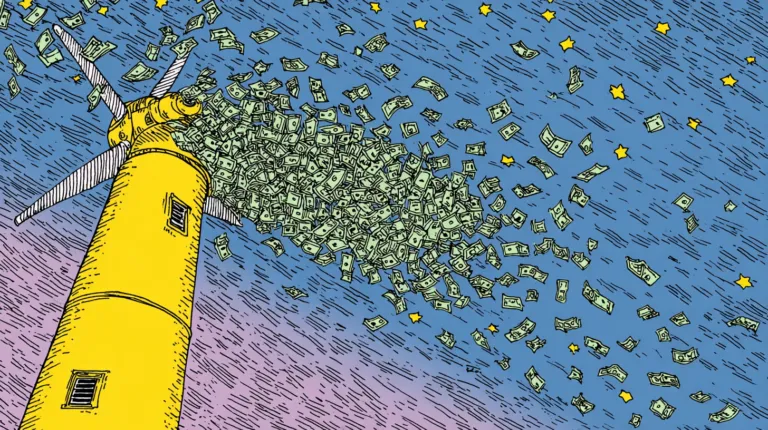
The lie that ‘renewables are the cheapest form of electricity’, trumpeted at every turn by Australia’s always-wrong and never-useful ‘Climate Change and Energy Minister’, Chris “Boofhead” Bowen, is solely based on government modelling. Don’t believe your lyin’ eyes as you watch your electricity bills burst through the stratosphere. The models say it’s not happening.
Except that now, the government modellers are, ever so quietly, admitting that their precious models are busted by reality.
Black coal has staged a comeback to rival firmed renewables as the cheapest form of electricity in 2024–25, amid a spike in costs to build onshore wind, while small modular nuclear plants remain the most expensive technology if built into Australia’s energy grid.
Says who? Says the models.

The CSIRO said black coal was $111 per megawatt hour at the lowest end of its annual forecasts, compared with backed-up wind and solar which was $116 MWh under the cheapest level of modelling. Those figures represent a turnaround from a year ago when black coal at $107 MWh was outpaced by firmed renewables, which was forecast at $97MWh.
Black coal is not expected to retain its position, however, with the costs of firmed solar and wind falling substantially to $76MWh by 2030, compared with black coal at $103MWh by the end of the decade.
Forecasts. Modelling. ‘Expected to’ and ‘Assumption’.
In other words, they’re talking through the arse-end of their spreadsheet.
What’s happened in the real world?
CSIRO points out the reduction in fossil fuel generation costs between 2024 and 2030 is not a result of technological improvement but rather cheaper fuel prices and capital costs, which were impacted by global inflationary pressures that peaked in 2022. “Also, using fossil fuels without carbon capture and storage makes them high emission technologies which makes them incompatible with national and state emission targets,” CSIRO added.
In other words, coal is cheapest, unless they fudge the numbers by handicapping it with lunatic ‘net zero’ politics.
While the cost of coal is going down, the cost of ‘renewables’ – to, I’m sure, the flabbergasting astonishment of readers – is going up and up.
CSIRO said the capital costs of onshore wind technology rose by a further 6 per cent in 2024-25, following an 8 per cent increase the year before.
This year’s spike included a one-off 4 per cent increase to take account of work camp costs not previously included in wind capital cost estimates. CSIRO also pointed more broadly to sustained long-term increases in Australian construction costs.
So, one of the most expensive forms of making electricity is even more expensive than they ‘modelled’, because they conveniently neglected to include the cost of employing and housing the people who are supposed to build it.
Yet still these clowns insist on driving their hooting, honking, demented little car at full speed to the cliff’s edge.
It comes as AEMO chief executive Daniel Westerman will tell a clean energy conference on Tuesday that 90 per cent of Australia’s remaining coal fleet is set to close in the next decade, posing a challenge for system security.
Which is government-speak for ‘we’re going to be fucked’ without a reliable grid.
The draft report issued in December claimed the cost of large-scale nuclear power plants far exceeded firmed renewables over the long term, even if solar and wind farms are completely rebuilt every 25 or 30 years. The opposition, which took its pro-nuclear policy to the federal election, and other nuclear advocates had previously slammed historical GenCost figures, which were modelled over a 30-year time frame, claiming that was a flawed assumption, and that nuclear facilities were designed to operate for a period of more than 60 years.
Large-scale nuclear has been costed at between $180MWh and $293MWh with small modular reactors between $456MWh and $757MWh.
Because the models say so.
The same models that they’ve just admitted were completely wrong.
These people are barking.