Table of Contents
Retail trade and consumer confidence has steadily improved in recent months, but retailers remain uneasy as retail crime continues to rise and prolonged cost-of-living pressures have led to more cautious consumer behaviour.
The latest data from the Australian Bureau of Statistics (ABS) reported that retail trade in June 2025 increased 1.2 per cent month-on-month and rose 4.9 per cent compared to the corresponding time last year.
Concurrently, the Westpac-Melbourne Institute Index of Consumer Sentiment has reported steady improvement through 2025 amid falling inflation and interest rates, and nearly hit 100 in August (a three-and-a-half-year high at 98.5) – meaning optimists would’ve outweighed pessimists in the economy, which hasn’t occurred since February 2022.
However, while the economic outlook for retailers is on the rise, so too is retail crime. New data from ABS reported 595,660 victims of theft nationally in 2024 – the highest number in 21 years and a six per cent increase on the previous year – and almost half of all theft incidents (45 per cent or 268,666 cases) occurred in retail settings.
Monash Business School’s Australian Consumer and Retail Studies (ACRS) conducted research into attitudes and behaviours of Australian shoppers towards consumer deviance and shopping centre safety and security as part of a larger study, the ACRS Retail Monitor.
The latest ACRS Consumer Deviance Spotlight report adds further context to retail crime by delving into the deviant behaviours consumers may be willing to take, crimes witnessed by Australian shoppers, and shopping centre safety and security.
How justifiable is retail theft in the eyes of Aussies?
While retailers may be starting to feel some economic reprieve, they need to stay vigilant of opportunistic consumers looking to take advantage through deviant means.
To explore consumers’ attitudes towards retail theft (for example, taking an item without paying for it), we asked shoppers to rate the justifiability of a range of deviant behaviours.
Surprisingly, more than a quarter of consumers believed blatant forms of retail theft were a little, to completely, justifiable. Specifically, “taking an item without paying for it” was perceived as a little to completely justifiable for 27 per cent of shoppers, followed by “changing price tags on products” (30 per cent), “not scanning some items when using a self-checkout terminal” (32 per cent), and “scanning items as cheaper items when using a self-checkout terminal“ (36 per cent).
While some shoppers believed these forms of retail theft to be justifiable to some extent, most (between 85 per cent and 89 per cent) acknowledged that these behaviours are illegal.
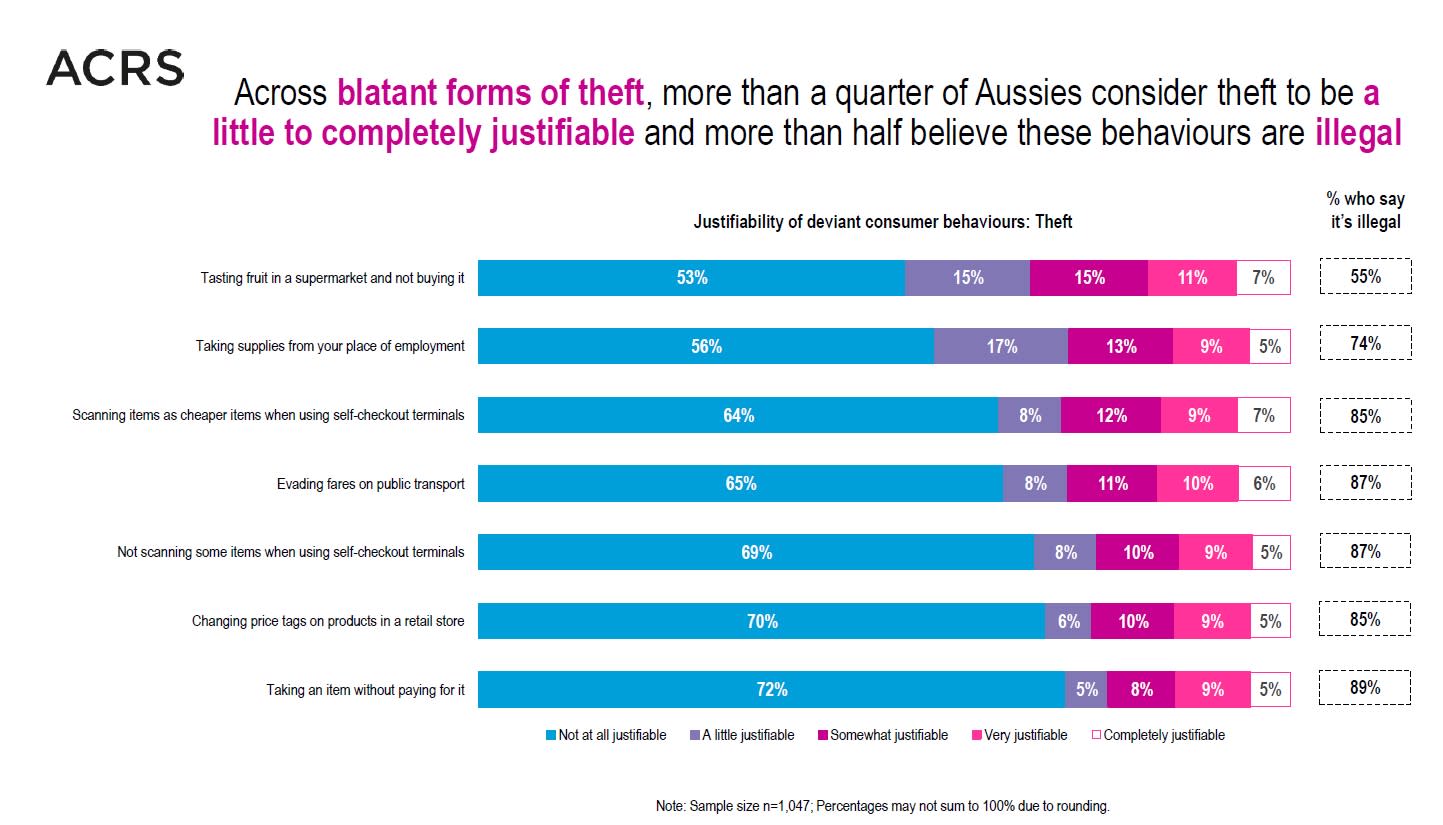
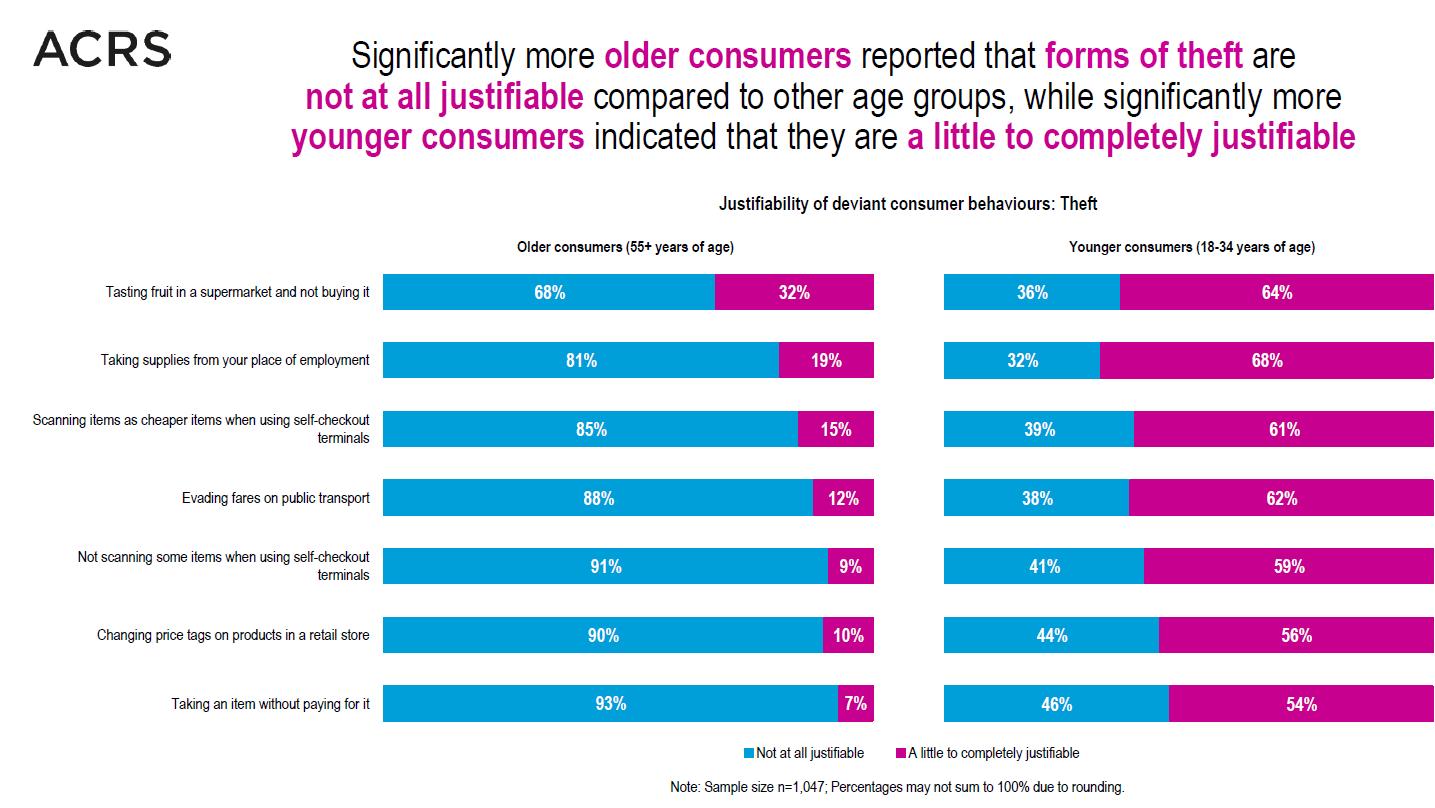
There were stark differences in how justifiable these deviant behaviours were viewed by different age groups. Significantly more older consumers (55-plus years of age) considered retail theft behaviours as not at all justifiable compared to other age groups, while significantly more younger consumers (18–34 years of age) indicated that forms of theft are a little, to completely, justifiable.
For example, taking an item without paying for it was not at all justifiable to 93 per cent of consumers aged 55 and older, while seven per cent believed it was a little, to completely, justifiable. In contrast, 46 per cent of consumers 18–34 years of age believed taking an item without paying for it was not at all justifiable, while the remaining 54 per cent felt it was a little, to completely, justifiable.
Retailers at the whim of consumer deviance
It’s not only blatant forms of theft that retailers suffer from. Consumers may also manipulate deals and promotions, mislead customer service, and falsely take advantage of returns policies.
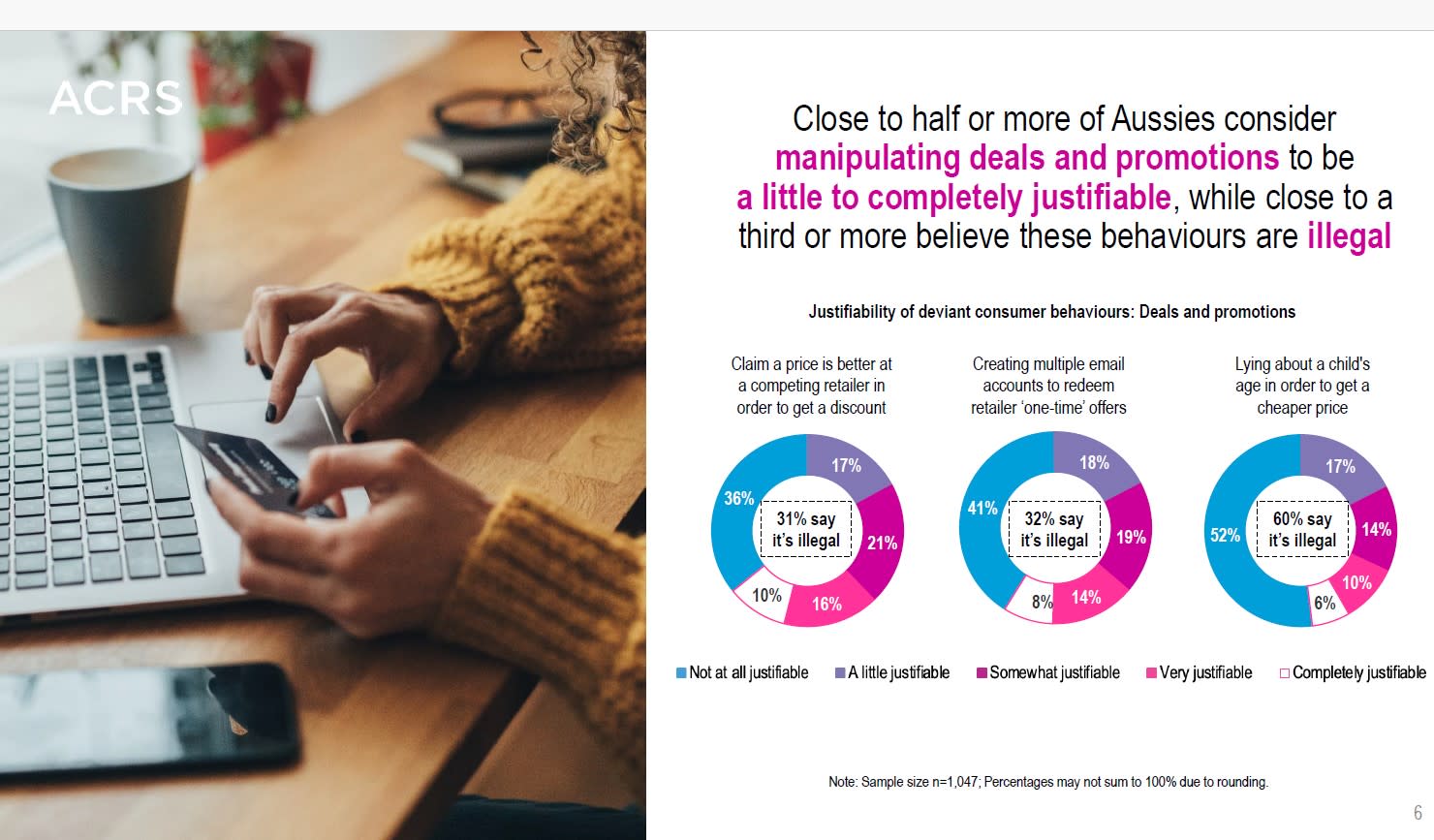
Close to half or more of Aussies consider manipulating deals and promotions to be a little, to completely, justifiable. For example, shoppers reported it’s a little to completely justifiable to lie about a child’s age to get a cheaper price (47 per cent), create multiple email accounts to redeem a retailer ‘one-time’ offer (59 per cent), and claim a price is better at a competing retailer to get a discount (64 per cent).
A third or more of shoppers consider taking advantage of customer service to be a little to completely justifiable. Specifically, Aussie consumers reported it’s a little to completely justifiable to give misleading price information to a clerk for an unpriced item (34 per cent), write a negative online review to receive compensation (40 per cent), and not say anything when a waiter miscalculates a bill in the shopper’s favour (60 per cent).
Finally, a third or more of shoppers consider questionable returns to be a little to completely justifiable. Consumers reported it’s a little to completely justifiable to buy items for single use and then return them (35 per cent), and return used goods for a refund (51 per cent).

Shopping centre safety and security under a microscope
Shopping centres offer convenience through a variety of retail, dining and entertainment options in one location, foster community connections by serving as gathering spaces and hosting events, and provide a safe and comfortable environment for shoppers.
However, shopping centre safety and security has been put under a microscope in the past couple of years due to several incidents, particularly violent knife crime and retail employee abuse, reported in the news.
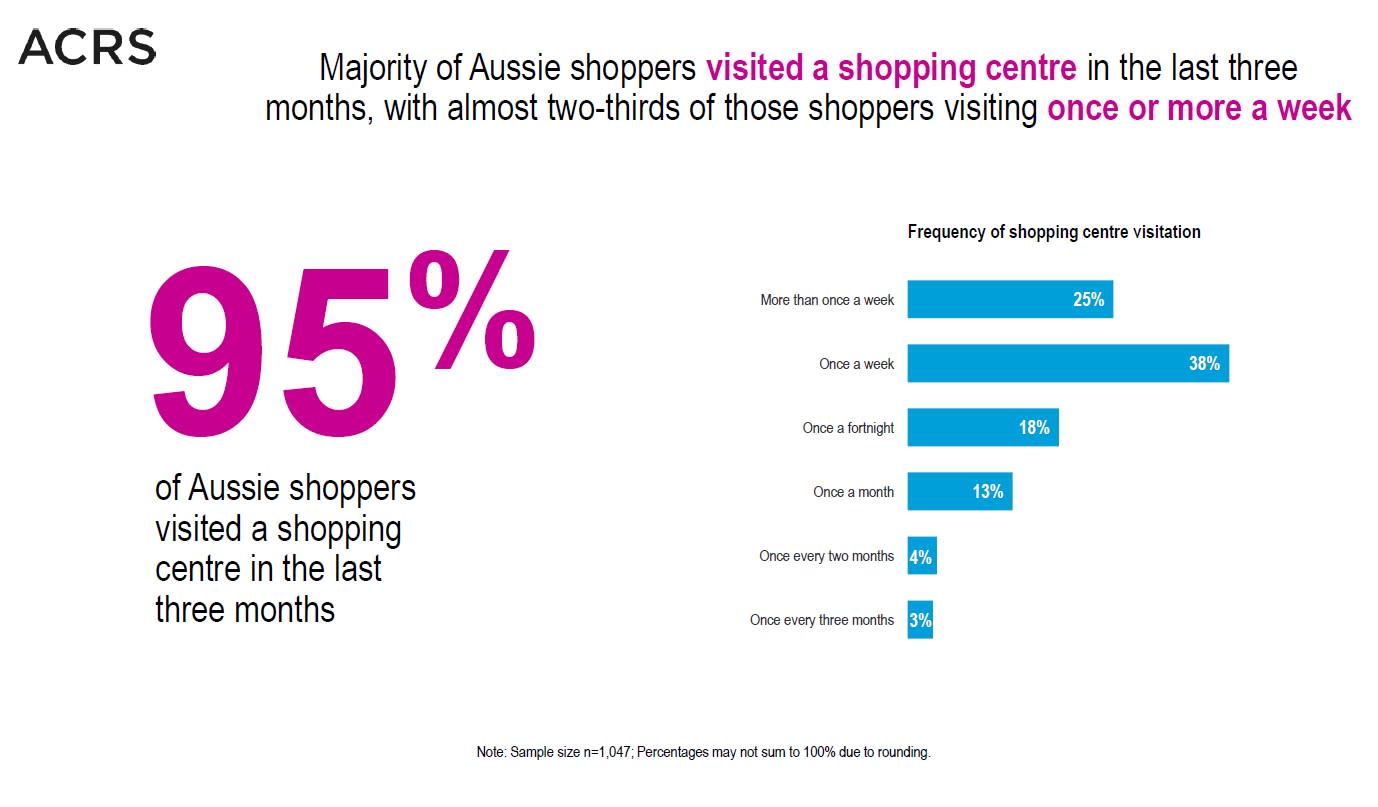
We asked Aussie shoppers about their safety and security experiences at shopping centres, and the results were predominantly positive. The vast majority of shoppers visited a shopping centre in the past three months (95 per cent), with almost two-thirds visiting once or more per week (63 per cent).
Most shoppers reported they felt safe (65 per cent, of which 27 per cent felt very safe) at shopping centres, while only a small minority felt unsafe (five per cent, of which one per cent felt very unsafe).
Among shoppers who felt unsafe, this most commonly occurred at the entrances and outside areas (45 per cent), followed closely by car parks (43 per cent), and food courts (43 per cent). Additionally, most shoppers recalled seeing security personnel once or more during their visit/s to shopping centres over the past three months (83 per cent).

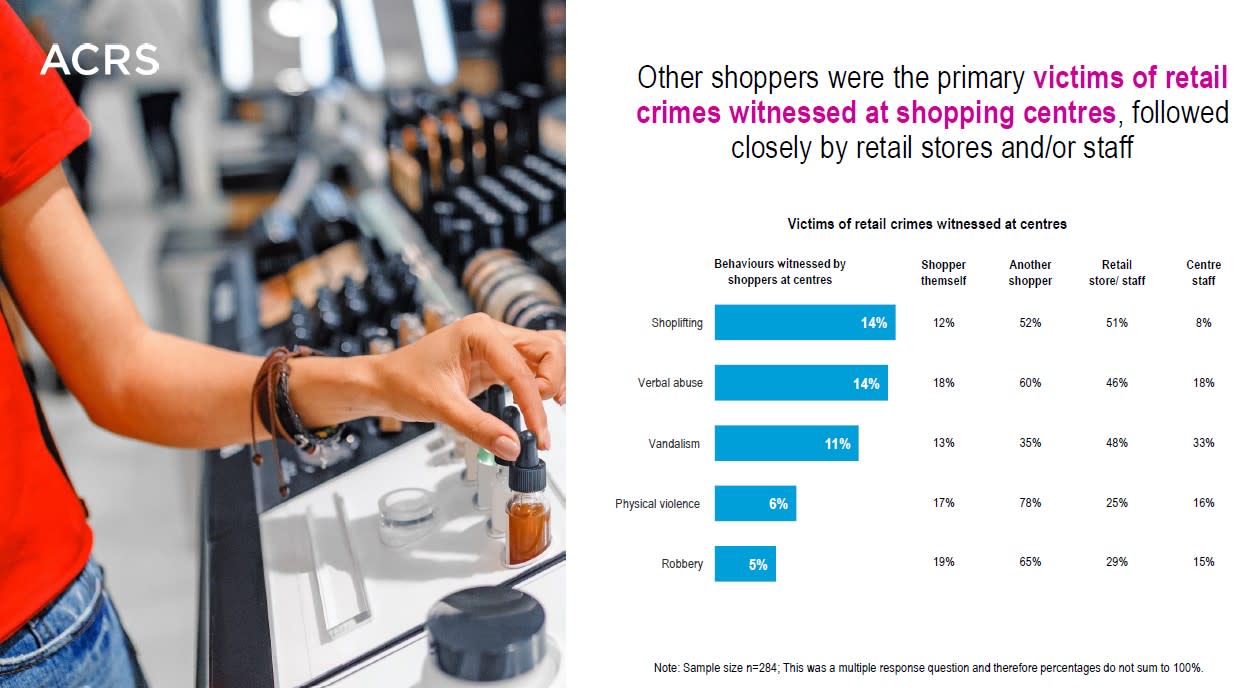
Positively, most shoppers did not witness concerning behaviours at shopping centres (58 per cent); however, some antisocial behaviours were witnessed by consumers, including loitering (26 per cent), disruptive congregations (15 per cent), shoplifting (14 per cent), verbal abuse (14 per cent), vandalism (11 per cent), physical violence (six per cent), and robbery (five per cent).
Of the retail crimes witnessed at shopping centres, other shoppers were the primary victims, followed closely by retail stores and/or staff. For example, other shoppers and retail stores were the main victims of shoplifting (52 per cent and 51 per cent, respectively) and verbal abuse (60 per cent and 46 per cent, respectively).
Further, other shoppers were the main victims of physically aggressive retail crimes witnessed by shoppers, including physical violence (78 per cent) and robbery (65 per cent).
Cracking down on retail crime
Retail crime costs Australian businesses millions, endangers retail workers and shoppers, and fuels other criminal activities.
The Australian Retailers Association (ARA) reports that 70 per cent of retailers experienced an increase in customer theft across the past financial year. Further, Crime Stoppers Victoria (CSV) reports that nearly 70 per cent of retail theft in Victoria is committed by repeat offenders, many operating in well-organised networks.
Offenders are becoming more brazen and violent putting frontline workers and shoppers at serious risk – in 2024, assaults linked to retail theft rose by 9.2 per cent, with women disproportionately affected.
In response to the alarming escalation of retail crime, the Shop Distributive Alliance (SDA), Victoria Police, Victorian government, ARA, National Retail Association (NRA) and retailers met in late July for the 2025 Retail Crime Symposium to discuss a united and consistent national action plan against retail crime and violence.
The symposium focused on cracking down on repeat offenders, with retail leaders and experts calling for national consistency in retail crime laws and police responses, ensuring uniform penalties and enforcement across all states and territories.
In September, Crime Stoppers Australia (CSA) and the Shopping Centre Council of Australia (SCCA) have partnered to launch a national awareness campaign to encourage Australians to be vigilant and speak up about crime or suspicious activity observed within and around shopping centre environments.
Crime Stoppers messages, including the 1800 333 000 number, will appear for free across more than 2000 digital screens, in more than 100 shopping centres across the country, with an estimated commercial advertising value of five million dollars. The campaign will run in two bursts, starting in the spring school holidays (8 September until 10 October) and then the back-to-school period (1-30 January, 2026).
Major retailers such as supermarket giants Woolworths and Coles are also taking action to fight retail crime. Hundreds of frontline staff have been issued body cameras and thousands of others trained in how to handle confrontation as retailers have been forced to upgrade safety measures for their workers and customers.
Retail crime is a shared problem that requires a united approach, integrating technology, improved communication, and consistent legal frameworks across retailers, law enforcement, and government bodies.
While retail crime in Australia has escalated in recent years, these collective efforts demonstrate positive steps towards combating retail crime.
Note about the research: The ACRS Retail Monitor investigates Australian consumers’ shopping preferences, attitudes, and behaviour. Data on consumer deviance and shopping centre safety and security was collected from n=1047 randomly selected Australian shoppers at the end of June 2025.
This article was first published on Monash Lens. Read the original article.