Table of Contents
Steve Holland
Broadcaster, commentator, media consultant, libertarian and former mayor of the Mornington Peninsula.
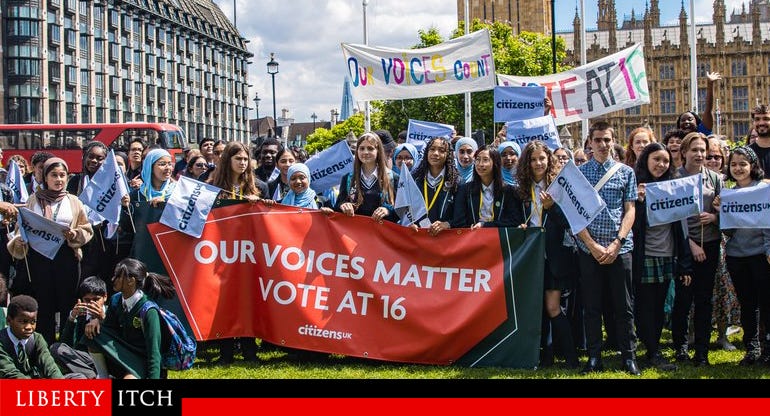
The UK government recently unveiled plans to lower the voting age to 16, enfranchising some 1.6 million additional young Brits in the biggest expansion of the electorate in over half a century.
Here in Australia, teal MP Monique Ryan has already pledged to introduce a bill to lower the federal voting age, putting the two major parties on the spot, and predictably they’re squirming. Labor MPs say they’re not open to the idea (yet), and some Liberal MPs (determined to lose the few remaining young voters in their corner) think Australia’s voting age should be increased.
Libertarians should welcome the debate about giving young people the vote. As boomers age, there’s a seismic demographic shift coming. Australians under 45 are now the dominant voting bloc, and they’re not particularly enthusiastic about the major parties. Opportunity beckons.
Objections to lowering the voting age have come thick and fast, most of them recycled from previous campaigns against enfranchisement.
Women were told they were too sensitive for politics and too emotional for political decision making. Some landlords weren’t happy about enfranchisement because they thought people shouldn’t have a say in how their country was governed unless they owned a piece of it. Aboriginal Australians were denied full voting rights under paternalistic laws that treated them as incapable of responsible citizenship. African Americans were subjected to ridiculous tests of literacy and mental capacity, including counting the number of bubbles in a bar of soap. Eighteen-year-olds were accused of lacking maturity, life experience and sufficient education to make an informed choice at the ballot box.
As for arguments about education or mental capacity, millions of adults cast ballots every election without an IQ test.
The restriction of voting rights, justified by the prejudices of the day, is antithetical to the values of freedom and individual liberty we must cherish and continue to fight for.
Each time Australia has extended suffrage – to women in 1902, Aboriginals in 1962, and 18-year-olds in 1973 – our society grew stronger. Lowering the voting age will bring us a step closer to fully respecting the natural, inalienable rights we are born with and that governments too often trample.
One of the more cynical objections to lowering the voting age is that young people are more likely to vote for left-wing parties and candidates. Whilst that may be true in Australia, for now, it’s not true elsewhere. In 2024, Donald Trump flipped key states including Michigan on the back of huge swings in the youth vote. Young voters are not a homogenous leftist bloc, and to the extent younger Australians are currently inclined to lean left, it’s not inevitable.
It’s no secret that the Liberal Party has a problem appealing to young voters. Only 26 per cent of Gen Z voters backed the coalition in 2022. The party’s response is, seemingly, to abandon the field. Perhaps that’s why our schools and universities are dominated by left-wing ideologues. Where’s the fight for the hearts and minds of Australia’s future voters?
Young people bring a unique perspective on many important centre-right issues, from home ownership to immigration and government debt. Why not appeal to this growing demographic?
Here’s a thought for the political parties on the right: maybe the problem isn’t the kids, it’s you. If your political movement can’t inspire anyone under 30, it’s extinct. The answer is not to ignore or disenfranchise the young, the answer is to offer a vision of the future that young people care about.
As for arguments about education or mental capacity, millions of adults cast ballots every election without an IQ test or requirement to demonstrate political acumen. Imagine that – some sitting MPs might not qualify.
The idea that we should deny young people a vote until they hit an arbitrary birth anniversary is irrational and illiberal. At 16, Australians can leave school, start full-time work, drive a car, be tried as an adult, and pay taxes. The latter is perhaps the most noteworthy from a libertarian perspective; after all, no taxation without representation. If we can trust a 16-year-old to handle our food, and tax them in the process, we can certainly trust them to choose their own political representatives.
Our expectation of a 16-year-old in our society is that they are good and productive citizens. Giving them the vote would affirm a basic truth – rights in a free society aren’t a gift from the government tied to your date of birth: they’re an inherent entitlement of citizenship, and voting is your civic duty.
Objections to lowering the voting age have come thick and fast, most of them recycled from previous campaigns against enfranchisement.
Australia’s early adoption of women’s suffrage made us a world leader when it comes to voting rights. Australia even pioneered uniform anonymous voting (the secret ballot is sometimes referred to as the Australian ballot). There’s no reason to stop there, and we should let liberty, not fear, guide us.
In fact, lowering the voting age to 16 could be more than just a reform in itself, it could serve as a catalyst for other overdue reforms. This is an opportunity to strike a deal to end compulsory voting, introduce optional preferencing, fixed terms or term limits, and recall elections. An effective federal opposition would have seized the day. Alas, it seems they’re preoccupied with gender quotas.
Personally, I haven’t found any of the objections to lowering the voting age particularly compelling when stacked against the arguments in favour. I’m always going to err on the side of liberty and fewer restrictions on our rights.
Liberals and conservatives fretting about socialism and left-wing indoctrination ought to take a deep breath. If they truly believe in their values, they should be confident those ideas can win over young minds in an open contest. I challenge those on the right to actively engage the next generation and scratch that liberty itch. We’ve all got some work to do.
We need to welcome the energy and idealism of young Australians into our political system. Invite them into the philosophical and ideological debates happening on the right. Sixteen-year-olds are not only capable, but they also deserve to have a say in the direction of their country. They, more than anyone, will have to live with the long-term consequences of government decisions. They’re already looking down the barrel of a lower standard of living than their parents. Let them have their say.
This article was originally published by Liberty Itch.