Table of Contents
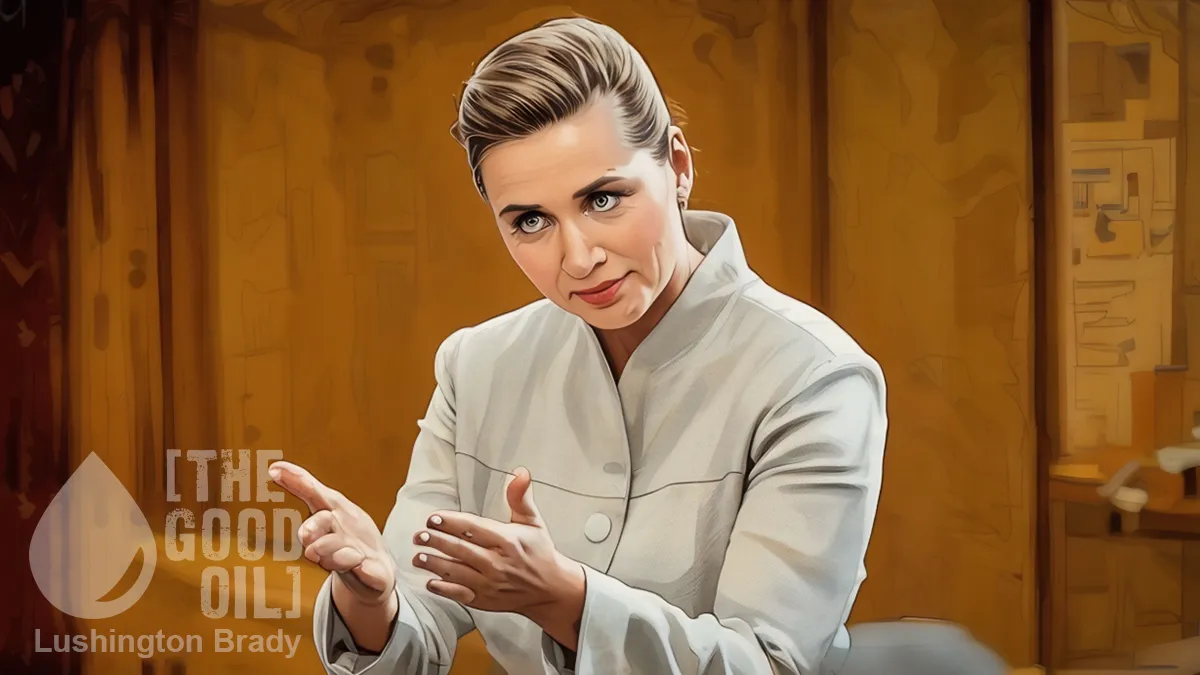
For years, Scandinavia has been the local left’s vision of socialist utopia. Never mind that Scandinavian countries are definitely not socialist – and have been at pains to try and make that clear. But the left’s love affair with Scandinavia, or Denmark at least, may not last much longer.
While the governing Social Democrats are members of the international Progressive Alliance, the party is increasingly adopting decidedly un-progressive policies – around the issues of immigration and Islam, especially. The party is often described as ‘anti-globalisation, anti-immigrant and critical of Islam’. Under PM Mette Frederiksen, the party has supported strict immigration controls, as well as expulsion of asylum seekers and repatriating Muslim immigrants. Social Democrats have also imposed bans on Islamic prayer rooms in schools and proposed a ban on burqas and niqabs.
Frederiksen is now advocating a more robust policy of asserting traditional Western values and acknowledging that the civilisational struggle of the 21st century is as much about values as military strength. To that end, she recently proposed “a form of rearmament that is just as important [as the military one]. That is the spiritual one.”
This was no passing remark. Just days earlier, Frederiksen had announced a major military build-up: increased conscription, a sharp rise in defence spending and intensified strategic readiness. Like the rest of Europe and Nato, Denmark is preparing for a more dangerous world.
But there’s a deeper problem, one that Frederiksen – unusually for a Western leader – has dared to identify. Many young Danes are unwilling to fight. Some openly admit they wouldn’t die for Denmark – not for democracy, not for the flag, and certainly not for a modern welfare state that promises everything but inspires nothing.
Frederiksen has hit the nail of Western malaise on the head: the spiritual hollowness at the heart of globalist multiculturalism. Through the 20th century, Denmark became a rigorously secular nation. Like many in the West, Frederiksen has realised what a catastrophic mistake that was.
The country’s prime minister is now calling on the church to return. In an interview with the Christian newspaper Kristeligt Dagblad, she went even further, urging the Church of Denmark to step up not merely as a cultural institution, but as a vital part of national life.
‘I believe that people will increasingly seek the church,’ she said, ‘because it offers natural fellowship and national grounding… The church room has helped people through many crises. I believe the church will find that these times call for such a space.’
Then came a sentence that would have been unthinkable from a Danish Social Democratic prime minister just a decade ago: ‘If I were the church, I would be thinking right now: how can we be both a spiritual and physical framework for what Danes are going through?’
The problem is obvious and ubiquitous across much of the West: no one wants to fight and die for Klaus Schwab or Jacinda Ardern. The globalist utopia is an empty promise: we will own nothing and believe in less.
This is not religious romanticism. It is political realism. It is the recognition that rights, services and social protections cannot sustain a society on their own. People are not willing to suffer for tax models. They do not risk their lives for procedural democracy. But they will fight for what they hold sacred.
The hard times of the early-mid-20th century made strong men, who made good times. But those good times made three or more generations of weak men. Belatedly, some are waking up that we need strong men – and strong men are men who have something worth believing in.
Denmark is discovering what many nations in the West are about to learn: that a system built on comfort, entitlement and personal freedom leaves nothing to defend when hardship occurs. And hardship – in the form of war, threat and sacrifice – is returning to the European Continent.
It’s also looming on the Antipodean horizon: a gigantic, panda-shaped shadow falling across the South Pacific. A threat for which we are completely unprepared. The Australian government is not only criminally neglecting defence spending – it wouldn’t matter much if they tripled defence spending.
Because the real shortfall is in belief and conviction.
No one seems to be asking the fundamental question: do we have anything left that people would die to protect? That is the real crisis.
Denmark is just of the handful of Western countries who are belatedly learning a harsh lesson: secularism is doomed to fail.
Rights and freedoms, as noble as they are, do not exist in a vacuum. They are the fruit of a deeper moral vision, one rooted in transcendence, in religion, in a shared understanding of truth and goodness. Cut off from those roots, the tree will not stand. And when sacrifice is required, the will to make it will vanish.
This is why Frederiksen’s words matter. They are not necessarily a return to personal faith, but they are an admission that faith itself is necessary. That no civilisation can survive, let alone defend itself, without something sacred at its foundation.
Scandinavia, like much of the West, has replaced churches with welfare offices. God with malleable ‘identities’. Prayer with streaming services, video games and transactional sex.
Now, Denmark, at least, has realised that’s a steady diet of civilisational poison.




![[The Good Oil] Stuff Up of the Day](/content/images/size/w1304/format/webp/2024/09/Stuff-up-image-1.webp)