Table of Contents
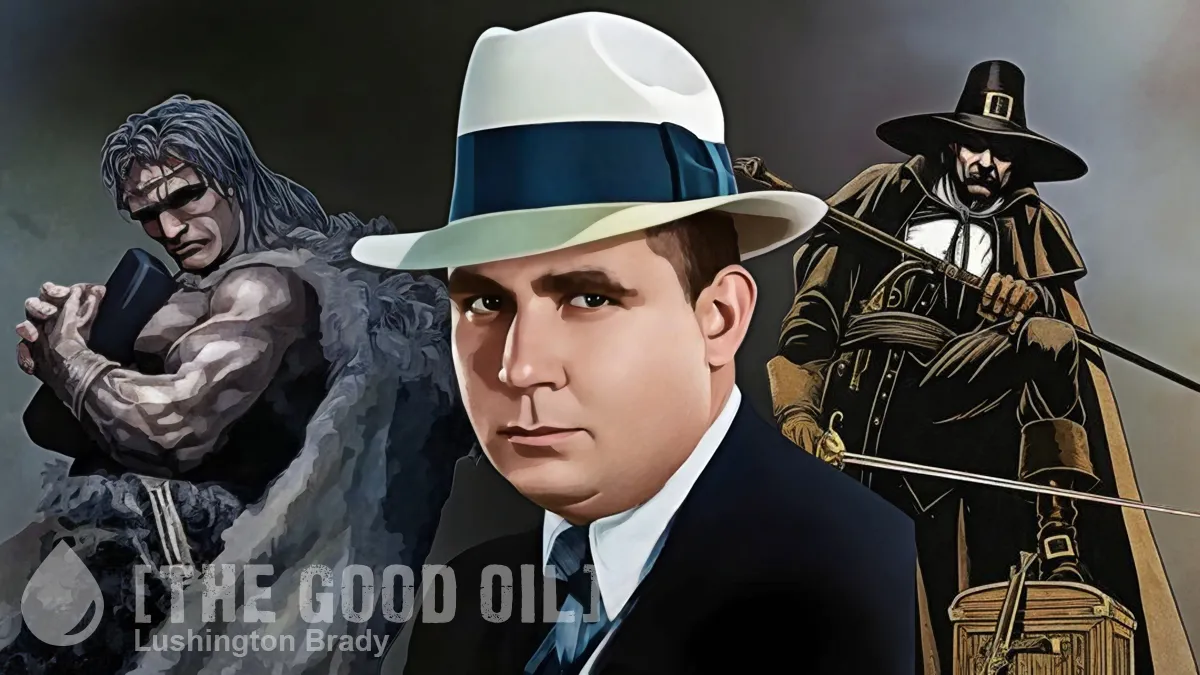
The ‘pulp’ era of popular fiction was one of the most fertile of the 20th century, producing many enduring pop culture icons and inspiring generations more. The Shadow, Doc Savage and Flash Gordon, not to mention their comic-book offspring such as Superman and Batman, and many more.
One of the most instantly-recognisable characters to stride with sandalled feet from the pages of the pulps is Conan the Barbarian. With his black locks, brooding stare, loincloth-clad muscled body and, of course, his savage sword, Conan has strode the pages of magazines, comics, novels and movies for nearly a century.
Conan was the creation of Texan writer Robert E Howard, who died by suicide aged just 30. In his short career – although he’d wanted to be a writer from the age of nine, his professional career lasted just seven years – he published hundreds of stories and poems. He is also not only regarded as the father of the ‘sword and sorcery’ genre, he created a gallery of memorable characters.
In fact, Conan was one of Howard’s final creations. When Conan first appeared, he was introduced to readers as the latest from the pen that brought them Solomon Kane and Bran Mak Morn. These latter two may not be remembered as well today as the savage Cimmeria, but in many ways they were even more seminal. Bran Mak Morn can be seen as the progenitor of the Celtic strand of modern fantasy, while Solomon Kane is the archetype for generations of brooding vigilante heroes.
These characters, while nowhere near as famous as Conan, hold profound significance in understanding Howard’s literary evolution and broader impact. Like Conan, they showcase his fascination with historical romance, moral ambiguity and the clash between civilization and barbarism. Solomon Kane, the Puritan avenger, blends religious zeal and pulp adventure, while Bran Mak Morn, the last Pictish king, explores themes of racial decay and defiant nationalism.
The last is particularly significant in light of a long argument, carried out in correspondence (the two never met in person), with Howard’s friend and admirer H P Lovecraft, another giant to emerge from the pulp scene. Lovecraft, the gentlemanly east coaster living in genteel poverty, firmly believed that civilisation was the natural destiny of mankind. Howard, who grew up in a Texas that straddled the years between the end of the cowboy era and the spread of rough’n’tumble oil-boom towns, adamantly argued that civilisation was a rare and fragile thing, with barbarism the rule.
Kane and Bran were thus not mere precursors to Conan, but foundational figures that fleshed out Howard’s personal ethos, enriched the pulp era and influenced modern fantasy.
Solomon Kane debuted in 1928’s “Red Shadows” in Weird Tales, four years before Conan’s first appearance. A peripatetic 16th-century Puritan, Kane fights evil with rapier, pistols and unyielding faith. His travels England and France, to Africa’s jungles. Conceived when Howard was still in high school and enamoured with stories of Elizabethan duellists, his weapons are flintlock pistols, a rapier (and, later, a “Juju stick”) – and his implacable thirst for vengeance, driven by divine madness.
Kane’s lasting legacy can be seen in Marvel’s Punisher. Like Frank Castle, Kane is driven by an uncontrollable impulse to avenge the innocent victims of evil. In “Red Shadows”, Kane spends years tracking the bandit captain Le Loup from France, to Italy, Turkey and finally the African jungle, all because of a chance encounter with a dying village girl, a victim of Le Loup’s band of desperadoes, whose name Kane never even learns. Kane is Castle with religious zeal.
Kane’s wanderlust and moral absolutism set him apart from contemporaries, offering depth unseen in Howard’s other works. He influenced pulp’s evolution toward character-driven stories, impacting figures like Indiana Jones or Van Helsing. Indeed, the 2004 Van Helsing movie drew heavily on Kane, from the character’s appearance (played by Hugh Jackman), to his hinted backstory as a doomed immortal wanderer, like the myth of the Wandering Jew. Tantalisingly, Kane’s origin is never explicitly explored in the original stories. All that is ever revealed is that he hails from Devon and was at one point a sea captain.
A 2009 film, Solomon Kane, starring James Purefoy and Pete Postlethwaite, explored the hero’s origins in (made up for the film) depth, underscoring his enduring appeal as a tormented avenger. Kane’s madness adds nuance, making him a prototype for flawed heroes in horror-adventure.
Bran Mak Morn followed in 1930’s “Kings of the Night”, two years pre-Conan. As the last Pictish king in Roman-era Britain, Bran rallies his degenerating tribe against Celts and Romans, blending heroism with horror. Where Kane introduced moral-driven action against supernatural foes, Bran explored racial pride and barbaric defiance, elements later amplified in Conan’s Hyborian world. Howard’s crossover in “Kings of the Night”, summoning Kull of Atlantis to aid Bran, hints at a shared universe, prefiguring Conan’s mythic scope. Indeed, Atlantis and the Picts figure heavily in the Hyborian Age history Howard delineated at great length as part of Conan’s creation. Without Kane’s zeal and Bran’s tragedy, Conan’s barbaric ethos might not have crystallised.
Beyond Howard’s personal literary development, Bran Mak Morn played a crucial role in popularising Celtic fantasy more broadly, romanticising ancient Britain’s tribal conflicts and infusing them with mythic horror. Howard portrayed the Picts as a proud, atavistic race facing extinction, with Bran as their unbroken bloodline’s defender against Celtic and Roman invaders. Stories like “Worms of the Earth” depict Bran’s desperate alliances with eldritch forces, evoking a “Pictish Twilight” akin to the Celtic Revival’s melancholic nostalgia.
Howard’s short, dark, savage Picts deviate from history, yet draw from Celtic lore, blending Arthurian echoes with Lovecraftian elements (e.g., references to Dagon). This fusion popularised Celtic fantasy by framing it as a struggle of indigenous peoples against imperialism, influencing later works like David Gemmell’s Rigante series. Bran’s tales emphasise ethnic clashes – Britons, Gaels, Norsemen – highlighting Howard’s view of history as cyclic decay, a theme that resonated in post-WWI fiction. By humanising barbarians and critiquing civilisation, Bran helped shift fantasy toward culturally rich, non-medieval settings, paving the way for modern Celtic-inspired epics.
As already seen, Howard’s more action-oriented style curiously crossed over with the cosmic horror of Lovecraft. Their friendship by correspondence began in August, 1930, when Howard wrote a letter to Weird Tales, praising a reprint of Lovecraft’s “The Rats in the Walls”. To Lovecraft’s pleased surprise, Howard picked up on some obscure Gaelic references in the tale, showcasing his deep interest in history and mythology. Over hundreds of letters, “Grandpa Theobald” and “Two-Gun Bob” (so nicknamed by Lovecraft due to Howard’s passionate rants about the American Southwest’s history and frontier spirit) debated philosophy, history and the human condition.
Howard became a key member of the “Lovecraft Circle”, a loose network of Weird Tales contributors including Clark Ashton Smith, August Derleth, and E Hoffmann Price, all connected through Lovecraft’s tireless letter writing. Lovecraft acted as the hub, introducing writers to one another, encouraging story sharing and fostering the adoption of each other’s fictional elements. This circle amplified the reach of their ideas, turning individual tales into a collective mythology.
One of the most significant aspects of their connection was Howard’s integration into Lovecraft’s Cthulhu Mythos, a framework of ancient, eldritch entities and forbidden knowledge that Lovecraft encouraged others to expand. Howard’s mythos stories often blended his signature sword and sorcery with cosmic terror. Core entries include “The Black Stone” (1931), where a protagonist uncovers a monolith tied to ancient rituals and the entity Xuthltan, echoing Lovecraft’s forbidden artifacts. “The Children of the Night” (1931), features serpent people and references to Lovecraft’s “Nameless City”, and “The Fire of Asshurbanipal” (1936), involving a cursed gem linked to eldritch forces in the Arabian desert, tying it to Lovecraft’s famed author of the Necronomicon, the “mad Arab, Abdul Alhazred”. Forbidden books are a staple of Lovecraft’s fiction, and Howard contributed the “Black Book of Von Junzt”, Unaussprechlichen Kulten.
Howard also expanded on entities like Tsathoggua (originally from Clark Ashton Smith) and incorporated references to Yog-Sothoth, Shub-Niggurath and Nyarlathotep, grounding them in his gritty, historical settings. This cross-pollination enriched the mythos, offering a muscular counterpart to Lovecraft’s existential introspection: Howard’s barbaric heroes instead confronted the cosmic horrors with sword in hand, adding a layer of heroic resistance contrasting with Lovecraft’s tales of inevitable doom.
The Howard-Lovecraft connection ended tragically with Howard’s suicide in 1936 (Lovecraft died of cancer a year later), but its legacy endures. Howard and Lovecraft’s bond was a fusion of minds that transcended physical distance, blending barbarism with cosmic horror to create something eternal.
Howard’s legacy endures as the father of sword and sorcery, with his works inspiring Tolkien’s successors and the fantasy boom of the 1960s–70s. Posthumous collections amplified his reach, influencing writers like Stephen King and George R R Martin. Solomon Kane and Bran Mak Morn highlight his versatility: Kane’s horror-infused Puritanism expanded pulp beyond mere action, while Bran’s tragic Pictish saga enriched historical fantasy with mythic depth. Both connect to Lovecraft’s Mythos, broadening Howard’s cosmic horror contributions. Their adaptations in novels, comics and films sustain Howard’s influence, proving his lesser-known heroes’ lasting, if lesser-known, significance in pop culture.