Table of Contents
Every science fiction fan knows the Big Three – Arthur C Clarke, Robert Heinlein and Isaac Asimov – but under their vast shadows lurk a plethora of often unfairly neglected geniuses. Some were more-or-less one-offs, like Walter M Miller’s A Canticle for Leibowitz, while others had respectable careers at the time but faded from the spotlight in subsequent decades, despite writing some remarkable novels.
When a friend recommended, for instance, Alfred Bester’s The Stars My Destination, I was amazed at what I read. Here was cyberpunk, 30 years before Neuromancer. When I recently read Clifford Simak’s City, at a YouTuber’s suggestion, I was frankly gobsmacked.
This is a book that amazingly prefigured not only cutting-edge philosophical insights into consciousness, but even groundbreaking physics, decades ahead of the philosophers and scientists. Thomas Nagel wrote, “What is it like to be a bat?” in 1974. Hugh Everett published his many-worlds interpretation of quantum physics in 1957.
City anticipated both, from the 1940s to 1952.
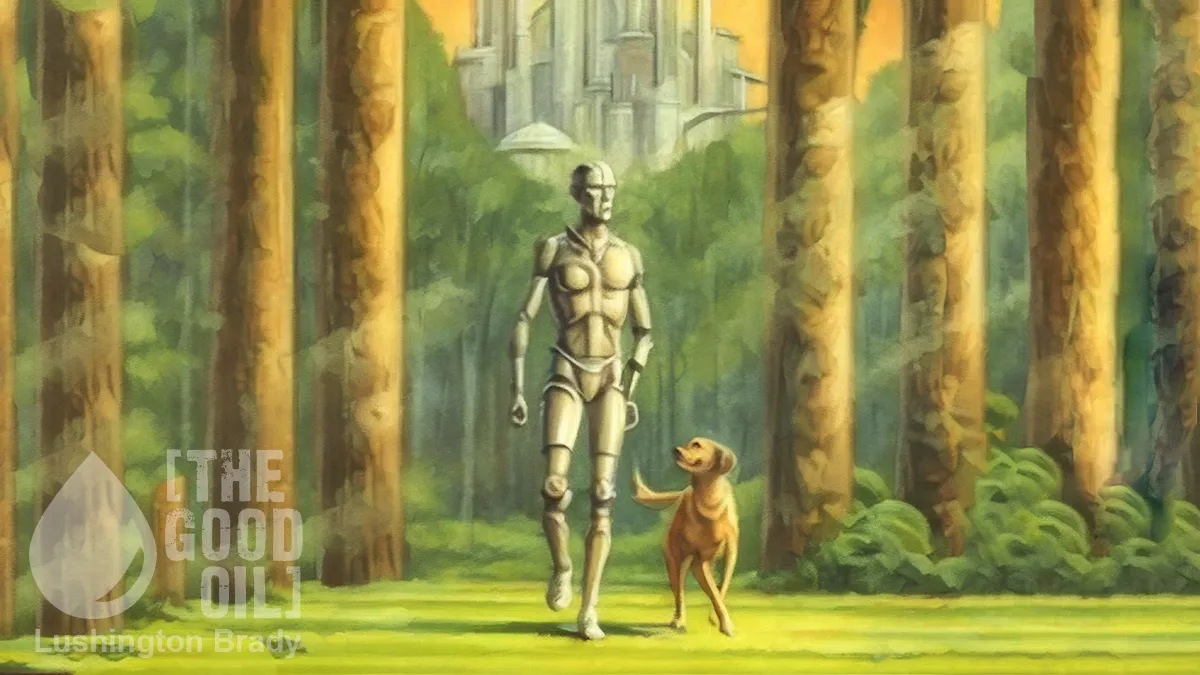
First, the basics. City is a fix-up novel, composed of interconnected stories originally published in the 1940s, published as a novel linked by short, fictional ‘commentaries’ by dog historians, in 1952. Over the course of nine short stories, it tells the tale of a future Earth where humanity gradually declines and is ultimately replaced by sentient dogs and their robot servants. Unlike most such stories, City is not so much apocalyptic as elegiac: humans simply gradually fade away, leaving behind the dogs for whom man is semi-mythical and gently godlike.
Rather than being violently destroyed by their technology, humans are liberated by it. At first, the liberation takes the form of humans with cheap, fast transportation abandoning crowded cities for the vast rural spaces left idle when intensive hydroponics puts an end to farming. Every man can suddenly live in the sort of easygoing frontier freedom Davy Crockett dreamed of.
As they colonise other planets, humans also develop the technology to assume the bodily form of alien species rather than clumsily adapting human bodies to hostile environments. Meanwhile, on an increasingly agoraphobic Earth, one family, the Websters, begin to assume a central role in human evolution, beginning with raising dogs to verbal intelligence, and adapting durable robot servants to be the dogs’ hands and fingers.
While the stories themselves give a satisfying arc from near-future to tens of thousands of years hence, from the pinnacle to the disappearance of man, the interstitial commentaries are perhaps the novel’s weakest link. They purport to comment on the stories as doggish fireside tales, but, with the exception of the last, they don’t read as such. The linking was added later, when editors wanted to publish the stories as a single novel, and it shows.
But the stories themselves are not just a poetic and elegiac masterpiece: the ideas they explore, almost incidentally, are an astonishing intellectual achievement.
Consciousness and the “What It’s Like” Problem
The first major philosophical current in City involves consciousness. As the stories unfold, with the fading of humanity, consciousness disperses into new forms, including telepathic and post-biological ones. One of the earliest involves human colonists on Jupiter, where even the toughest human technology breaks down under the intense pressure of its atmosphere. The solution is to transfer human minds to the indigenous alien ‘Lopers’. Except that no human transferred to a Loper ever returns. As we find out, that’s because, able to appreciate Jupiter as a Loper, life is just so wonderful that they don’t want to return to a human form.
It wasn’t until 1974 that Thomas Nagel wrote “What Is It Like to Be a Bat?” In this groundbreaking paper, Nagel argued that no matter how much objective knowledge we gain about another creature, there remains an irreducible subjective aspect: the “what it is like” of experience. Even telepathy, in City, isn’t the same as being a Loper. Dogs, even telepathic robots, can experience the thoughts of other animals, like the mice “[running] along their grassy burrows with happy mouse thoughts that were scarcely thoughts”, but they can’t know what it is like to be a mouse. They similarly debate whether human consciousness itself was so alien that it cannot be reconstructed. And they have no idea what the ants even do in their mounds, let alone know what they feel or think.
Telepathy, Simak says, may allow one to share a thought, but it cannot fully collapse the gap between perspectives. To be a dog, an ant or even a machine is to inhabit a unique mode of being that cannot be translated into human terms without remainder. In this way, City anticipates not only Nagel’s challenge to reductionism but also later debates in philosophy of mind about qualia and the hard problem of consciousness. Simak’s science fiction does not supply technical arguments but imaginative demonstrations. By inviting readers to dwell in the minds of non-human agents, he foregrounds the mystery and multiplicity of subjective life.
The many-worlds hypothesis
But it’s City’s anticipating of Wheeler’s many-worlds interpretation of quantum physics that is perhaps it’s most incredible achievement.
Today, ‘multiverses’ are not just commonplace but, as in the Marvel movies, little more than a lazy, deus ex machina device for both writers who’ve cornered themselves and studios and publishers who want to milk as many variations of a popular character as possible.
It’s thus hard to remember that the idea of multiverses, in the sense of the many-worlds hypothesis, was revolutionary and at the extreme edge of physics in the 1950s. It was in 1952 (the very year City was published) that Erwin Schrödinger gave a lecture in which he posited simultaneous ‘superpositioned’ multiverses, an idea even he acknowledged might “seem lunatic”. Two years later, Hugh Everett published his groundbreaking many-worlds thesis.
It’s all there, in City. In several of the stories, Simak’s characters experiment with perception-altering technologies and speculative sciences that allow them to slip into parallel worlds. These worlds are not simply metaphorical: they are tangible alternative realities, sometimes close to the familiar Earth, sometimes strange and alien.
“Other little things that were different began to show themselves. The way a tree leaned at the edge of the meadow. And a new kink in the river far below… For they were just extensions of the Earth. Just other worlds following in the track of Earth. Not quite like it, perhaps, but very close. Just a minor difference here and there. Maybe no tree where there was a tree on Earth. Maybe an oak tree where Earth had a walnut tree. Maybe a spring of fresh, cold water where there was no such spring on Earth.”
Simak does not treat this as an abstract physics problem, but something that his characters can experience literally. A character might find that a simple shift of mental focus – or the mediation of an unusual technology – reveals a different world pressing alongside our own. In this sense, Simak anticipates the psychological and existential implications of the many-worlds idea: how the recognition of parallel realities could destabilize one’s sense of home, history and purpose. For instance, the ancient robot servant Jenkins decides that the best chance for the dogs is to live without the humans they love and worship, so, like a gentle, benevolent Pied Piper, he guides the Eloi-like remnants of humanity to a world of their own.
Still, Jenkins misses the humans he served for so long. So do the dogs who loved them, even if they’re not sure man ever really existed. Thus, Simak makes the question less about measurement and mathematics than about belonging. If there are countless worlds, which one is ours? And what responsibility do we carry toward the lives we might have led in other branches?
City is often remembered for its elegiac vision of humanity’s retreat and the rise of talking dogs, and even on that limited reading would still be a great and hugely enjoyable novel. But it is far more than just a ‘good read’ or a quaint curiosity of mid-century science fiction. The novel anticipates, in narrative form, two major philosophical discussions that would only crystallize later in the 20th century: the many-worlds hypothesis in physics and the irreducibility of phenomenal consciousness in philosophy.
Simak’s achievement lies in making these ideas concrete and affective. The many-worlds are not theoretical abstracts but fields and forests into which one might wander. The problem of consciousness is not a puzzle of neurophysiology but the lived distance between species, each with its own ‘what it is like’. In marrying speculative science to pastoral melancholy, Simak transforms philosophy into story, and, in doing so, he invites us to reflect not only on what worlds exist but also on what kinds of minds might inhabit them.