Table of Contents
When I wrote recently that the so-called ‘autism epidemic’ isn’t really, it certainly upset a lot of people. Partly, it seemed, because I dared impugn their golden idol, RFK Jr, but also because a great many clearly didn’t understand what I was saying.
I wasn’t saying that autism is imaginary. Nor was I saying that everyone on the spectrum is a grifter. What I was saying was three thing: firstly, that most of the ‘increase’ in autism rates was an outcome of better and broader diagnostic criteria. That is, that autism is now recognised to cover a spectrum of behaviours, many of which would not previously have been recognised as such.
Secondly, that that spectrum has been grossly misrepresented by the media, in a version of the Straw-Man fallacy. In this case, ignoring that the most common behaviours on the spectrum are the mildest and presenting the most extreme as the norm. In the case of autism, call it the ‘Rain Man fallacy’. Popular media representations of autism are hyper-focused on the most extreme manifestations of the spectrum, especially the notion that autists are ‘idiot-savants’, people with crippling social inabilities who are yet extraordinary mathematicians, for example.
This ignores that by far the greatest numbers of people on the autism spectrum are crowded at the mildest end. Which is not to say that even the mildest end of the spectrum have no consequences, but it’s like pretending that everyone with a bad knee is a quadriplegic.
Thirdly, and most damnably, that autism, now rebranded as ‘neurodiversity’, has become grotesquely fashionable. ‘Neurodiverse’ has become the must-have social-media-bio box to tick, along with ‘indigenous’ and rainbow flags. Far from ‘normalising’ autism, this kind of bandwagon-jumping is a gross disservice to people whose autism is a daily struggle. Especially when, like ‘indigeneity’, it diverts precious resources from those who really need it to a bandwagon of box-tickers who really don’t.
Which brings us to the case peculiar to Australia: the vast financial incentive of the NDIS.
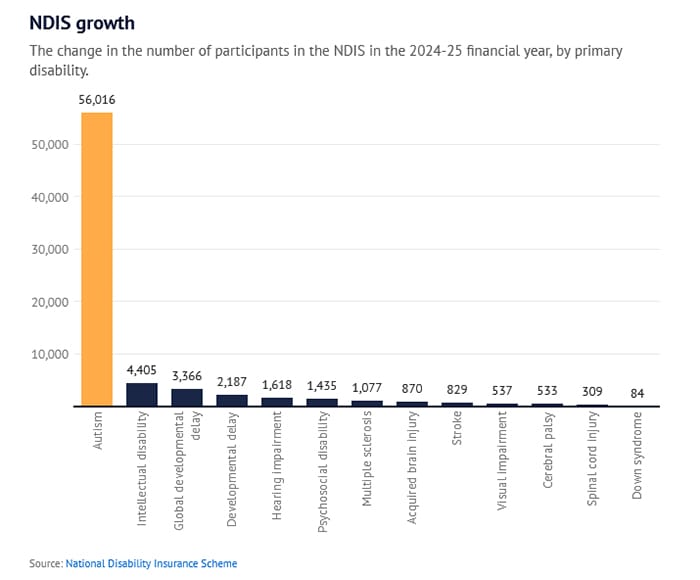
Seven in 10 people who joined the National Disability Insurance Scheme in the past year had a primary diagnosis of autism, and most were children, in a fresh sign of the challenges facing Health and Disability Minister Mark Butler as he seeks to secure the future of the $46 billion scheme.
An analysis of government data by this masthead reveals that 56,000 of the 78,600 participants who signed up to the NDIS between June 2024 and June 2025 had autism as their main diagnosis. It brings the total number of people using the NDIS for autism support to 295,000 – about 40 per cent of the scheme’s 740,000 participants […]
the figures are a stark indication of how a scheme designed to support Australians with the most profound lifelong disabilities has become a de facto support system for struggling children.
Or worse, a massive scam for welfare grifters. Getting a kid on the NDIS can be a massive, taxpayer-funded, windfall. Little surprise that unscrupulous doctors are openly touting an NDIS diagnosis for five grand a pop. The ‘Greek Back’ of the ’80s has morphed into the ‘Neurodiverse Kid’.
And it’s the rest of us who are paying for it. From its launch by Julia Gillard in 2013, the NDIS has become a bloated, $52 billion Gargantua. The NDIS now costs more than Medicare ($34 billion) and is on track to become the single most expensive government program.
Save us all from socialist prime ministers fixated on securing their ‘legacy’.
Autism specialists are well aware of what’s going on.
The chief executive of Autism Awareness Australia, Nicole Rogerson, said the Albanese government needed to make difficult decisions when it came to NDIS eligibility, or else “the Australian people are going to start losing faith in this system”.
“We have a number of Australian children who are not thriving. Their parents have concerns about their development, and those kids need support. Was the NDIS designed to support those children? No, it wasn’t.”
Instead, it’s become a de facto family welfare scheme.
About 43 per cent of NDIS participants are under 14 years old, and this masthead revealed last week that 16 per cent of all six-year-old boys in the country now rely on it.
Across the country, more than 10 per cent of five to seven-year-old children are participants: 13.7 per cent of boys and 6.4 per cent of girls. But the rate of children’s participation can be much higher in certain areas. For example, in both the regional Victorian area of Loddon and on the NSW Central Coast, 13.3 per cent of all nine to 14-year-old boys were on the scheme at the end of June.
Does anyone really believe that we are at a state where one in 10 children is ‘disabled’ enough to require tens of thousands of dollars in government support, year in, year out?
Australia has higher rates of autism than comparable countries. It’s raised thorny questions. Could the $42 billion National Disability Insurance Scheme have inflated diagnosis rates?
At least we’re not yet at the point of a place like India, where criminal gangs are surgically crippling children to make them more convincing beggars.
Not yet.