
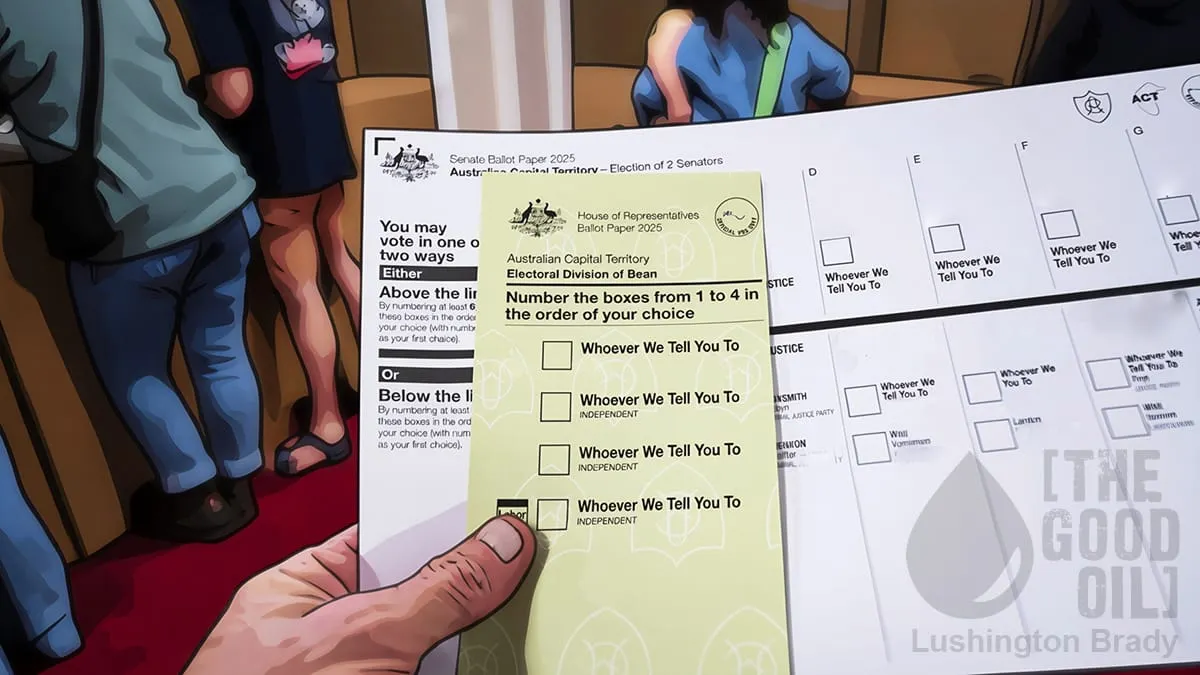
As New Zealanders dealing with the MMP system should have learned from bitter experience, whenever the political class starts mouthing off about ‘electoral reform’, your Bullshit Shields should immediately be up at maximum strength. Almost always, ‘electoral reform’ is code for moving more power to a political class more remote from the people they feel entitled to rule over than the court of the Sun King. L’etat c’est nous is their operative motto.
Poet Les Murray called them “the elite Revolution that rules unsullied by elections”. If they could make that a literal truth, they would.
They’re working on it.
The latest outbreak of this familiar disease arrives wrapped in the usual packaging of sober reports, economic modelling and bipartisan nodding. A new study from the Four Year Terms Australia crowd claims shifting the House of Representatives to fixed four-year terms could deliver between $81 billion and $93 billion in benefits over two decades.
Australia is an international outlier, the report argues, combining a maximum three-year term with an unfixed election date that allows prime ministers to call elections when politically advantageous. Only three of 87 democracies examined have parliamentary terms of three years or less, while Australia is the only country in the study combining a three-year term with short notice of an election.
And if the other 84 voted to jump off a cliff?
It doesn’t get any better when Four Year Terms Australia’s Facebook boasts that “Malcolm Turnbull, Allegra Spender and Bob Carr want four year terms”. Well, that doesn’t sound like an elite circle-jerk at all, now does it?
Cue the solemn chorus of elite chin-stroking. Marty Gray, the campaign’s founder, calls the three-year cycle a “historical hangover from Federation”. OK, and…? Australia after Federation was a much more vibrant democracy than the dreary elite club it’s become since.
The sales pitch doesn’t get any more attractive.
Everything, we are assured, is about good governance and taxpayer savings. Yeah, right, Tui. That’s what they always say.
Such as when they rammed through the 2016 Senate voting ‘reforms’, which were sold as cleaning up a rort. In reality they were a bipartisan stitch-up designed to lock out the minor parties who made the upper house such a minefield for successive governments. Which, pardon my ignorance, I thought was kind of the point.
Instead, party registration thresholds were raised, the crossbench thinned and the Senate duly turned into a rubber stamp instead of a genuine house of review. The major parties congratulated themselves on restoring ‘integrity’. What they really did was entrench their own duopoly.
Victoria offered an even clearer demonstration of the principle. For years successive governments left the state’s upper-house group voting tickets untouched, even after multiple inquiries recommended their abolition. The system was useful. Micro-parties could still be harvested or neutered as required. Only when Avi Yemini’s Free Palestine Party (and a couple of similarly pointed vehicles) openly announced they intended to use the same preference machinery the majors had long exploited did the Allan government suddenly discover urgency. Terrified of the system operating from left to right for once, the tickets were finally scrapped. Principle had nothing to do with it. Self-preservation did.
Three-year terms are supposed to keep the political class on their toes. The hangman’s noose of frequent elections should concentrate the mind. In practice the hangman has turned the whole business into a game of musical nooses in which the trapdoor never quite drops beneath the interchangeable clown shoes. Labor and the coalition have become so indistinguishable on the big questions – mass immigration volume, net-zero, the nanny state – that elections have become little more than changing the branding without changing the product. That is why One Nation’s rise is treated as an existential emergency rather than ordinary democratic competition. The end of the uniparty arrangement threatens the only certainty the political class truly values: that its cosy arrangement will never face a serious outside challenge.
So when the same people who engineered the Senate rules and delayed Victorian reform until it was forced upon them start talking about lengthening their own tenure “for the good of the country”, treat the argument with the disdain it deserves. Longer terms and fixed dates might indeed reduce campaign costs and give ministers more uninterrupted time to pass complicated legislation. They would also give the same political class longer uninterrupted time to dig themselves deeper into the machinery of state, further insulated from the voters they already treat as an occasional inconvenience.
The report notes that governments are 25 per cent less likely to pursue meaningful reform in an election year. One might observe that they are not notably more ambitious in the years between elections either. The problem is not the calendar. It is the people who have captured the calendar and everything else.