Kevin Rudd and Julia Gillard told us that ‘free laptops for all students’ was the panacea for all of Australia’s educational woes. ‘Digitally connected’ this, and ‘online that’ were going to churn out a generation of tech-savvy savants who would make us the ‘clever country’.
It was all just another load of lies, of course.
Not just the ‘free laptops’ that proved about as elusive as Dan Andrews’ 4,000 new ICU beds. The whole ‘education revolution’ turned out to be yet more of the same steady decline in results. Not only in reading and mathematics, but in the one thing the younger generations are supposed to beat us all into a cocked hat with: technological literacy.
As it turns out, posting a river of selfies on TikTok isn’t exactly an in-demand skill, any more than it’s genuine technological literacy.
Australian students have recorded their worst-ever results in national tests that measure digital literacy, with just 37 per cent of year 10 students and 50 per cent of year six students assessed as proficient.
Approximately 10,000 students across both year levels took the test in May last year and were marked on creating presentations, searching for information, analysing data and online safety […]
“The 2025 results show a decline in student proficiency in ICT [information communication technology] literacy and continuing gaps between different groups of students,” Australian Curriculum Assessment and Reporting Authority (ACARA) CEO Stephen Gniel said.
“It’s our lowest level since testing began in 2005. We can see that kids are using devices more and more [but] that’s not translating into them having the proficiency skills that they need.”
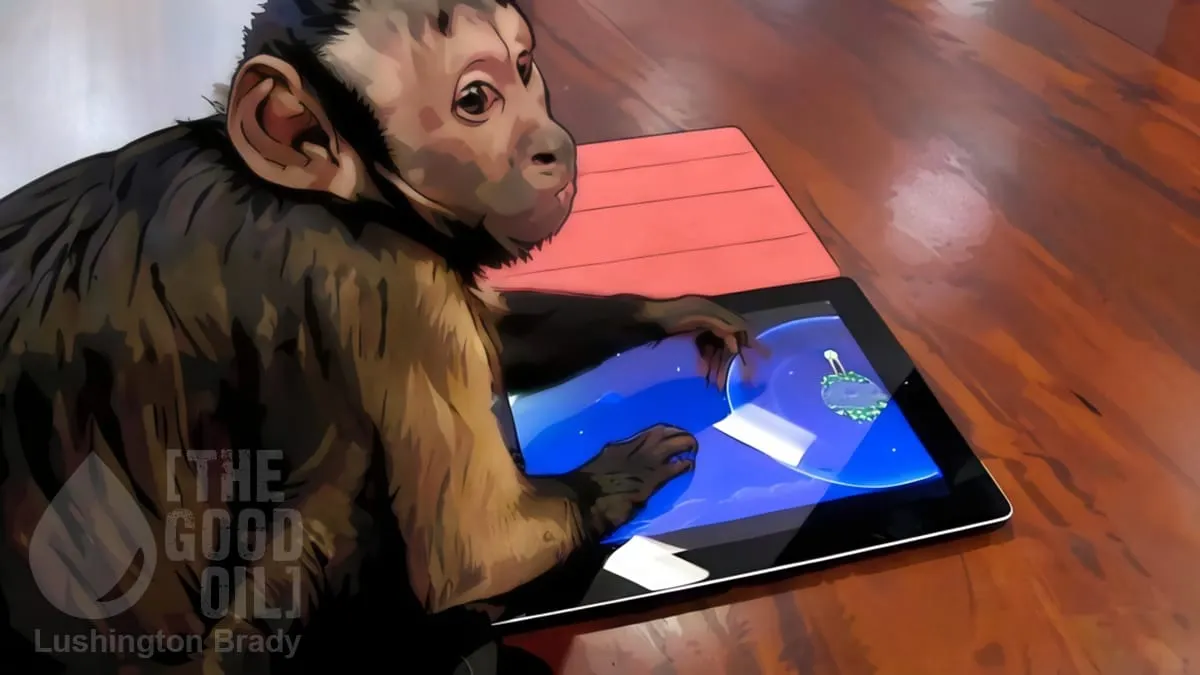
Because even a monkey can be trained to press a button and get a reward. That doesn’t mean it has the foggiest idea of mechanics or electronics.
“Just because you have a tool, it doesn’t mean you know how to use it; it certainly doesn’t mean you know how to maximise its use. That also includes not understanding the risk factors,” Mr Gniel said.
An example I’ve used many times is the engineer of the steamboat Nellie, in Joseph Conrad’s Heart of Darkness.
He was useful because he had been instructed; and what he knew was this – that should the water in that transparent thing disappear, the evil spirit inside the boiler would get angry through the greatness of his thirst, and take a terrible vengeance. So he sweated and fired up and watched the glass fearfully (with an impromptu charm, made of rags, tied to his arm, and a piece of polished bone, as big as a watch, stuck flatways through his lower lip).
The technologically illiterate youngsters of the TikTok generation are no better. They can work an app, but how it works is as mysterious as the ways of voodoo gods.
In his short story, “All the Troubles of the World”, Isaac Asimov imagined an all-powerful computer, Multivac, which humans access via a small terminal embedded behind their ear. ‘Schooling’ consists of learning to ask Multivac questions and following its subsequent instructions. The story ends badly for the computer, which becomes so overwhelmed by human demands that it essentially wants to die.
Like many SF ‘future predictors’, Asimov got it kinda-sorta right.
Kids are already offloading their brains to AI. One in four year-10 students use it frequently for schoolwork; more than 60 per cent of year 10s and nearly a third of year sixes use it to generate written content at least once a month.
Education Minister Jason Clare, generally one of the better performers of the Albanese cabinet (a low enough bar, to be sure), can’t make head or tail of it all.
“These results have been trending down for two decades. At the same time, more and more children have had access to digital technology and devices,” Mr Clare said.
“It begs the question: what is going on here?”
What’s going on here is the entirely predictable result of decades of progressive education fads. More devices, more screens, more ‘self-esteem’ and less actual teaching of fundamentals. Blaise Joseph, a former teacher and current director of education at the Centre for Independent Studies (CIS), at least gets it it: ICT skills are built on foundational literacy and numeracy. If kids can’t read or think, they can’t use technology properly either. AI has already made some of the tested tasks redundant, but the basics haven’t changed.
Professor Therese Keane, a former ICT teacher at La Trobe University, put it even more bluntly.
She said that despite being digital natives, many high school students had “perfunctory” and “superficial” knowledge of technology.
Professor Keane, a former ICT high school teacher, said a lack of highly skilled specialist computing teachers was hurting student achievement.
“You can give a student a computer, but if they don’t know much more than just the basics, they’re not going to move past that,” she said.
“In many classrooms, for example, laptops are just note-taking devices. iPads are just content consumption tools for looking at the internet.”
The education blob’s solution? More funding, more ‘digital literacy’ programmes and more AI integration: self-reinforcing feedback loop of digital dumbassity. The one thing they refuse to do is return to teaching reading, writing, maths and critical thinking properly. Is it because they can’t teach what they don’t know themselves? Mind you, that would require admitting the entire ‘education revolution’ was an expensive, decade-long fraud and that the whole system is screwed.
Another Rudd-Gillard legacy delivering exactly as we’ve come to expect.