Table of Contents
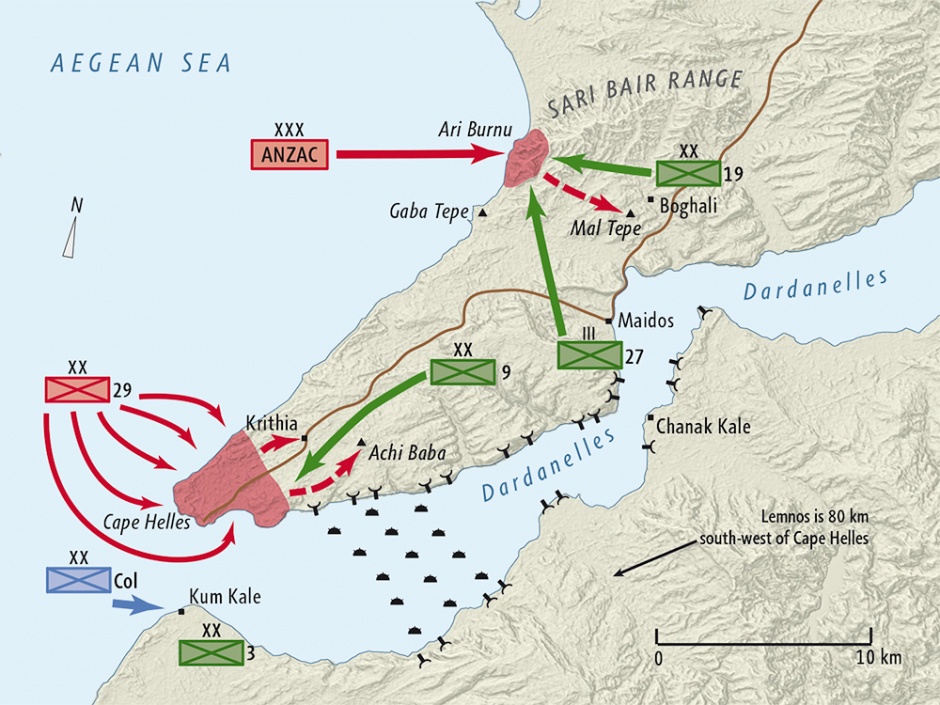
[…] In 1915, the Allies launched a plan to force the Dardanelles Strait, attack the Ottoman capital of Constantinople (Istanbul), and knock the Ottoman Empire out of the war. Initial attempts by British and French warships to clear the underwater mines and coastal batteries (shown as gun symbols on both sides of the straits) protecting the straits failed.
Rather than concede defeat, the Allies despatched the Mediterranean Expeditionary Force (MEF) to capture the Gallipoli Peninsula and destroy the Ottoman defences holding up the naval operation. On 25 April, the British 29th Division landed at five beaches on the southern tip of the peninsula (shown by the five red arrows around Cape Helles) and tried to capture the heights of Achi Baba (shown by a broken red arrow).
[…] In 1915, the Allies launched a plan to force the Dardanelles Strait, attack the Ottoman capital of Constantinople (Istanbul), and knock the Ottoman Empire out of the war. Initial attempts by British and French warships to clear the underwater mines and coastal batteries (shown as gun symbols on both sides of the straits) protecting the straits failed.
Rather than concede defeat, the Allies despatched the Mediterranean Expeditionary Force (MEF) to capture the Gallipoli Peninsula and destroy the Ottoman defences holding up the naval operation. On 25 April, the British 29th Division landed at five beaches on the southern tip of the peninsula (shown by the five red arrows around Cape Helles) and tried to capture the heights of Achi Baba (shown by a broken red arrow).
At the same time, a French colonial division launched a diversionary attack at Kum Kale on the Asiatic side of the straits (shown by blue arrow).
The Australian and New Zealand Army Corps (ANZAC) made a separate landing around 20 km to the north at Ari Burnu (later known as Anzac Cove). Their job was to secure the Sari Bair Range, culminating in the capture of Mal Tepe (shown by a broken red arrow), a hill overlooking the main north-south road along the peninsula (shown as a brown line on the map).
Defending Gallipoli and the Asiatic side of the straits were units from the Ottoman Fifth Army (shown as the green boxes on the map).
By 28 April, the two sides had fought themselves to a standstill. While the British and Anzacs had managed to establish beachheads at Cape Helles and Ari Burnu (indicated by the shaded red regions), they had not achieved their other objectives. The Ottoman defenders had been unable to push the invaders back into the sea. It was a stalemate.
nzhistory.govt.nz