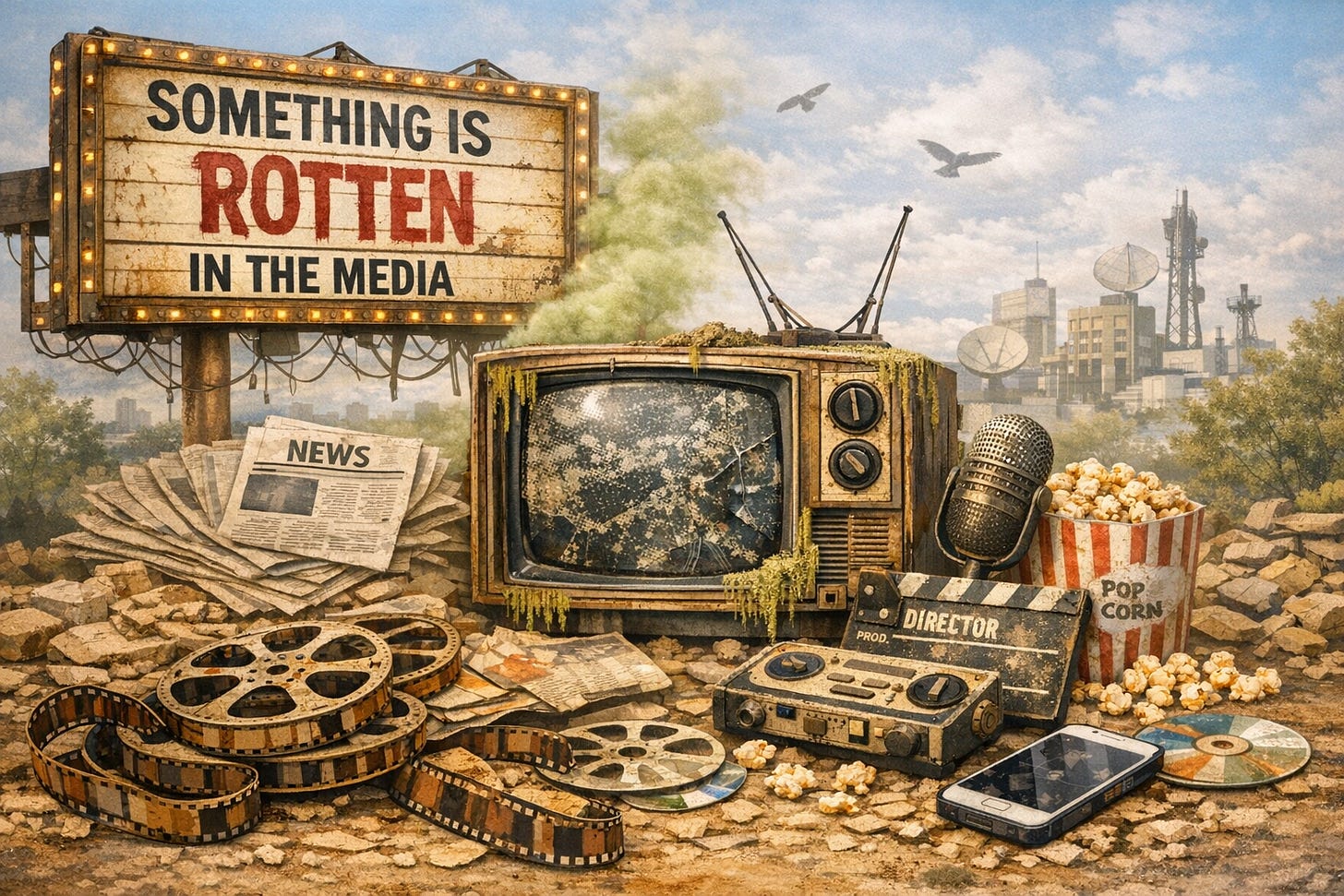
To badly quote Marcellus from Shakespeare’s Hamlet (Act 1, Scene 4) – there is something rotten with the state of our mainstream media and its wider ecosystem.
Whether it is the behaviour of some reporters, the increasing use of lawyers by the media, or the actions of the Broadcasting Standards Authority (BSA) – the Fourth Estate is like the proverbial leviathan, eating itself.
Recent Substacks by Ani O’Brien have set the proverbial ‘cat amongst the pigeons’ and raised questions of journalistic favouritism after reporters chose not to report the conduct of a colleague.
Concerning a late evening drinks party in the Minister of Finance’s office, TVNZ political editor, Maiki Sherman, is accused of a homophobic slur directed at Stuff reporter, Lloyd Burr. As with any situation, there are various accounts including a suggestion of inappropriate comments by Burr, although this has been strenuously denied by him.
Regardless of who said what or not, the initial question is whether this happening was newsworthy. Audrey Young from the NZ Herald writes nobly of her principle that, “I [Audrey] take what may be an old-fashioned view on such matters – that a private argument in a private setting is not news, whether it involves a journalist, a politician or both.”
I cannot help thinking however, had this being a member of parliament, it would have been immediate front-page news. As Bob McCoskrie has written, you also had the example of sportsman Israel Folau being harassed (abused) by media for a social media post on his personal account, notably not uttering any derogatory slur as happened at the aforementioned party.
We are ultimately dealing with a double standard, a lack of accountability, and likely a desire to sweep a story under the carpet because the story was ‘in house’. Journalists are not MPs, but they have made themselves public figures and that comes with consequences.
Simultaneously, we also have the situation where some of the parliamentary press gallery were aggressively pursuing National Party Whip, Stuart Smith, during the latest round of leadership coup rumours. They chased the whip through corridors the media are not meant to be present in, and then aggressively bashed on his door demanding an interview. Once again, Maiki Sherman from TVNZ is implicated and has just been handed down a five day suspension by the speaker (I might add, the speaker’s response has been weak and, whether intentional, has enabled Maiki Sherman and TVNZ to avoid scrutiny at the very time they should be scrutinised).
This behaviour is, sadly, not unusual and something I have witnessed several times. I recall one instance where a MP whose office neighboured mine, was literally been chased through the parliament due to something they had done. Some reporters even pushed through the doors into our private corridor (again, media are not meant to be there), and trying to get into said MP’s office. Eventually we had parliamentary security posted to the doors. There are other incidents too.
While not justifying these behaviours (as I don’t think it is appropriate), I think I understand why it arises. It’s all about getting the story. A scoop even better. Media is competitive and, as an overall industry, struggling with everything from trust to finances. We often have younger reporters who are more ‘enthusiastic’, shall we say. There is also a story-frenzy that develops and, when there is ‘blood in the water’, things turn ferocious. It’s somewhat analogous to what I wrote last week about MPs who “indulge in self-fulfilling prophecies by ruminating over the very things that will lead to the very trouble they should be avoiding”. Put another way, the environment of parliament often leads to problematic behaviours and outcomes.
To a lesser degree, I experienced this feral and ferocious dynamic myself, around my very transparent pro-life views. I have always found the situation somewhat bemusing with the media getting rather intense – constantly calling my phone, staking out my offices, and more – over a matter of principle and opinion, and one that was always public and hardly a secret.
We then have the extraordinary exposure of the legal threats going on by media and within media. TVNZ legally threatened Newstalk ZB if they reported the story around Sherman and Burr. When Ani O’Brien wrote her Substack, Stuff threatened her with two legal letters (so far). The irony must have clearly been lost on the Stuff team, threatening a commentator for a story they themselves have utilised.
The Fourth Estate, meant to ‘speak truth to power’, is attempting to use the law to stop speech. Instead of more journalistic reporting to uncover the truth and point out errors, media outlets are misusing power to silence stories.
I’m also aware the extraordinary lengths many journalists need to go through to publish stories, with lawyers pouring over what is written. Important stories, often around matters of national security, are being vetted or vetoed by the lawyers. This is not to suggest journalists should be complacent around the legal implications of what they publish, but there is a worrying degree of silence being imposed on an industry that should be fearless in its writing and speaking.
Finally, we have running alongside all of this, the ongoing behaviour of the Broadcasting Standards Authority (BSA). They are acting similarly with double standards and seeking to limit opinions.
It remains remarkable that the BSA continues to pursue Sean Plunket and the Platform over a ‘nothing’ of a comment on his show. The BSA is effectively acting as an enabler to the vexatious, turning its processes into a punishment. We have other complaints pointing to the enormous bias in some broadcasts, yet these are dismissed. ‘Standards’ appear to be rather arbitrary at the BSA and a bit like the situations above, only to be applied when it suits their ideology or agenda. As I have said before, it is time to scrap the BSA.
We need a strong functioning Fourth Estate. It is essential to our democracy and institutions. While much focus is often on the external challenges to traditional media, it would seem the internal rot is as much, if not more, to blame for the decline.
This article was originally published by On Point.