Table of Contents
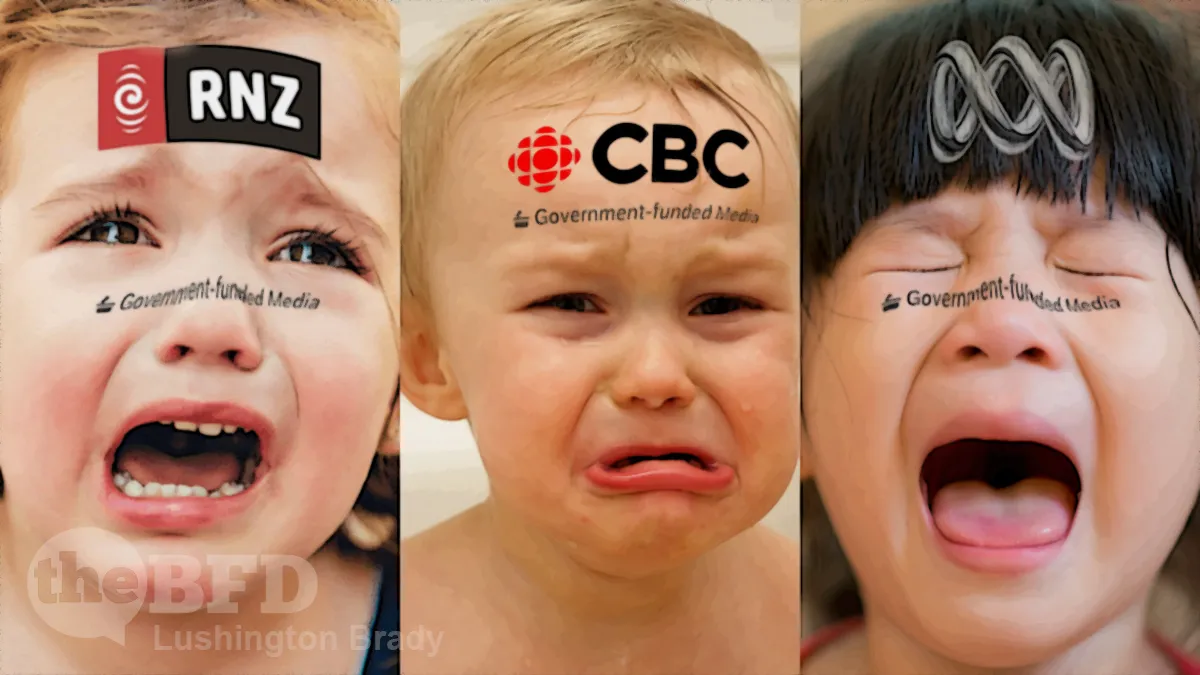
There was a collective tanty from government-funded media across the world yesterday, as they had a good old sook over being labelled, well, government-funded media.
As part of his bid to increase transparency on Twitter — which includes removing millions of “bot” accounts — Elon Musk has rolled out a new labelling system for media:
RNZ and Australia’s ABC both had a right old whinge about being accurately badged as government-funded. CBC in Canada suspended their Twitter activity, while NPR in the US straight-up quit in a huff.
The thing is: they are government-funded. At least partly, in the case of NPR, wholly, for the rest. So, why are they having such a hissy-fit?
Twitter users might have noticed something different about the RNZ account in the last 24 hours.
The social media platform has decided to add the label ‘government-funded media’, which sits both in the page’s bio and above every tweet it makes.
RNZ is funded by the government through New Zealand On Air, which injects $48 million annually.
RNZ
The label, according to Twitter, is meant to provide additional context for accounts heavily engaged in geopolitics and diplomacy.
“We’re liaising with Twitter regarding changes to account verification and labels,” an ABC spokesperson said.
What’s got the government-funded media in such a tizz is the implication — which, in fact, many New Zealanders specifically noted, in the latest Trust In Media survey — that government funding creates some form of government control.
The platform defines government-funded media as outlets where the government provides some or all of the outlet’s funding. It also states that it may have varying degrees of government involvement over editorial content.
ABC Australia
Note that: may. It doesn’t say “does”. But even the suggestion that the government may have involvement over editorial content is enough to get the government-funded media flouncing onto their high horses. How dare you! as their beloved doom goblin might say.
RNZ’s head of content Megan Whelan said the second part of that criteria is not the case for the public broadcaster.
“Our legislation specifically says the government may not have control over editorial matters. We are independent public media here to serve the public interest,” Whelan said.
RNZ
But are they, really? As journalist and lawyer Paul Chadwick once noted, no matter how much or how sincerely a government pretends to keep at arm’s length, “politicians of all complexions are drawn irresistibly… to manipulate, to intimidate and to suppress. All roads from a so-called independent statutory tribunal lead back through a parliament to a cabinet room.”
Lest anyone doubt the verity of Chadwick’s observation, consider only the endless bunfighting and whinging from the opposite of the aisle, every time the government of the day appoints new board members, managers, and so on, to the ABC, RNZ, or the CBC.
But RNZ’s high dudgeon act is even further undercut by the fact that it has received at least around $5 million in funding from the “Public Interest Journalism Fund” — funding which very much comes with editorial strings attached.
The standard funding agreement to access the PIJF contains a section titled “New Zealand Identity and Culture and Public Interest requirements” […] It then asks journalists to ensure, among other matters, that content “actively promotes the principles of Partnership, Participation and Active Protection under Te Tiriti o Waitangi (Treaty of Waitangi) acknowledging Maori as a Te Tiriti partner.”
This might sound innocent enough, but anyone who’s paid the least attention to how the co-governance agenda has played out in New Zealand knows that “Te Tiriti” permeates nearly every area of public policy.
Whether it is health, education, water infrastructure, monetary policy, the management of the public service or policing, there are practically no areas left which do not have a Treaty component added to them.
The Australian
Because the PIJF funding agreement is between the government and media companies, that means that all journalists working for RNZ are bound by the contractual requirement to “actively promote” government policy in nearly every area imaginable.
The government-funded media can cry and stamp their feet as much as they like, but they can’t piss on our legs and tell us it’s raining, and get away with it any more.
Update:
Elon Musk has addressed CBC’s concerns.
![[The Good Oil] Stuff Up of the Day](/content/images/size/w1304/format/webp/2024/09/Stuff-up-image-1.webp)