Robin Vale
FSB
I didn’t expect Ed Sheeran to become a useful symbol of resistance to political conformity. Yet here we are.
Apparently writing songs, selling millions of records and filling stadiums is no longer sufficient. If you’re famous enough, there’s now another clause buried somewhere in the contract: when the political cause of the moment arrives, you must say something. Actually, scratch that. You must say the ‘right’ thing.
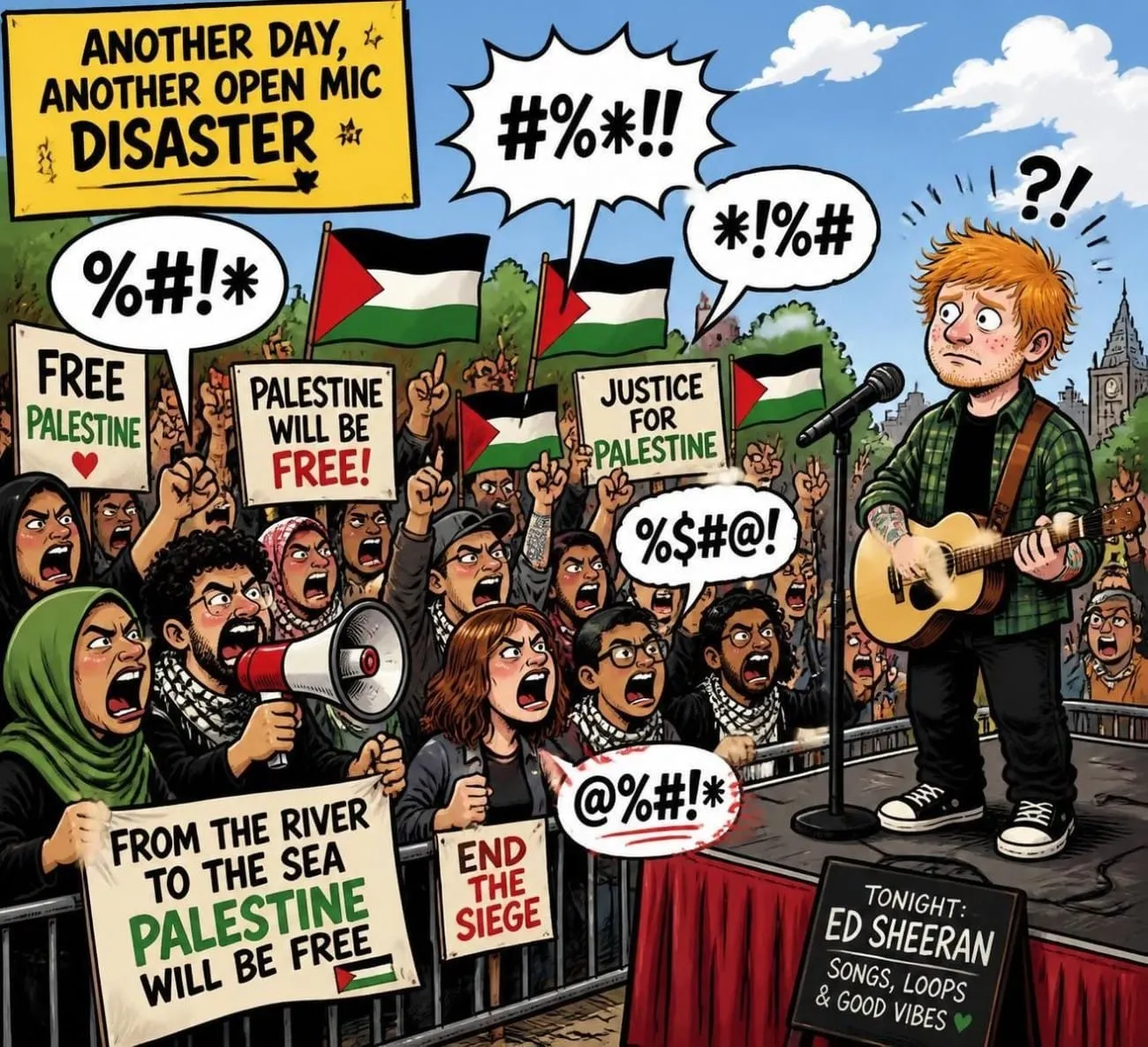
Sheeran discovered this after Macklemore used a support slot on his Loop tour to speak in support of Palestine. Subsequent venues objected to Macklemore appearing, he was removed from the tour, and other supporting artists walked out in solidarity. Sheeran says the promoter ultimately made the decision and that he had tried to resolve the dispute.
Then the left’s self-appointed moral tribunal convened. Charlotte Church accused Sheeran of choosing “consumerism and capitalism” over doing the “right” thing. Sheeran subsequently spoke publicly about Gaza, describing Israel’s treatment of Gazans as catastrophic, unjustifiable and disproportionate. And there, buried beneath all the noise, is the part I find fascinating: “Doing the right thing.”
Whose right thing exactly?
Apparently, we no longer need historians, diplomats, intelligence analysts or scholars of the Middle East. The correct interpretation of one of humanity’s most bitter and complicated conflicts has already been established by the celebrity activist class. How convenient. Because let’s be honest about what ‘use your platform’” increasingly means. It doesn’t mean “think carefully, study the evidence and tell us what you conclude”.
Imagine Sheeran had used his enormous platform to deliver a passionate defence of Israel. Not an uncritical defence of every decision made by the Israeli government, but a defence of a country whose civilians have endured decades of suicide bombings, indiscriminate rocket attacks, hostage-taking and terrorism, culminating in the Hamas-led attacks of 7 October 2023, when around 1,200 people were killed and roughly 250 were abducted into Gaza, including women, children and elderly people.
Imagine he’d reminded his audience of buses and shopping centres blown apart during the suicide-bombing campaigns of the 1990s and 2000s, or of the thousands of rockets fired at Israeli towns over the years. Imagine he’d said that whatever anyone thinks of Benjamin Netanyahu or Israel’s conduct in Gaza, Israelis too have spent years burying victims of terrorism and living with the knowledge that civilians have deliberately been targeted.
Would the left currently demanding that musicians ‘use their platform’ have applauded Sheeran for courageously speaking his mind? Would they continue to demand that musicians speak out, and then congratulated him for courageously using his voice?
Come off it. He’d have been metaphorically burned at the stake before the encore.
So the demand isn’t really ‘speak’. It's ‘repeat’ what the left thinks, or thou shalt be cancelled.
Repeat the ‘correct’ slogans. Display the ‘correct’ outrage. Prove publicly that you’ve absorbed the ‘approved’ moral vocabulary. ‘Approved’ by the left of course. And whatever you do, don’t shrug your shoulders and say, ‘I’m a singer. I’d rather not.’
That, apparently, is suspicious too.
Which makes me wonder whether parts of leftist modern activism have stopped being political movements and started resembling religious sects. Sometimes it feels less like politics and more like a belief system. There are approved opinions, approved phrases and approved enemies. Question the orthodoxy and you’re treated as suspect. Apologise and you’re expected to perform the familiar ritual: ‘I listened, I learned, I’ll do better.’ Step too far outside the accepted line and the punishment can be very real including (but not limited to) public shaming, boycotts, pressure on employers and social exclusion. Yes, that’s right, the left will literally exclude childhood friends if their opinions differ from their own.
And there is an extraordinarily enthusiastic congregation on social media waiting to decide whether your opinions sufficiently match their own and, if they don’t, whether you deserve to be boycotted, shamed, ostracised or simply cancelled altogether.
At times, it feels less like politics and more like a secular religion.
And the particularly uncomfortable question is where the “political certainties” of the left actually come from. Millions of Westerners now consume war through social-media feeds deliberately engineered to maximise engagement. Horrifying image. Angry commentary. Crying child. Political slogan. Influencer explanation. Swipe. Repeat.
Within weeks, somebody who couldn’t previously distinguish Gaza from the West Bank is now explaining a century of Middle Eastern history with the serene confidence of a university professor, usually arriving, remarkably enough, at the same conclusion: Israel cast as the villain, the Palestinian cause treated as morally untouchable, and anyone questioning that framing viewed with immediate suspicion.
Then comes the inevitable instruction: ‘Educate yourself.’
I adore that one.
Nothing screams intellectual sophistication quite like being ordered to educate yourself by somebody whose foreign-policy education may have been delivered vertically, in 60-second instalments, between skincare videos on TikTok.
And this is where another deeply uncomfortable question deserves asking.
Has part of the Western activist left become an unwitting amplifier for Islamist propaganda? And before the usual ritual begins, no, this isn’t an argument that every pro-Palestinian activist is a Hamas sympathiser, or that every criticism of Israel is antisemitic. That would be intellectually lazy.
The more uncomfortable question is whether people can sincerely believe they’re campaigning for justice while simultaneously repeating narratives that Islamist organisations have every strategic interest in spreading? Propaganda would be remarkably useless if only committed extremists repeated it. Its real power begins when ordinary, seemingly well-meaning people absorb the framing, strip away the source, package it as morality and distribute it to millions of others, all while remaining completely convinced that the conclusion was entirely their own.
It means Hamas is simultaneously an Islamist militant organisation, a political actor and an information actor. Researchers have documented its deliberate use of propaganda to legitimise itself, portray Israel as an oppressive enemy and encourage audiences abroad to support its narrative. Of course it does. Only a fool would fight a modern war without fighting an information war too.
The more interesting question is whether everyone amplifying those narratives understands where they originated, what has been omitted and whose strategic interests they may serve. Propaganda in 2026 doesn’t require somebody from Hamas headquarters telephoning Charlotte Church with this week’s talking points.
That would be ridiculous.
Modern propaganda works much more elegantly. A narrative enters an information ecosystem. Activists distribute it. Influencers compress it. Algorithms discover that it generates rage and engagement. Celebrities encounter it through people they already trust. Audiences demand public declarations.
And eventually it lands on an audience primed to accept it, an audience eager to signal its virtue, reluctant to question the approved narrative, and sometimes so intellectually lazy (a polite way of saying ‘dumb’) that sharing the slogan becomes a substitute for actually understanding the argument. The slogan itself becomes fashionable: a kind of moral accessory, a quick way of saying, ‘Look at me, I’m one of the good guys,’ without having to grapple with the history, the contradictions or the uncomfortable facts underneath it.
In that environment, displaying the ‘correct’ opinion can matter more than actually knowing what the hell you’re talking about. And that may be the most powerful propaganda imaginable, because once a political position becomes a badge of personal goodness, people stop interrogating the message and start protecting the identity they’ve built around believing it.
The world is complicated. Israel can commit actions worthy of fierce condemnation while Hamas remains an extremist organisation responsible for atrocities. Palestinian civilians can suffer catastrophically without every political claim made in their name automatically becoming true.
Adults should be capable of holding those things in their heads at the same time. Social media apparently considers that an unreasonable workload. It prefers oppressor and oppressed, villain and victim, coloniser and resistance.
Choose your character, press start. History solved.
And celebrities are exceptionally useful in that environment because nobody actually needs Ed Sheeran’s expertise. Nobody is waiting for his analysis of the Oslo Accords.
They want his ‘reach’. Get the singer. Get the actor. Get the footballer. Get the influencer. Get enough famous people repeating the same political vocabulary and eventually an opinion stops feeling like an opinion. It becomes morality. A badge.
Then something ugly happens: disagreement becomes wickedness, uncertainty becomes cowardice, silence becomes complicity and neutrality becomes something for which you must publicly apologise.
That is why Sheeran’s original instinct, essentially, ‘I’d like my concerts to bring people together rather than become political rallies’ was so interesting. Perhaps it wasn’t cowardice. Perhaps it was humility. Imagine that: a celebrity recognising that possessing 50 million followers doesn’t automatically make him Henry Kissinger.
Even if I think much of what Macklemore and others are saying has been shaped by Islamist propaganda, social-media groupthink, a fair bit of gullibility, and a hefty dose of virtue-signalling, he should still be allowed to say it. That, after all, is the test.
If you ONLY defend speech when you agree with it, you don’t really believe in free speech. You believe in ideological comfort.
So if venue owners pressured organisers to remove Macklemore because of what he said, that raises its own free-expression problem. I can think his politics are misguided, his framing simplistic and his activism deeply influenced by propaganda and virtue signalling and still defend his right to stand on a stage and say it. Otherwise I’m no better than the people I’m criticising.
Let Macklemore speak. Let Charlotte Church speak. And, just as importantly, let Sheeran NOT speak. Because the freedom to express an opinion also has to include the freedom to refuse to perform one on demand. Freedom that only protects the approved opinion isn’t freedom. It’s a dress code.
What worries me most about this saga isn’t Palestine, Israel, Macklemore or Ed Sheeran, it’s the increasingly widespread belief that declining to participate in the left’s political crusade isn’t just suspicious but it can be enough to trigger the familiar machinery of cancellation: public shaming, boycotts, pressure on employers, lost opportunities and demands that you either fall into line or pay the price.
That’s not merely creepy: it’s coercive, it’s ideological intimidation, an attempt to enforce political conformity through fear of punishment, the sort of pressure that should worry anyone who claims to care about free expression because it shows exactly how conformity can be imposed without ever passing a single law.
Because once society accepts that principle, every cause merely has to declare itself urgent enough, moral enough or emotionally devastating enough to demand your allegiance. Climate change, war, race, gender, immigration, Palestine, whatever comes next. The mechanism is the same. First comes the claim that silence is unacceptable. Then comes the expectation that you speak. Then comes the demand that you speak ‘correctly’. And before long, neutrality itself is treated as a moral failing and refusal to join in becomes evidence that there is something wrong with you.
And suddenly we're not asking celebrities to have opinions. We're administering loyalty tests. So perhaps the most rebellious political statement Ed Sheeran could ever make isn’t ‘Free Palestine’ or ‘Stand With Israel’, it’s simply: ‘You don’t get to decide what I must believe, what I must say, or when I must say it.’
Frankly, more people could do with trying it.
This article was originally published by the Free Speech Backlash.