Summarised by Centrist
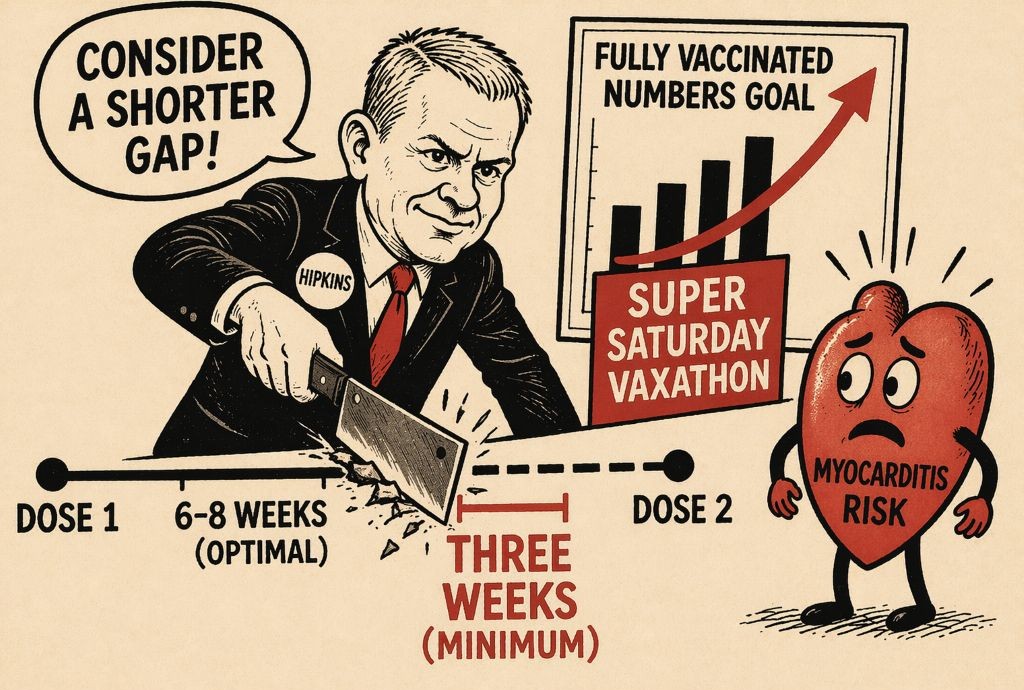
Commentator Ani O’Brien argues Chris Hipkins had enough warning about myocarditis risk in young people, but pressed on because vaccination targets and the “Super Saturday Vaxathon” came first.
On October 6, 2021, he told people to “consider a shorter gap” and admitted why: “we also need all those people to be fully vaccinated with two doses as soon as possible.”
O’Brien writes that New Zealand had earlier moved to a six-week standard interval. The Ministry had also described a “six to eight-week gap” as the “optimal schedule.” But when the pressure came on to lift the fully vaccinated tally, the government swung back to the three-week minimum. That shift lined up neatly with the push for Super Saturday and the race to hit vaccination targets.
The Ministry’s own documents, as quoted by O’Brien, say Super Saturday was timed with “the objective to drive first dose uptake while there was still time for people to receive their second dose and be ‘fully vaccinated’ before the summer holidays.”
O’Brien cites later CV TAG advice, referenced in a March 2022 Cabinet paper in Hipkins’ name, warning that a two-dose schedule given in the shortest timeframe “may add an unnecessary risk of myocarditis” in under-18s. It also said young people should not be pressured to get both doses quickly, and that their low Covid risk did not justify a two-dose mandate.
Hipkins claimed he “always left the advice on vaccine safety” to health officials. But O’Brien notes he still told the public the Pfizer shot was “very safe” and “absolutely the best course of action”.