Table of Contents
Ani O’Brien
Like good faith disagreements and principled people. Dislike disingenuousness and Foucault. Care especially about women’s rights, justice, and democracy.
Chris Hipkins’ caucus-retreat speech was intended to signal renewal, momentum, and hope. Instead it revealed a Labour Party still unwilling to take responsibility for the impact of its time in government and one willing to engage in historical revisionism. Hipkins’ speech was not a forward-looking address about what Labour would do differently. It was an exercise in proportioning blame, deflection, and narrative laundering.
Luxon’s State of the Nation speech deliberately avoided mentioning Labour at all. It was not widely regarded to be a particularly impactful speech, but it was focused on the future, on the government’s programme, and on where New Zealand is heading. Hipkins went the other way entirely with a speech in full attack mode.
Hipkins claimed New Zealanders are “looking for hope” and are instead being fed “negativity” and “doom and gloom” by the current government. That argument felt clunky given the prime minister had just delivered a positive (if boring) speech the day before while Hipkins’ speech was almost entirely devoted to attacking political opponents. His attempt to position himself and his party as the hope of New Zealand ignores the fact that Labour spent six years promising transformation, delivered disorder, and then spent the next two years insisting none of it was their fault.
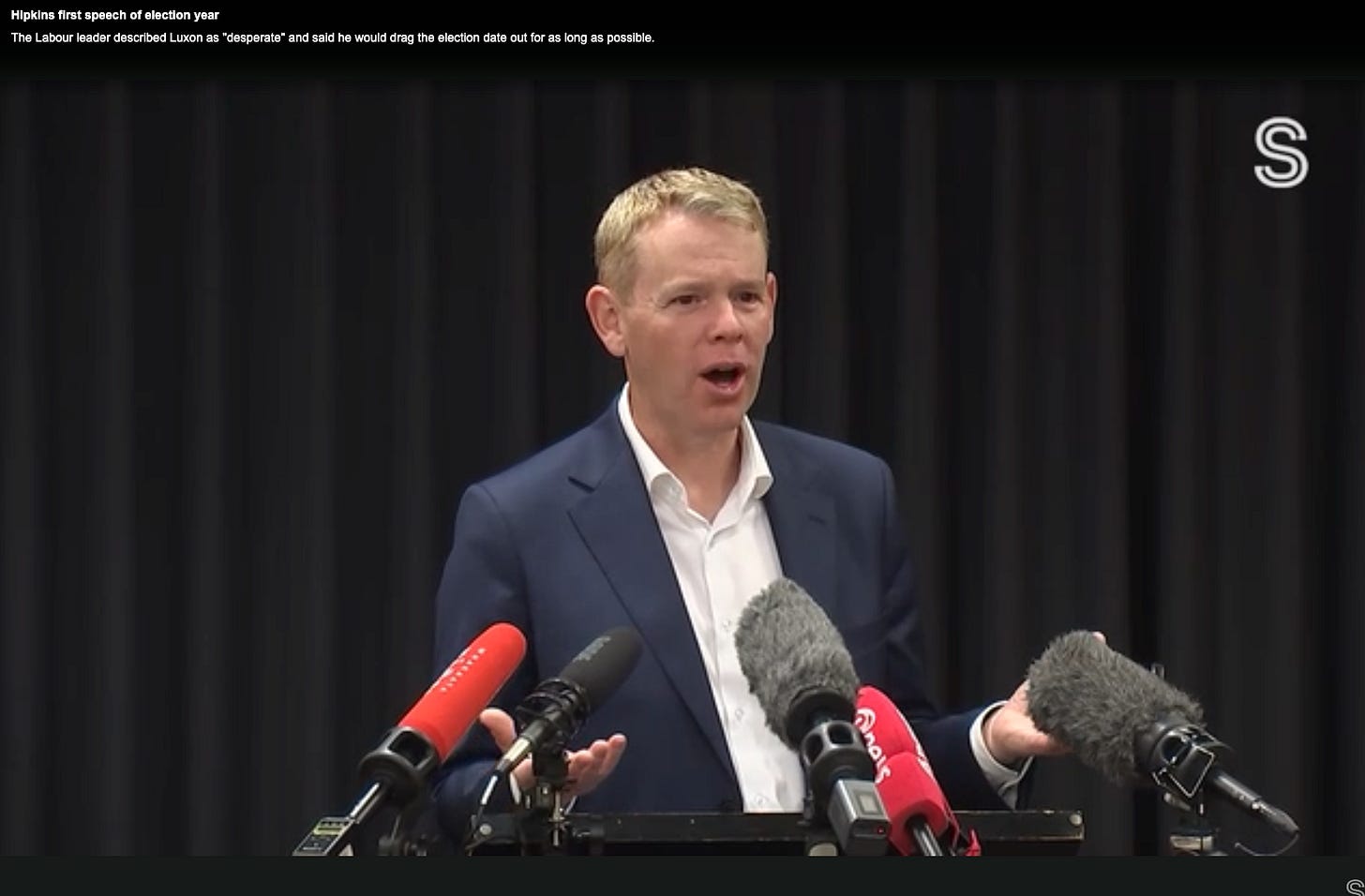
This is particularly obvious in Hipkins’ rhetoric on migration. He implored that we need to “give young New Zealanders a reason to stay” and warned that people are “looking for opportunity elsewhere”. This is extraordinary coming from the leader of the government under which net migration surged, youth outflows accelerated, and skilled workers left in droves. Those departures coincided with record housing unaffordability, collapsing productivity, and a cost of living crisis driven not just by global shocks but by Labour’s domestic policy choices. Labour cannot credibly cast itself as the party that kept talent at home when its own decisions made it harder to build, invest, hire, or get ahead.
More damning still is the fact that as prime minister, Hipkins personally helped make it easier for New Zealanders to move to Australia. He stood alongside Anthony Albanese and proudly announced changes that removed barriers for Kiwis to live, work, and access pathways to citizenship in Australia. It was sold as a diplomatic win, and in a narrow sense it was. The omission is politically convenient, but it materially weakens the credibility of his claim. If today’s exodus is an “absolute indictment”, Hipkins needs to explain why he chose to reduce the barriers to leaving for Australia instead of fixing the conditions that made leaving attractive in the first place.
The most dishonest section of the speech was Hipkins’ attempt to pin the structural deficit on the current government. He claimed it was “created” by National, that Nicola Willis did not inherit it, and that Labour had New Zealand on a clear pathway back to surplus. This is simply false. When the government changed, inflation was still well above target, operating deficits were locked into the forward years, debt was structurally elevated, and spending commitments vastly exceeded sustainable revenue. Labour’s so-called pathway to surplus relied on heroic assumptions and growth forecasts that collapsed on contact with reality. To claim that a few months of fiscal restraint caused years of accumulated deficit is not just economically incorrect – it requires a wholesale misrepresentation of the fiscal record. This is the point at which political framing crosses into outright dishonesty. To date, these claims remain largely unchallenged in mainstream coverage.
Hipkins characterises the government’s response to the state of the books as “slash and burn”. In truth, ending wasteful spending probably does feel harsh if your political identity is built on spending announcements. But restoring fiscal credibility is not doom and gloom. It is one of the very minimum requirements of governing.
From 2017 to 2023, Labour presided over the largest expansion of public spending in modern New Zealand history, a massive growth in the size of the public service, zero productivity growth, collapsing business confidence, and inflation that peaked above seven per cent by the time the government changed. It was credit-card governance, turbo-charged by Labour’s Finance Minister Grant Robertson, whose budgets treated borrowing as a substitute for discipline.
If Hipkins and his speech writers had not decided to take the path of rewriting history, we might not need to relitigate the poor decisions of 2017–2023 so much. But since they have put the blame game on the table, it is imperative that New Zealanders get an accurate picture.
Hipkins is relying on familiar villains in landlords and tobacco companies to cast shadowy aspersions on the ethics of the government. On housing, his rhetoric is disconnected from current market data. It is thanks, in part, to the changes around interest deductibility (which Hipkins calls tax breaks for landlords) and a cooling market that rents have actually gone down in many parts of the country.
On tobacco, the anger is just as cynical. Smoking rates are still falling. The real dispute is that the government has chosen a different approach to reducing harm and one that does not allow public policy to be dictated by a small group of Otago academics with significant institutional and career incentives tied to a single model. Labour’s fury is about losing control of the policy levers, not about failed outcomes.
The big bold solutions proposed by the man presenting himself as our alternative focused on the few policy announcements he made toward the end of 2025. These included the three GP visits he insists on calling “free” when really our taxes would pay for them and which will drive our primary health sector into a crisis. And, of course, his ‘Claytons’ Capital Gains Tax that he hopes will appeal to the harder left voters who will not look at the detail without scaring the middle New Zealand vote.
Hipkins also clearly believes that job creation is the government’s job and this government is failing to do it. What the speech does not acknowledge is that every job the government “creates” must be paid for by taxpayers, indefinitely. The current government’s strategy of stimulating the private sector to create jobs means employment growth does not come with a permanent bill attached. Hipkins is not shy in demonstrating he is offering a more interventionist model. His vision is for bigger government, more state direction, and more public payrolls. It is the same approach that delivered brief sugar hits followed by an immense inflation-fuelled hangover last time they were in charge.
What the speech emphatically tells New Zealanders is that Chris Hipkins and Labour will not be taking the “kindness” approach to campaigning for the election. The gloves are off and Hipkins is kicking things off by placing narrative ahead of accuracy. His personal attacks on Luxon were pretty dated and will need updating as he once again dusted off the years-old, out of context quotes about “bottom feeders” and a “wet, whiny, miserable country”. Both quotes were spliced from comments delivered before the last election. If after two years in opposition Hipkins has nothing more than old out-of-context quotes he is in big trouble.
This was not a renewal speech. It was a calculated attempt at poisoning the narrative from the get-go so that National has to defend itself against lies as well as their own record. Hipkins is asking voters to forget six years of mismanagement, forgive a historic spending binge, and believe that the party responsible for the damage is somehow the solution. Hope is not rhetoric alone. It is built on credibility. And until Labour tells the truth about its own record, New Zealanders will view them with suspicion.
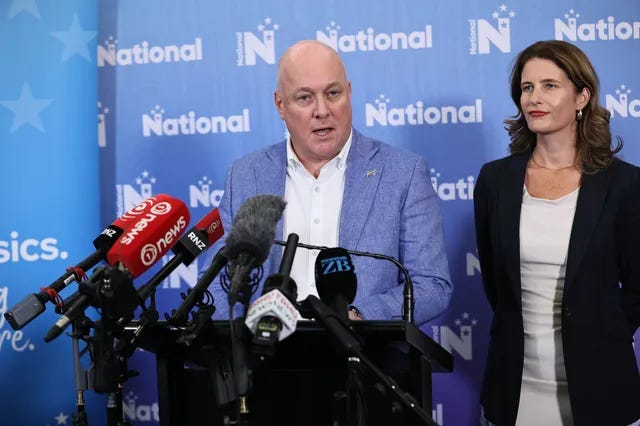
Christopher Luxon got another crack at his State of the Nation speech as he announced the election date. And this speech packed more of a punch than his last. The prime minister also used it as an opportunity to deliver a rebuttal to Hipkins’ attacks and the broader attempt to rewrite the last two years.
Luxon confirmed the election would be held on 7 November and framed the coming contest around the proposition that New Zealanders should stay the course. His message framed his party as disciplined, deliberate, and anchored in outcomes rather than grievance.
He directly challenged the economic dishonesty that underpinned Hipkins’ address, pointing out that, under his government, interest rates have been cut nine times – a material relief to households. He also highlighted markedly improved crime statistics and clear improvements in education performance, areas where his government has undoubtedly excelled.
The prime minister characterised his government as stable and strong in an increasingly volatile world, contrasting it with Labour’s appetite for constant intervention, spending escalation, and moral panics. His speech returned repeatedly to fundamentals of safer streets, world-class education, housing supply, infrastructure, and roads. Most notably, he renewed his promise that if you work hard and make good choices, you deserve to get ahead in New Zealand.
Unlike his understated State of the Nation speech, Luxon did not shy away from drawing a clear line between his government and Labour. He described Hipkins and the broader left bloc as a force that would “send New Zealand backwards”, arguing they remain fixated on punishment rather than progress. He characterised Labour as reflexively committed to taxing New Zealanders more and more in order to spend more and more, with little regard for productivity or long-term sustainability. And he explicitly tied Labour’s credibility problem to its own record, referring to the “ungodly mess” the country was left in when National took office.
In contrast to the negative politics of Hipkins’ speech, Luxon’s tone was overall optimistic. He described New Zealand as “the best country on planet Earth” and argued that global leaders envy its potential. The prime minister has struggled to connect with Kiwis as well as previous National leaders like John Key, but for all his corporate speak his belief in New Zealand’s future prospects feels genuine. He has confidence that the ground work laid in the first two years of this term will see progress in the third.
He emphasised that two years is not a very long time and his government has achieved a great deal in that time. They have just under a year to go until the election and he is promises we will see the fruits of their hard work coming through.
Taken together, the two speeches revealed the real shape of the coming election. Hipkins is running a campaign rooted in historical revisionism, recycled outrage, and an ever-expanding role for the state. Luxon is running on continuity, restraint, and the argument that New Zealand is finally turning a corner after years of mismanagement. One is asking voters to forget the past. The other is asking them not to risk repeating it.
This article was originally published by Thought Crimes.



![[The Good Oil] Stuff Up of the Day](/content/images/size/w1304/format/webp/2024/09/Stuff-up-image-1.webp)