Greg Bouwer
IINZ
There is something deeply rotten about the climate of hostility towards Jews and Israelis that has been allowed to develop in New Zealand.
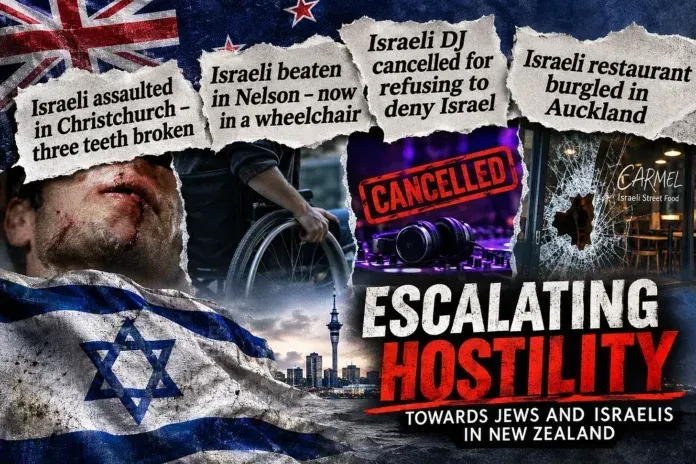
First, there was Yuval Shekel, an Israeli visitor assaulted in Christchurch after being questioned about his nationality and military service. Three of his teeth were broken. His attacker was subsequently sentenced to 28 months in prison.
Then came another disturbing report from Nelson, where an Israeli man was allegedly beaten so severely that he is now using a wheelchair. The full circumstances, including the attacker’s motive and the extent of the victim’s injuries, still need to be independently established.
And then there was DEKEL. An Israeli DJ invited to perform at a New Zealand music festival, only to be cancelled because he hadn’t publicly denounced Israel and continued to perform in his own country.
The organisers of Twisted Frequency admitted they had found nothing verified or substantial about his personal political beliefs.
Nothing. But his silence was enough. His continued willingness to play music in Israel was enough.
Apparently, being Israeli now comes with an obligation to recite the approved political catechism before you are permitted to entertain New Zealanders.
What extraordinary, sanctimonious nonsense.
Meanwhile, John Minto has been publishing photographs of Israeli visitors, accusing them of participation in genocide without presenting substantiating evidence, and encouraging members of the public to confront them.
Not report evidence of crimes to the police. Not submit allegations to competent authorities.
Confront them.
This is the same John Minto whose organisation established a hotline encouraging people to identify and report Israeli soldiers visiting New Zealand. The same campaign that prompted an explicit warning from Chief Human Rights Commissioner Stephen Rainbow about the danger of exposing Israelis and Jews to harm.
And yet the targeting continues.
Now comes news that Carmel, a much-loved Israeli street-food restaurant in Auckland, has been burgled. Someone smashed its window at approximately four in the morning and stole property.
Was this an antisemitic attack? We don’t know. The owners haven’t suggested it was, and there is no established evidence of a political motive. It may have been an entirely ordinary burglary.
But consider what we have reached when the first question many people ask after an Israeli restaurant is vandalised is whether it was targeted for being Israeli.
That suspicion does not establish motive. It does, however, tell us something about the atmosphere in which Jewish and Israeli New Zealanders are now living.
And that atmosphere has not materialised out of thin air.
It has been fed by the relentless demonisation of Israel, by the casual treatment of Israelis as collectively guilty, and by the increasingly fashionable idea that Jewish identity, Israeli nationality or an unwillingness to denounce one’s country somehow makes a person a legitimate target for exclusion and public hostility.
Criticise Israel’s government all you like. Protest its policies. Argue about Gaza, settlements, borders, international law and Palestinian statehood until you’re blue in the face.
That’s democracy.
But when an Israeli musician is excluded because he refuses to perform a political ritual, when identifiable Israeli travellers are publicly singled out for confrontation, and when an Israeli visitor is beaten after being questioned about his background, we are no longer talking merely about vigorous political debate.
We are talking about conduct that crosses, or threatens to cross, the line between political expression and personal intimidation.
And the distinction is not remotely complicated. An Israeli tourist is not the Israeli government. An Israeli DJ is not a government spokesman. An Israeli restaurant in Auckland is not an embassy. And a Jewish New Zealander is not personally responsible for a war thousands of kilometres away.
Why does this even need explaining?
What is particularly galling is the moral self-righteousness surrounding some of this behaviour.
People who claim to champion inclusion suddenly discover exceptions when the person seeking inclusion is Israeli.
People who preach tolerance demand ideological conformity.
People who profess concern about racism find elaborate justifications for treating individuals as representatives of an entire nationality.
And people who insist that words can cause harm seem remarkably relaxed about publishing photographs of identifiable strangers and inviting hostile confrontations.
Enough.
There is no requirement to agree with Israel’s government. There is no requirement to support Zionism. There is not even a requirement to like Israel.
There is, however, a requirement to obey the law, and a basic civic obligation to respect the safety and dignity of other people.
That includes Jews. That includes Israelis. That includes people whose political opinions you despise.
As for Carmel, the owners have responded to the burglary with admirable determination.
“WE’RE NOT GOING ANYWHERE.”
Good. They shouldn’t have to.
Neither should any Jewish family, Israeli traveller, musician, student or business owner feel obliged to retreat from public life because someone else has decided that their nationality or identity is politically unacceptable.
The police should investigate threats, assaults and criminal damage without fear or favour. Festival organisers should be prepared to defend their political exclusion tests. And public figures who encourage the targeting of identifiable individuals should be held accountable for their words.
Above all, New Zealanders need to reject the idea that the intensity of someone’s political convictions gives them special permission to intimidate other human beings.
You do not get to turn your hatred of a government into hostility towards an entire people. You do not get to demand that Israelis publicly repudiate their country before they are permitted to participate in ordinary life. And you do not get to disguise intimidation as human-rights activism simply by waving a Palestinian flag.
This country is supposed to be better than that. It is time we insisted on it.
This article was originally published by the Israel Institute of New Zealand.