Table of Contents
In brief
• Ian Wishart recalls working in Mike Moore’s office during the Rainbow Warrior fallout, when French trade pressure forced New Zealand to quietly abandon its hard public stance on justice.
• He argues that calls for a purely “principled” position on Iran overlook how economic, geopolitical realities and ‘Realpolitik’ often shape foreign policy decisions.
• The result, he says, is a recurring dilemma: moral rhetoric versus the practical need to protect New Zealand’s economy and strategic interests.
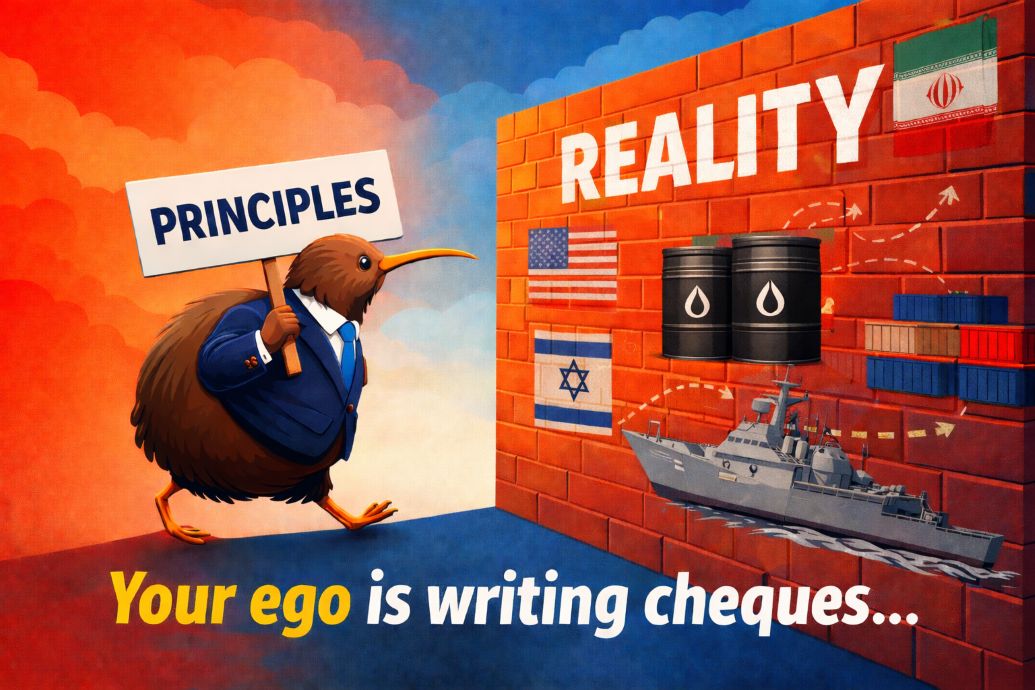
“Son, your ego is writing cheques your body can’t cash”.
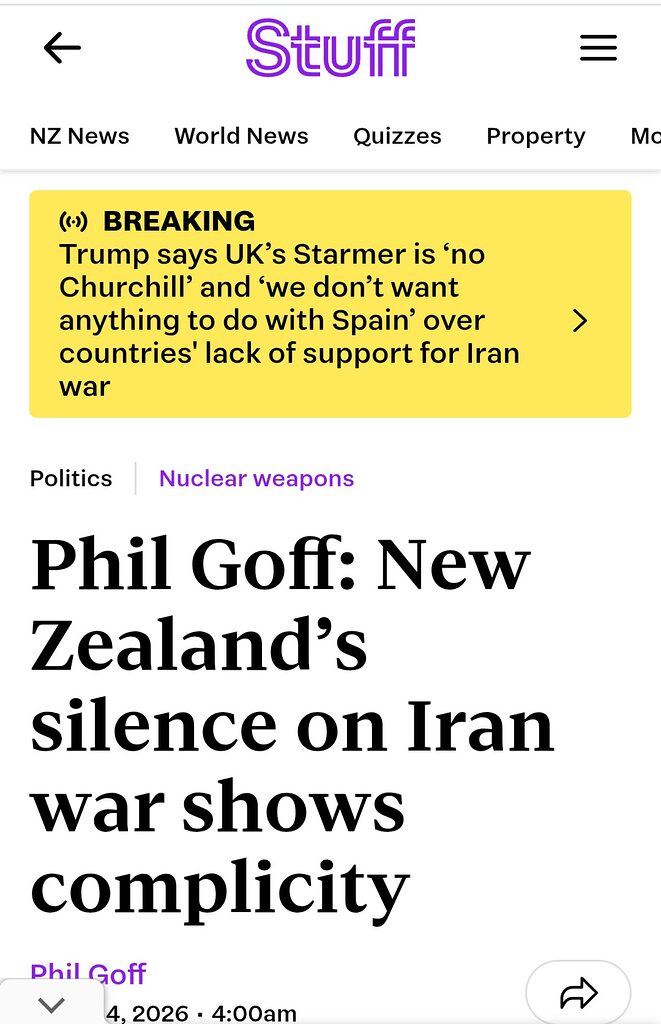
It was memorable advice in the 1986 movie Top Gun, and it’s advice that Labour party alumni Phil Goff and Helen Clark should pay heed to still, as they make calls for NZ to take a “principled stand” on the Iran conflict.
Both those politicians (Clark, then a backbench MP and Goff, a cabinet minister) were members of a government that was publicly promising “New Zealand justice is not for sale, the convicted Rainbow Warrior bombers must serve their allotted sentences”, while behind the scenes we were furiously trying to sell that same justice system to the French, working out a plan to allow the prisoners to be deported swiftly.
I know. I was there, working for Overseas Trade Minister Mike Moore, reading the “SECRET” diplomatic cable traffic every morning between Wellington and our embassies in Paris and London (the incident now declassified).
The French were blocking New Zealand’s trade with Europe because we had jailed two French intelligence agents as common criminals.
Hundreds of millions of dollars were at stake as the French grabbed NZ’s family jewels and squeezed them. “Release the agents back to France, or we will financially crush you,” was the message that greeted our office every single morning.
Realpolitik eventually triumphed over youthful, “no one is above the law” political enthusiasm. Our justice system and ideals were for sale after all, because New Zealand jobs and the economy were at stake if we didn’t release the two agents to a tropical holiday in the French Pacific. For face-saving reasons all around it was left to the United Nations to announce in mid 1986 that agents Prieur and Mafart would serve the remaining nine years of their prison sentence at Hao Atoll in French Polynesia.
“In what was seen as the final insult,” notes the government NZHistory site, both prisoners were released early, Mafart in 1987 and Prieur in 1988.
Fast forward forty years, and here we are again at a moral crossroads: rock to the right of us and a hard place to the left.
Look, I get why commentariat figures are desperately clinging to a rules-based world order fantasy. It makes for a great morality movie. But it’s another example of the Emperor’s new clothes.
Take the prattling about international law. That doctrine was designed and implemented by the bureaucratic servants of despots to essentially legitimise their despotism within their own borders.
It is hard to argue, at a moral level, that a dictatorship or, in Iran’s case, a brutal theocracy, is morally and legally equivalent to a full participatory Western democracy, and therefore immune to scrutiny.
And yet they do. Iran can execute thousands of young people for protesting in the streets, and under the doctrine of international law, no one is allowed to intervene.
A narco state like Colombia in the 80s can’t be touched because the UN recognises its criminal leadership as “sovereign” and therefore inviolable.
To be frank, the doctrine of international law practised in this fashion is like a legitimised version of an Epstein network, where dark things are allowed to happen whilst the elites avert their delicate gaze.
As an Iranian expat, now an Auckland lawyer, Samira Taghavi writes in the Herald:
“As someone who has lived in and suffered under that republic, I dissent from Clark’s view. In short, our Government should be commended on its principled position.
“I attended Clark’s AUT talk last Thursday and left with the distinct impression that she is quite unaffected by realism. Having introduced myself there, I explained that I had practised law in Iran until the age of 24, that I had been imprisoned, tortured and lashed by Islamic Republic thugs and that I continue working in human rights advocacy now in New Zealand.
“I asked what I consider to be the central question when every peaceful mechanism has failed – when UN resolutions, special rapporteurs, Human Rights Council sessions and diplomatic negotiations have not dismantled the regime’s coercive machinery: “What is left to save us?”
Helen Clark, she writes, shrugged and effectively said, suck it up:
“The doctrinaire response was that apparently only a toothless cycle of failed steps is available – and its inefficacy is just how life is.
“As for the breach of international law argument, it is not unusual for non-legally qualified people, like Clark, to assume that certainty lies in the legal texts, from which they take strength. But going deeper, it is very arguable that the American/Israeli position is legal. Even so, using legal text as the reason not to save people is unredeeming.”
There’s a legal concept called void ab initio, or illegal from the beginning. Arguably, a nation-state that breaks the international law it pledged to uphold can lose the protection of sovereign immunity, meaning it becomes fair game.
But I come back to the Top Gun advice. Essentially, it translates to “Fools rush in where angels fear to tread.” It’s easy for an idealist commentator to grandstand on principle, even if it has huge consequences for our economy.
The NZ government has to walk a tightrope in a world where the biggest players no longer care about “international law”. Rightly or wrongly, the world has changed.
They have to govern not just for the effete ivory tower-dwelling elites, but also the New Zealand companies employing millions who don’t need their market access snuffed out on a whim.
I appreciate that a rules-based order provides protection mechanisms for precisely that scenario, but as reality tells us, that order has crumbled, and commentators, usually left-leaning as far as I can see, still don’t have their heads around it.