Table of Contents
The most noticeable thing about the Climate Cult is how utterly bourgeois it all is. Whether it’s the ignorant, spoiled children of multi-millionaires bellowing and stamping their feet, Twitter Hyphenated-Surname gluing they/themself to roads, or mega-wealthy celebrities finger-wagging the rest of us from their private jets, the first prerequisite of a climate alarmist seems to be wealth and privilege.
Particularly when it comes to ‘renewables’. Rich people in exclusive, inner-city suburbs vote to subsume the homes of country people with endless fields of aluminium and glass and bulldoze vast stretches of bushland to cover in whirling blades of bird-and-bat killers. For some reason, they never build them on the windy cliffs of Bondi or the parklands of inner Melbourne.
Country people are, more and more, arcing up. Especially as their hard-pressed volunteer firefighters are expected to front a new, rich-people-made danger. For the people of Dederang in Victoria’s Alpine region, bushfires are already a constant threat. Throwing massive, fire-prone, lithium-ion battery farms into the mix is too big a risk to live with.
It’s why most of the town’s population – about 200 residents – are fighting proposals to build two Battery Energy Storage Systems (BESS) on private land.
“It’s one of the highest, most bushfire-prone areas in the state. If they lose control, it will go and then it’ll be chaos,” said local resident Paul Ingram.
They’re fighting against very well-heeled opponents, though: developers often flush with rivers of taxpayers’ money.
Late last year, Mint Renewables and Trina Solar submitted planning applications to the Victorian state government to build a BESS in Dederang.
The systems are designed to support wind and solar renewable energy by storing excess electricity and releasing it when demand is high.
Troughers whose attitude toward country people is sneering condescension.
In response to the backlash against the proposals, [Trina Solar’s Country Manager John Zhong] compared the rejection of the batteries to kids who refuse to go to school.
“My kid doesn’t like to go to prep, but then I have to tell them ‘hey, going to prep is … part of your journey to actually learn and study and to become an adult’,” he said.
Which doesn’t sound at all arrogant.
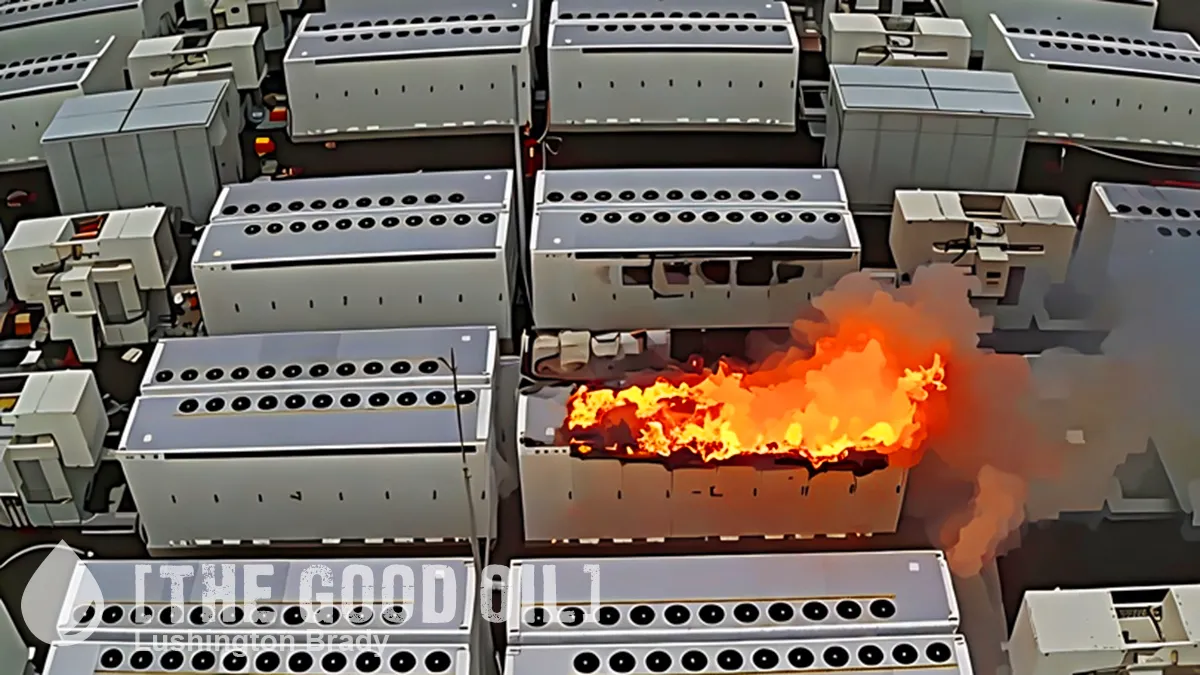
Tell you what, mate: how about you get on the truck when a battery fire that’s near-impossible to put out is belching clouds of black, toxic smoke over your town.
He admitted the company had sought guidance from a CFA consultant based in Melbourne, not in Dederang […]
Dederang is full of CFA volunteers; most are farmers, and they fear the fire risk that lithium-ion batteries could pose for the town.
Doug Connors, a CFA volunteer in Dederang for 50 years, says the town wouldn’t be able to fight a battery fire if one erupted.
“As a brigade, we’re equipped and trained to fight grass and scrub fires,” he told 7.30.
“A battery fire, all of a sudden it’s involving toxic chemicals and smoke, and we don’t have the equipment or the training to deal with it.”
Oh, but the experts say there’s nothing to worry about. It’s not as if the ‘expert’ class has given us any reason to doubt them in recent years, now is it?
Dr Matthew Priestley is a battery and energy expert from the University of New South Wales. […] Dr Priestley says the chance of a fire breaking out at a large-scale battery plant is low.
So low that there have already been several large-scale battery fires in Victoria in just the last few years. I’m sure there’s nothing to worry about siting them in bushfire-prone areas.
“When one does fail, often they move into a very dangerous state called thermal runaway.
“Essentially, what that means is the temperature of the battery continues to exponentially increase to really high temperatures, sometimes in excess of 500 degrees Celsius, and it’s very difficult to put these fires out.”
Well, at least they won’t be in the sort of places that matter.