Table of Contents
Tom Valcanis
Life-long politics tragic, digital marketer and writer. Articles in the Age/SMH, the Big Issue, the Spectator, and editor of alt-lifestyle mag Hysteria from 2014–2020.
You’d be forgiven if you hadn’t noticed that the US conducted a military operation to decapitate the Venezuelan government, bombing capital Caracas to exfiltrate President Nicolas Maduro for narco-terrorism crimes.
Libertarians have zero love for Maduro. The successor to Hugo Chavez, Maduro is a brutal socialist dictator, immiserating his population with his progenitor’s Chavismo: populist socialism that centralised political and economic power in the hands of a few, causing famine, economic decay, and repression.
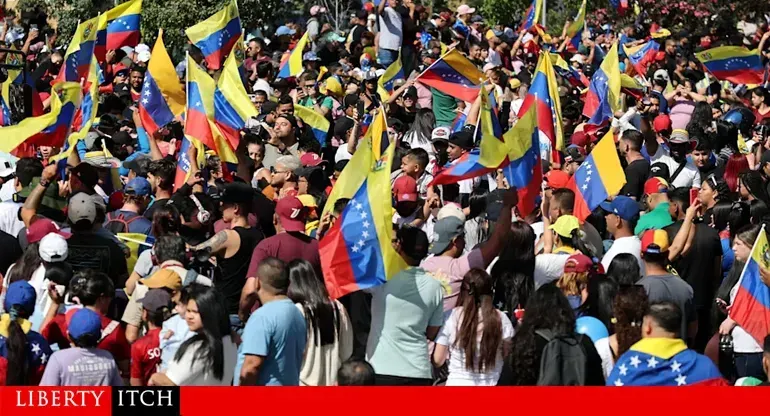
When news broke on the night of the 3rd that US Delta Forces captured Maduro, Venezuelans in the country and in exile celebrated. As a freedom lover, I was swept up in their jubilation, even if it was a violation of international law and Westphalian conceptions of sovereignty.
When I had hair and T-shirts fit me without squirming, I took international relations in both high school and at university. (Can you spare a dime, brother?) If I had to sum up what I learned in a sentence, it’s this: international order hinges on us all agreeing on something until might makes right.
Rules are rules, until they’re for chumps.
International cooperation means that we get post from overseas unencumbered, that the Red Cross helps displaced people during war, and that when we enter libertyitch.com into our browser, we’re served the Liberty Itch website. Relatively uncontroversial and universally useful aspects of life are overseen by rules-based consensus.
A state can and will use its force to advance its national interest if and when prudent.
Talking about domain names, which I know way too much about for a normal person, the way that works is through broad international stakeholder agreement. In the ye-olde days, the Internet Assigned Numbers Authority was once an offshoot of the US Department of Defence. IANA was the organisation that set international standards for internet names and numbers (Basically, it makes the World Wide Web work). In 1998 it was spun off into ICANN under the aegis of the US Department of Commerce, then finally entered the private sector as a not-for-profit in 2016.
In the scheme of international rules-based order, how internet names and numbers are administered is universally accepted and straightforward. The US could have kept this entirely in its control, though the strategic and economic benefits would be few and far between.
When force enters the chat, talk about concepts of sovereignty and international law are always thrown out the proverbial window. The pen is mightier than the sword, but a BGM-109 Tomahawk Land Attack Missile will obliterate the pen, the ink, and its wielder.
We can all tut-tut and wag fingers in the face of the US defying Article 2(4) of the United Nations charter: “All members shall refrain in their international relations from the threat or use of force against the territorial integrity or political independence of any state” – but to bring it back to our fundamental maxim, we can all agree on this until might makes right. The Australian Defence Force could theoretically invade Papua New Guinea tomorrow and win, but there would be a whole bunch of mightier actors around to either stop us with force or make life miserable for us through sanctions and trade embargos.
We return to the ultimate question: ‘What’s in it for us?’
Did Trump have a moral imperative? Sure, Maduro rigged elections in 2024, and the Venezuelan people have a powerful claim that the current regime is not the legitimate government. What constitutes a legitimate government? The Venezuelan government retains an exclusive force to perpetuate its hold on the apparatus of state, therefore it does.
On the international stage, the United Nations will hem and haw and heave that the US shouldn’t have done what it did, while the US will respond with ‘Well, who’s going to stop us? You?’ It seems puerile, because blunt force is puerile.
International order hinges on us all agreeing on something until might makes right.
No state military acting as an extension of their government’s political objectives is going to bust into a lush ICANN conference all guns blazing and demand the global domain name system bow to their will. A state can and will use its force to advance its national interest if and when prudent. Venezuela rests atop the largest proven global oil reserve, which international interests have been barred from owning outright since 1976. If a liberal democratic Venezuela emerges from this, the Trump Administration will coax US oil producers to invest in Venezuela’s broken and decaying oil infrastructure to ‘win bigly’.
What’s stopping the US doing this to other nations? Well, cost greatly outweighing the benefit, or at least the perception of such.
The US could liberate North Korea tomorrow with a similar decapitation strike – but what would they get out of it apart from Seoul reduced to slag and a nation that’s functionally 50 years behind the rest of the world?
So no, the US shouldn’t have done it. But the fact that it can get away with it means it did.
If I was back at high school in international studies class, I’d probably bash my fist on a table and declare that the whole thing was wrong and a farce (like I did during the second US-Iraq war.)
My teacher would smile, shrug, and simply reply, “Well, that’s just how it works.”
This article was originally published by Liberty Itch.