According to Islam, we are all ‘born Muslim’, which raises the obvious question: why did it take humans nearly 300,000 years to notice? More to the point, why does so much of the Koran sound exactly like the sort of thing you could expect from an illiterate itinerant Arab trader who was merely repeating garbled snatches of stuff overheard from local Jewish and Christian communities.
For instance, Old Testament stories with later Jewish legends tacked on, such as Abraham smashing his father’s idols. Or accounts of Jesus’ childhood which come, not from the canonical Gospels, but much later apocrypha. Other Koranic accounts are clearly pilfered from popular Jewish folk tales, such as Solomon commanding the wind and ruling armies of jinn.
All in all, it sounds suspiciously as if the Koran, rather than the perfect, uncreated word of Allah delivered directly to his messenger, is a garbled mish-mash of pilfered and misunderstood Jewish, Christian, pagan and pre-Islamic Arabian sources that the illiterate Muhammad encountered in seventh-century Arabia. But surely not.
Now, at this point, some of you may say, ‘Ahah! But what about the Bible?’ Well, leaving aside that whataboutism is not a valid rebuttal, it’s also a false comparison.
Unlike the Koran, it is not an incontestable Christian dogma that the Bible is the literal, directly transmitted speech of God. While biblical literalism exists in some circles, particularly in the US, it is very much a minority view in Christianity. Rather, the Bible is inspired: literally, ‘breathed in’. Thus, even the earliest church fathers were quite clear that there is scope for human error in the transmission of God’s inspired word.
Islam, on the other hand, is dogmatic that the Koran is the literal, directly transmitted (via the intermediary of the archangel ‘Gibreel’ – another Arabic pilfering, of the Hebrew and Christian Gabriel) speech of Allah, who, as it happens, speaks Arabic.
This begs yet another question: why did Allah apparently get so much wrong?
After all, even Islam admits that many verses as they exist in the Koran today are ‘abrogated’ by later versions, as if Allah just changed his mind at times. This is something of a trap for unwary non-Muslims. The Koran is not ordered chronologically: so, early, ‘abrogated’ verses might appear later than the verses which supposedly abrogated them. It’s telling, in fact, that the ‘peaceful’ verses of the Koran are all early ones: many of them were abrogated by later, much more violent and intolerant ones, which just so happens to coincide with Muhammad and his followers moving from Mecca, where they were a relatively powerless, persecuted minority, to Medina, where they established themselves as a powerful group.
It’s just a coincidence, surely, that, as soon as Muhammad was in a position of power, Allah’s message changed from one of peace and ‘coexistence’, to one of violence and oppression. Funny that.
But in any case, the Koran we read today is not the ‘perfectly preserved, unchanged text straight from Muhammad’ we’re told it is.
Muhammad died in 632 CE. No complete, bound Quran existed at that time. Recitations existed in scattered form on bones, palm stalks, leather, and in the memories of companions. After the Battle of Yamama in 633 CE killed many memorizers, Abu Bakr ordered Zayd ibn Thabit to gather what existed. This first collection was kept privately and passed to Hafsa, daughter of Umar. Regional differences in recitation already existed and grew as Islam spread.
By the time Uthman became caliph around 644 CE, disputes over how to recite the Quran had broken out among Muslim soldiers in distant provinces.
Well, that’s a bit awkward: everyone shouting that their particular copy of Allah’s word is the ‘true’ one. What’s a caliph to do?
Uthman formed a committee led by Zayd to produce an official version based on Hafsa’s copy. Standardized copies went out to major cities. Uthman then ordered all other Quranic materials burned.
This was not gentle editing. Companion codices, including those of Abdullah ibn Masud and Ubayy ibn Kaab, contained differences in wording, arrangement, and dialect. These were destroyed to enforce one text. Islamic sources themselves record the burning.
This all seems at odds with the claim (Quran 85:21–22) of a preserved tablet in heaven and the assertion (Quran 15:9) of divine protection over its message. Just as well a later committee happened to choose the right one to keep and burned all the others to achieve uniformity.
When Muslims insist the Quran has never changed in any way, they must explain why Uthman felt compelled to burn other versions.
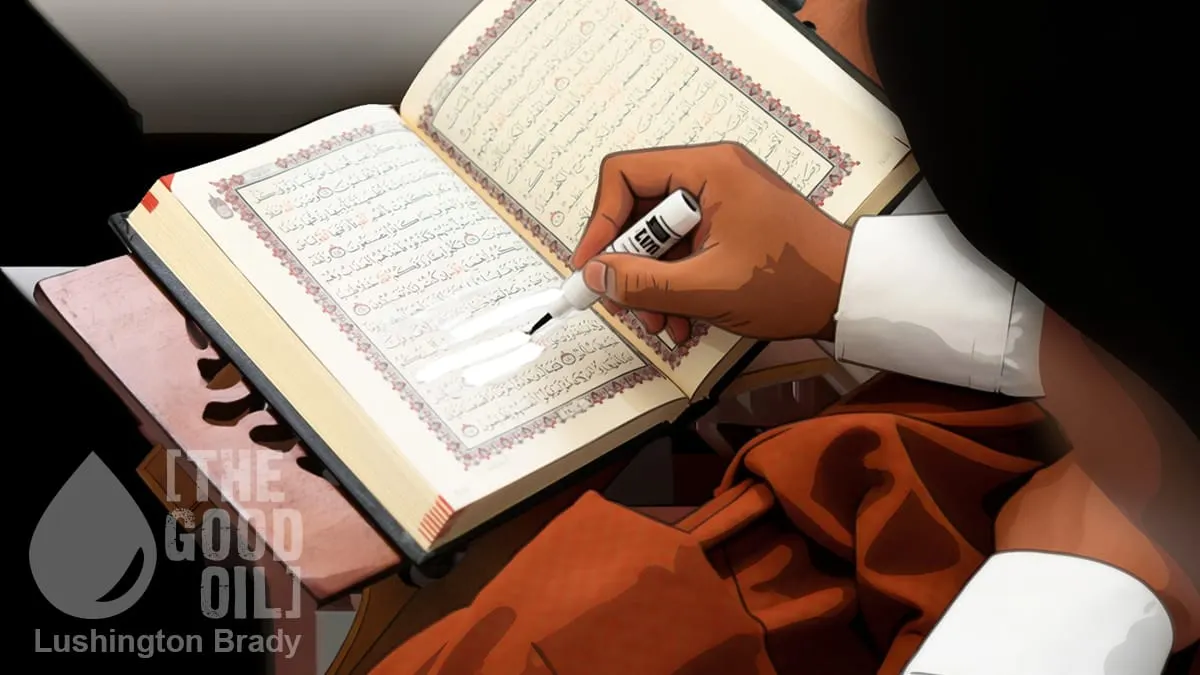
But don’t dare suggest that the Koran is just the ramblings of a half-educated, illiterate Arab trader. It’s the perfect, unaltered transmission of Allah’s words. It just needed a bit of cleaning up. When you can’t reach for the divine Tipp-Ex, a match and a sword will do just as well.