Table of Contents
The history of cinema is paved with technological innovations – and littered with the rusting wreckage of many more. For every Jazz Singer that ushered in the ‘talkies’, there’s a Fantasound (Disney’s groundbreaking sound system, developed for Fantasia in 1939, but discontinued in 1941), Sensurround and Laser Disc. Despite at least three attempts since the 1950s, 3D has never lasted. VR has so far been a passing fad.
Other technologies flare brightly as a gaslight projector, fade away for years of decades, then slowly revive. IMAX seemed to wither on the vine after its initial hoopla, only to return in recent years, as audiences chase a truly ‘big screen’ experience as an alternative to the big screens at home.
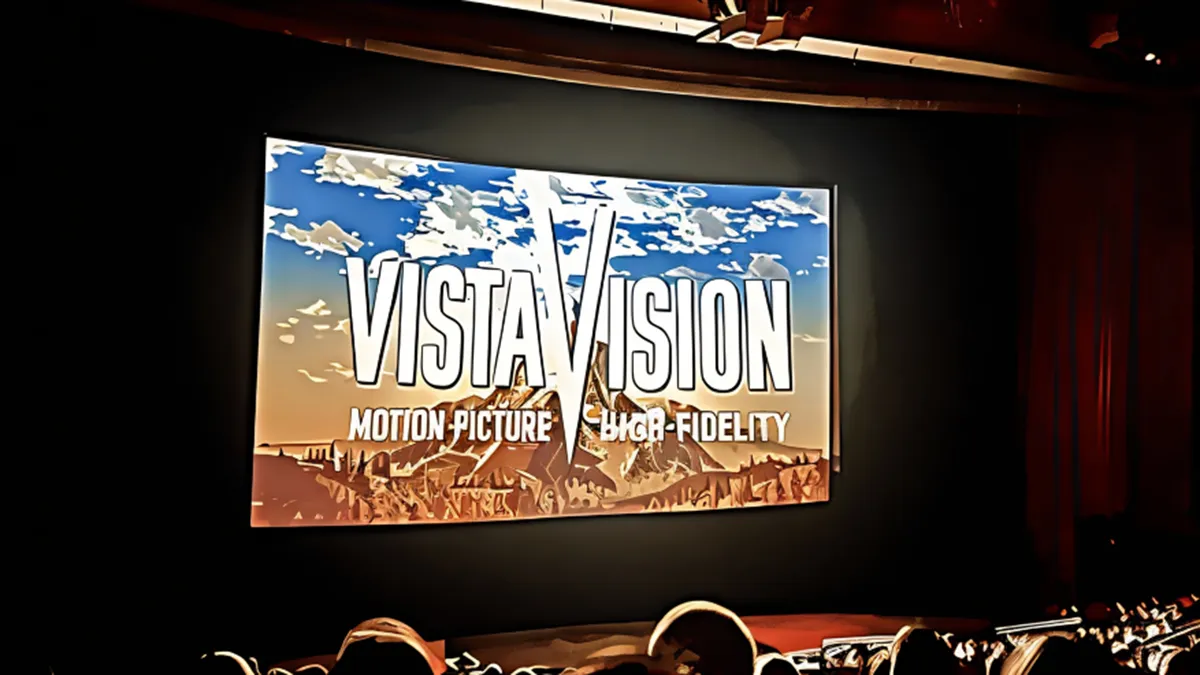
Another once-popular format making something of a comeback is VistaVision, a big-screen, high-resolution format from the 1950s.
In the 1950s, Hollywood faced an existential threat: television. Studio bosses realised one way to draw people back to cinemas was to offer spectacular images through bigger screens and immersive widescreen formats. New technologies such as 3D and colour offered something small, black-and-white TV sets couldn’t.
In 1953, 20th Century Fox patented CinemaScope. Films such as The Robe (1953) and 20,000 Leagues Under the Sea (1954) were shot using special lenses that squeezed a wider image onto regular 35mm film. When projected back onto the screen with another type of lens, the image could be stretched out. The widescreen format was born.
Then, in 1955, producer Mike Todd developed Todd-AO, an early form of curved widescreen that projected 70mm film onto enormous screens. Oklahoma (1955) and Around the World in Eighty Days (1956) were shot this way.
Paramount’s answer to the demand for widescreen was VistaVision. This process uses 35mm film, which is the most commonly used film gauge. But instead of the film running vertically through the camera gate, as is usually done, it runs horizontally so each frame is eight perforations (sprocket holes) wide, rather than the standard four perforations.
A larger frame means more light, which means greater scope for high resolution, colour and textural detail.
VistaVision also bettered CinemaScope by not squeezing (when filming) and un-squeezing (in projection) the image, a process which led to distorted edges and ruining close-up shots of faces. VistaVision didn’t just allow enormous panoramic shots, it also produced sharper images in close-up.
The first Paramount film shot in VistaVision was the Bing Crosby musical White Christmas in 1954. Blockbuster epics like The Ten Commandments and The Searchers followed in 1956. Hitchcock used the format for Vertigo and To Catch a Thief.
Yet the format faded away within a few years. The last major film shot entirely in VistaVision was in 1961.
One reason was the cost: VistaVision consumed double the film stock of regular 35mm formats. At the same time, film stock dramatically improved, achieving the same fine grain and sharp colour as VistaVision. VistaVision was also much harder to use on location.
Still, it never quite went away. Many blockbusters, like Star Wars, Star Trek: The Motion Picture, and Back to the Future used the format in limited fashion, mostly for special effects shots. This piecemeal use of the format has been a constant through the decades.
But some recent films have marked a return of entire films shot in the format.
Brady Corbet’s The Brutalist (2024) was the first film in decades to be shot fully in VistaVision. Oscar-winning cinematographer Lol Crawley spoke enthusiastically about the minimalist and maximalist possibilities […]
Since The Brutalist, Paul Thomas Anderson and several other high-profile auteurs have opted for VistaVision, including Emerald Fennell for her version of Wuthering Heights (2026), Alejandro González Iñárritu for his as-yet-untitled Tom Cruise film, and Yorgos Lanthimos for Bugonia (2025).
The return of VistaVision speaks to showmanship and product differentiation, something Anderson has been eager to publicise ahead of the release of One Battle After Another. It is one of several old formats making a comeback in an era of digital fatigue and AI slop […]
The wider context here is the post-pandemic struggle to get people back to cinemas. At a time when most content is streamed online, the use of a unique, outmoded format makes a statement. The bold disclaimer “shot in VistaVision” becomes a distinctive mark of craftsmanship and prestige.
Perhaps. But there’s only so much turd-polishing even the best cinematic formats can do. Preachy crud like One Battle After Another or The Brutalist are still preachy crud, no matter how big the format.