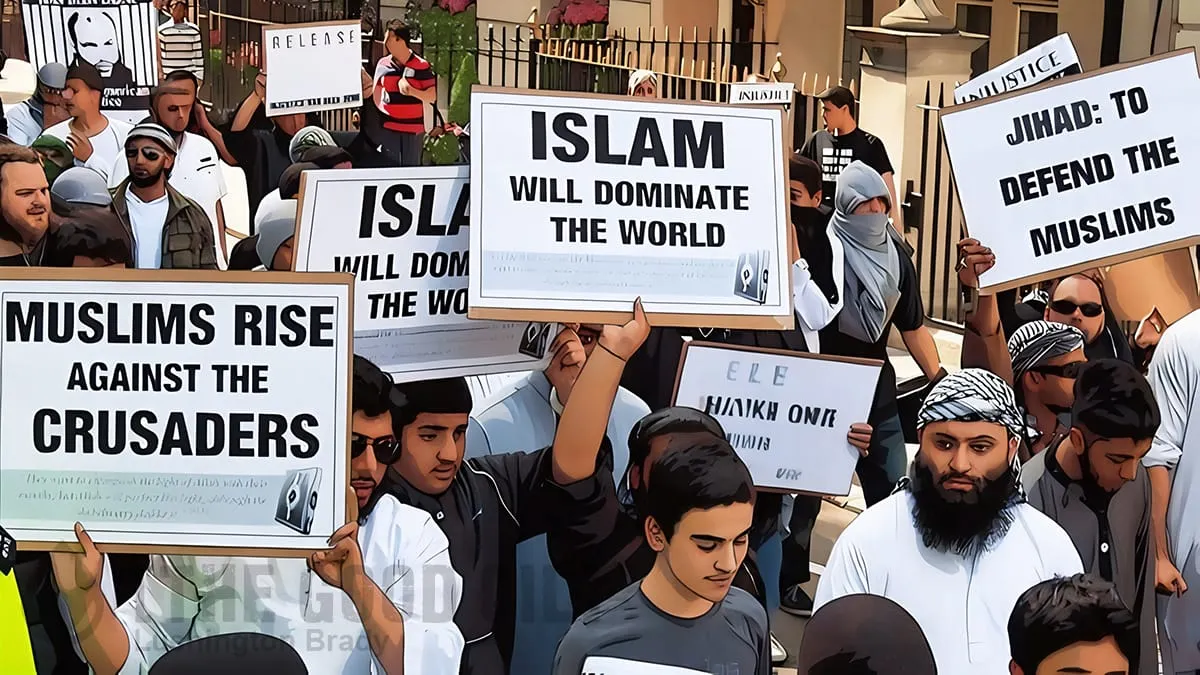
“When Muslims are in the minority they are very concerned with minority rights, when they are in the majority there are no minority rights.” Just because Winston Churchill never said it, doesn’t make it untrue. After all, Churchill never said, ‘Water is wet,’ either. That doesn’t make it untrue.
But is the claim about Muslims behaving differently as a majority than when they’re a minority hold water? It goes right back to the very founding of the cult, and the composition of its holy book. When Muhammad and his merry band of bandits were a persecuted minority in Mecca, it was all ‘peace’ and ‘coexistence’. But when they decamped to Medina, the rhetorical gloves came right off – and the scimitars came out. The Jews who had succoured the nascent Islam in Mecca were massacred by Islam in Medina.
The Koran can be divided into the earlier Meccan and later Medinan verses. And, according to orthodox Islamic hermeneutics, later verses abrogate earlier ones, if they conflict. So, if an early verse says to live in peace with infidels, and a later one says to cut their heads off – it’s the later one which is binding.
From the seventh century on, this is the playbook by which Islam has operated. ‘Religion of Peace’ when in the minority; conversion, dhimmitude or death for unbelievers when in the majority.
History supplies the receipts. Take Abdul-Hameed ibn Badis in Algeria. Before the second world war, he assured French colonial authorities that his movement was purely apolitical and fully supportive of French rule. A few decades later the same man was leading violent uprisings against those same authorities. The Islamic Assembly of North America has published essays openly praising ibn Badis “for his skilful use of deception”.
That deception has a name: taqiyya. Non-Muslims are routinely told it is a Shia-only practice. That is false. The consensus of Sunni commentaries – the overwhelming majority of Islam – holds that Muslims living under the political dominance of non-believers are justified in deceiving them. The approved method is showing “friendliness and kindness to non-Muslims as a protective measure, so long as they hold fast to their faith (and enmity) in their hearts” (Durie, 2010).
The behavioral patterns of Muslim populations in non-Muslim countries change predictably based on their percentage of the total population.
When the Muslim share sits below two per cent the posture is low-profile da’wah: interfaith dialogues, victimhood narratives, and careful use of liberal language about rights and tolerance.
Cross two to five per cent and the demands harden – halal food, prayer rooms, curriculum scrubbing – all still wrapped in the language of equality.
Demands are no longer requests but framed as civil rights: halal food in schools and hospitals, Islamic prayer rooms in public buildings, gender-segregated swim times, and recognition of Islamic holidays.
These demands are wrapped in the language of equality, but the subtext is unmistakable: Islam is not merely seeking parity; it is beginning to shape the host society.
At this stage, sharia-compliant accommodations are requested, not just in private religious life but in public institutions. Workplaces are asked to allow prayer breaks. Public schools are pressured to remove curriculum deemed Islamophobic.
Terms like “Islamophobia” become strategic weapons to intimidate critics and silence public debate.
Between five and 10 per cent parallel societies appear: no-go zones, informal sharia courts and the first open enforcement of Islamic norms.
Police avoid intervention, and informal sharia enforcement takes hold. Honor killings, female genital mutilation, polygamy, and forced marriages begin to appear, not as isolated events, but as features of a separate legal order within the host nation.
This stage also sees increasing legal jihad, efforts to redefine blasphemy laws, criminalize criticism of Islam, and pressure media, academia, and politicians into compliance. Islam’s totalizing nature refuses compartmentalization.
More than 80 Sharia courts already operate in Britain. ‘Sharia zones’ may be unofficial, but the infidel wouldn’t notice the difference, as gangs of Muslim men, co-ordinating with mobile phones, act with an alacrity the UK police abandoned decades ago. In the Muslim-dominated banlieues surrounding Paris, and in Molenbeek in Brussels, or Stockholm and Malmö, the state’s police patrol only with heavy backup, if at all.
Past 10 per cent the gloves come off entirely.
At this point, the Muslim community ceases to be a subculture and becomes a rival culture. Integration is abandoned for Islamization.
Political parties with explicit Islamic agendas rise. Muslim representatives in parliaments begin defending jihadist regimes and condemning Western foreign policy not from a critical citizen’s perspective, but from the standpoint of civilizational opposition […]
The Muslim community, now entrenched and numerically significant, weaponizes democracy against itself.
Lebanon, Syria and Iran once welcomed large numbers of Muslim refugees as guests. Within a few decades those countries were dominated by the very populations they had taken in. The same trajectory is visible today across Western cities that have crossed the critical thresholds.
Other immigrant groups do not follow this script. Chinese, Indian, or Korean communities do not demand parallel legal systems or the criminalisation of blasphemy. They lack a theological mandate for supremacy. Islam possesses one. The behavioural shift is not an accident of culture or economics: it is the logical working-out of a doctrine that treats political power as a religious duty.
Churchill may never have coined the line, but 14 centuries of history have tested it thoroughly enough.


![[The Good Oil] Stuff Up of the Day](https://storage.ghost.io/c/31/f4/31f4e20a-0315-499e-83ff-139e8eab53bf/content/images/size/w1304/format/webp/2024/09/Stuff-up-image-1.webp)