Table of Contents
Poor James Scullin had nothing to do with causing the Great Depression, but he still paid for it with his political life. Anthony Albanese ought to take note of the fate of his Labor predecessor.
Scullin was elected to government in a landslide in early October 1929. He won what was then Labor’s biggest landslide, romping home with an 8.3 per cent swing that saw the incumbent Bruce government lose a whopping 18 seats in the then 75-seat parliament.
October 1929: not an auspicious time to enter government. Just two weeks later, the crash hit and Scullin’s fortunes plummeted faster than a Wall Street stockbroker taking the window exit. Facing an unprecedented economic crash, Scullin was a rabbit in the headlights. Barely more than two years later, Scullin lost power in a landslide even bigger than he’d won with. Labor’s primary vote dropped to 29 per cent and the party went from 46 seats in the parliament to just 14.
Anthony Albanese won the last election as convincingly as Scullin did in 1929. It’s been more than two weeks, perhaps, but an economic shock is barrelling down on his government, and they, too, are caught like a rabbit in the headlights. More ominously for Albanese, the seat count at the last election shouldn’t deceive anyone: Labor’s primary vote was barely four per cent more than when Scullin was humiliated in 1932.
The economic shock about to belt him is nowhere on the scale of the Depression – we can hope – but Albanese’s position is a lot more precarious than Scullin’s ever was. More ominously, we’re in the earliest throes of an energy crisis such as three generations of Australians have never seen.
In 1979, Ayatollah Khomeini ascended to power in Iran’s Islamic Revolution. As AMP economist Shane Oliver explains, the flare-up cut out about five per cent of global oil supply.
News clips from Sydney showed drivers queuing up at service stations with only enough petrol to serve cars with number plates starting with odd numbers. Even numbers were served the next day. On weekends, all stations were closed.
The revolution marked the last time Australia rationed fuel. Iran’s response to US-Israeli strikes and the assassination of Ayatollah Ali Khamenei might spawn a more severe crisis.
In 2026, about 20 per cent of the world’s oil travels through the Strait of Hormuz, which Iran has shut down to increase the costs for US President Donald Trump.
“At a high level, it’s four times as big,” Oliver says, while noting the world now has oil reserves and Russian supply that could help fill the gap.
This brings up two problems. First, scrambling to the Russian pariah because we desperately need their oil will not just be a political humiliation for the West, but a political and economic victory for Vladimir Putin. Second, the world may have strategic oil reserves, but, like almost everything strategic, Australia has been utterly let down by its political class, Albanese Labor more than most. Japan, for instance, has 156 days of oil reserves. Australia has just 36. Despite industry groups clamouring desperately at the government for three years to get its arse into gear, Labor is still yet to even form a working group to consider the problem.
And then there’s Albanese’s most fundamental problem: he is not a serious leader. He’s a political gamesman. His entire career has been about backroom manoeuvring, scheming and backstabbing with one goal only in mind: grabbing as much power as he can in the Canberra Bubble. As we saw with Bondi, this mindset means that he is completely and utterly out of his depth when it comes to a real-world crisis.
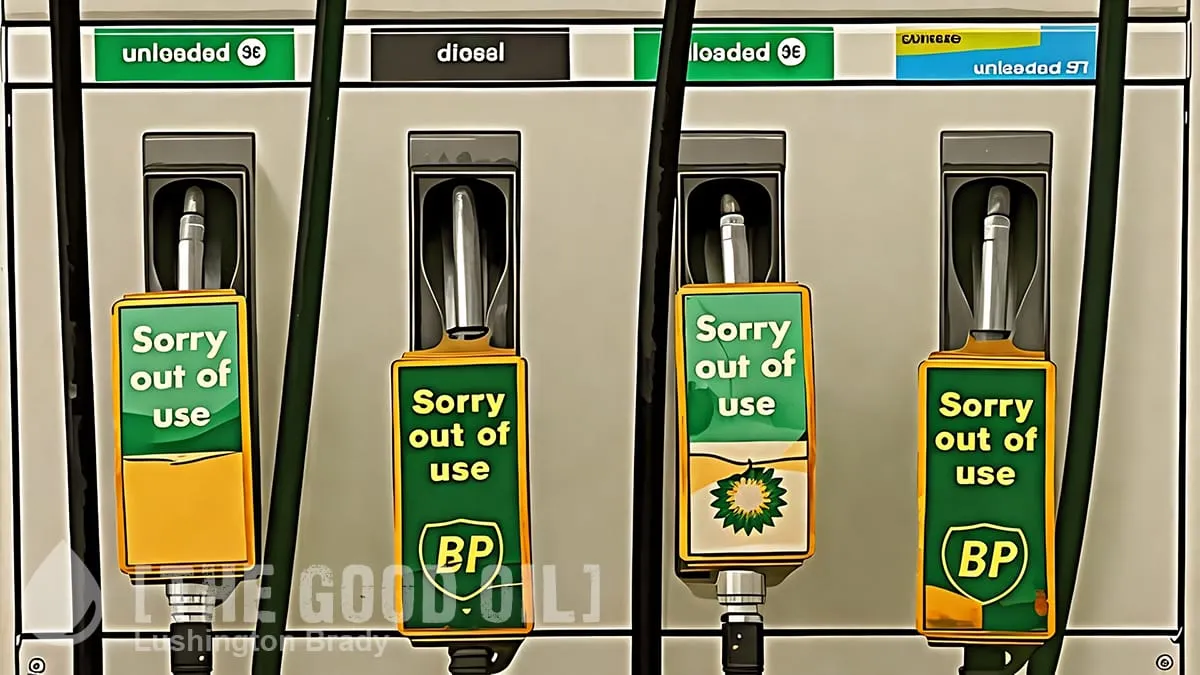
In the face of what the International Energy Agency says is the biggest oil shock ever, he has tried to avoid doomsday talk as Australians rush to petrol stations – some near Albanese’s Canberra residence had run out of certain petrol types on Thursday.
They might as well be in Timbuktu for all that he notices or cares.
The prime minister will come under pressure as the weeks go on to play a central role in managing the crisis, use his position to urge calm, condition the public for what might come next and outline the broader national resilience plan beyond fuel.
Yeah, right. We saw exactly what he’s made of, in the aftermath of Bondi. His immediate instinct was to treat a shocking crime as just another political problem to be spun and ‘managed’. Consequently, his first reaction was to nudge and wink at the swivel-eyed anti-Semites of Muslim Western Sydney, his government’s key voting bloc. Compare Albanese’s pathetic actions to John Howard’s response to the Port Arthur massacre.
And, as the Climate Cult are about to find out, for all their blatherskite about ‘Net Zero’, we still need oil and gas, very, very much, and not just to keep our cars running.
Chief executives are worried about the prospect of shortages not just of petrol but of the plastics used in construction, and the petrochemicals – made even more scarce by the disastrous explosion at a crucial LNG plant in Qatar – used in fertiliser and drugs we rely on from China and India.
Still, while we’re eating the possum we snared raw, in the cold and dark, there’s one glimmer of schadenfreude: Albanese is likely about to get a very, very well-deserved does of karma. His signature scheming politicking of the Covid era is, if the opposition have the guts, let alone the nous, about to be served right back at him.
Opposition Leader Angus Taylor has been preoccupied this week fighting One Nation in Farrer. Some of his colleagues are agitating internally to drop everything and shift focus to the oil crisis and Labor’s response, setting minimum standards for success and turning it into a topline political issue.
Labor tore strips off former prime minister Scott Morrison for elements of his pandemic response and his “I don’t hold a hose moment” during the 2019–20 bushfires.
In a blistering press club address, Albanese scolded Morrison on sovereign capability, saying, “Failing to plan is a plan to fail.”
You mean, like failing to plan for a crisis that food and industry groups have been screaming at you to prepare for, for the past four years?