Summarised by Centrist
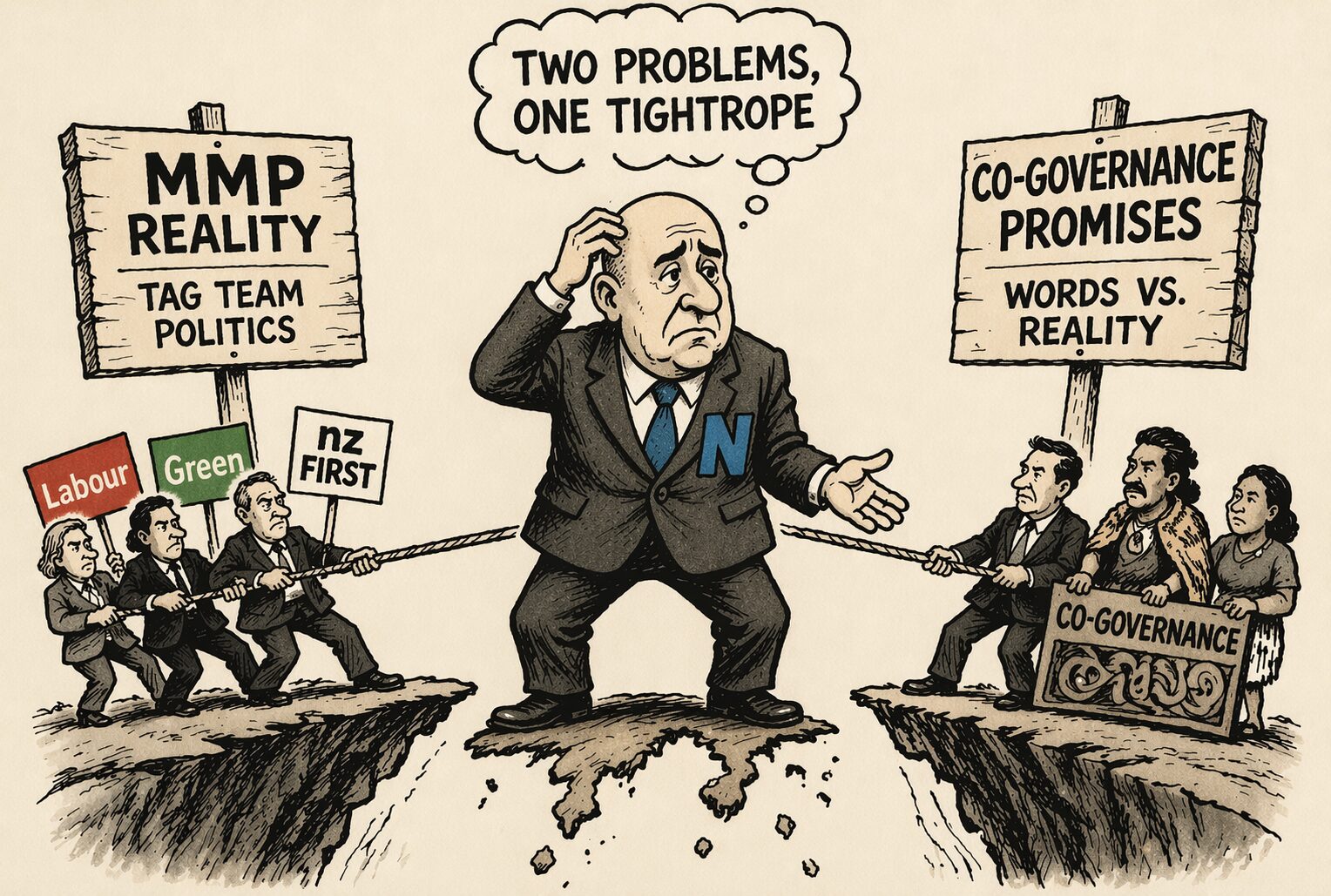
An exchange between Sean Plunkett and Jordan Williams gets at two uncomfortable truths for National. Plunkett’s argument is that under MMP, the old model of “two massive parties on either side of the political divide” having a “knockout slugfest” is fading. “It’s now tag team politics,” he said, calling it “the inevitable outcome of MMP” after decades of the system bedding in.
The timing is awkward for National. In the latest Taxpayers’ Union-Curia poll, it edged up but stayed below 30%, while NZ First surged to 13.6%, leaving the coalition with a clear governing majority.
Williams, though, says National’s problem is not just electoral fragmentation. “I would argue that that isn’t the reason. It’s not MMP. It is the fact that the National Party haven’t even delivered what they promised in the last election.” He said the party was especially vulnerable on co-governance because, on Three Waters, “they were very clear that there would be no co-governance” and that the assets would remain “democratically controlled”. Instead, he said, “they’ve abandoned it”.
His argument is that voters are not just adjusting to MMP. They are noticing that National “promised A, B, and C last time and you simply haven’t delivered”. He said core centre-right voters “can see straight through the BS”.
Williams said the government’s defence, that it is “not requiring co-governance”, is “nonsense on stilts”. He argued that in places such as Wellington, ministers are still allowing “unelected co-governed committees” that water entity boards report to “instead of democratically elected councillors”.
Editor’s note: Wellington’s own water reform material points in that direction. The council’s consultation documents said the preferred option was developed jointly by five councils working in partnership with Ngāti Toa Rangatira and Taranaki Whānui ki Te Upoko o Te Ika, and stated that iwi would have “an active role in all levels of the water services eco-system”, including “long-term planning, governance, operations/management” and community engagement. The same consultation said the new model “better provides for the involvement of iwi” and that iwi had been “around the table from the start”.