Table of Contents
Summarised by Centrist
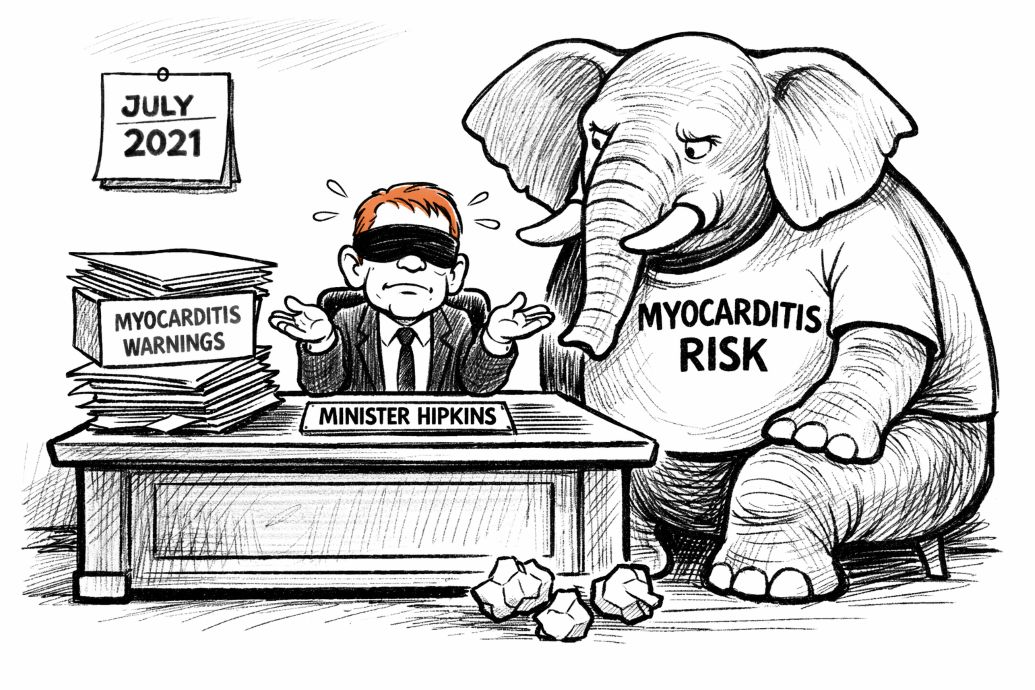
Political commentator Ani O’Brien argues that Official Information Act documents undermine Chris Hipkins’ repeated claims that ministers were unaware of myocarditis risks to young people when COVID vaccine mandates were introduced.
O’Brien writes that what she found in archived documents was “not absence of knowledge, rather a system actively engaging with myocarditis risk in young people long before the 9 December 2021 COVID-19 Vaccine Technical Advisory Group (CV TAG) advice that Hipkins and Verrall claim not to have been given.” She adds that while this “does not automatically prove ministers saw the December advice when it was written,” it makes “total ignorance of the underlying risk much harder to believe.”
She traces references to myocarditis concerns back to July 2021, when CV TAG formally advised the Director-General of Health that emerging overseas data indicated a higher risk of myocarditis following second doses, particularly among younger males. She cites internal emails, advisory minutes, and policy discussions showing the issue being “studied and monitored” and later incorporated into operational guidance.
By August 2021, minutes from the Immunisation Implementation Advisory Group noted “the concerns around myocarditis in younger males” when considering vaccination of 12–15 year olds. By October and November, myocarditis was a standing agenda item, and officials were discussing long-term follow-up studies in New Zealand.
O’Brien writes that a March 2022 Cabinet paper in Hipkins’ name acknowledged that under-18s were at low risk from COVID, that transmission risk did not justify a two-dose mandate, and that a compressed two-dose schedule “may add an unnecessary risk of myocarditis in this population.”
She argues that the cumulative record makes it increasingly difficult to reconcile Hipkins’ public statements with the documented internal discussions. “The idea that this issue existed everywhere except the ministerial orbit is increasingly implausible,” she writes.
O’Brien says the core issue is no longer a medical one but one of accountability. The documents, she concludes, show “early awareness, ongoing monitoring, formal consideration in policy settings, and eventual operational response” before the public debate caught up.
Loading...

![[The Good Oil] Stuff Up of the Day](/content/images/size/w1304/format/webp/2024/09/Stuff-up-image-1.webp)