It’s often said that generals fight the last war, which, as war historian and ex-soldier Gordon Corrigan pointed out, is largely unavoidable. Generals can only base their strategy on what they know. But they can learn from other people’s wars.
Which many Allied leaders failed to do in WWI: the US Civil War had already demonstrated the futility of massed frontal assaults – the standard tactic in musket warfare, against modern weapons. By the time European generals learned the same lesson, millions of men died on the Western Front.
Alert modern commanders are determined to learn the lessons of Ukraine and Iran: missiles and drones are the decisive weapons of the 21st century. For once, the Albanese government, which has overseen a shocking decline in Australia’s defence capability, seems to be heading at least marginally in the right direction.
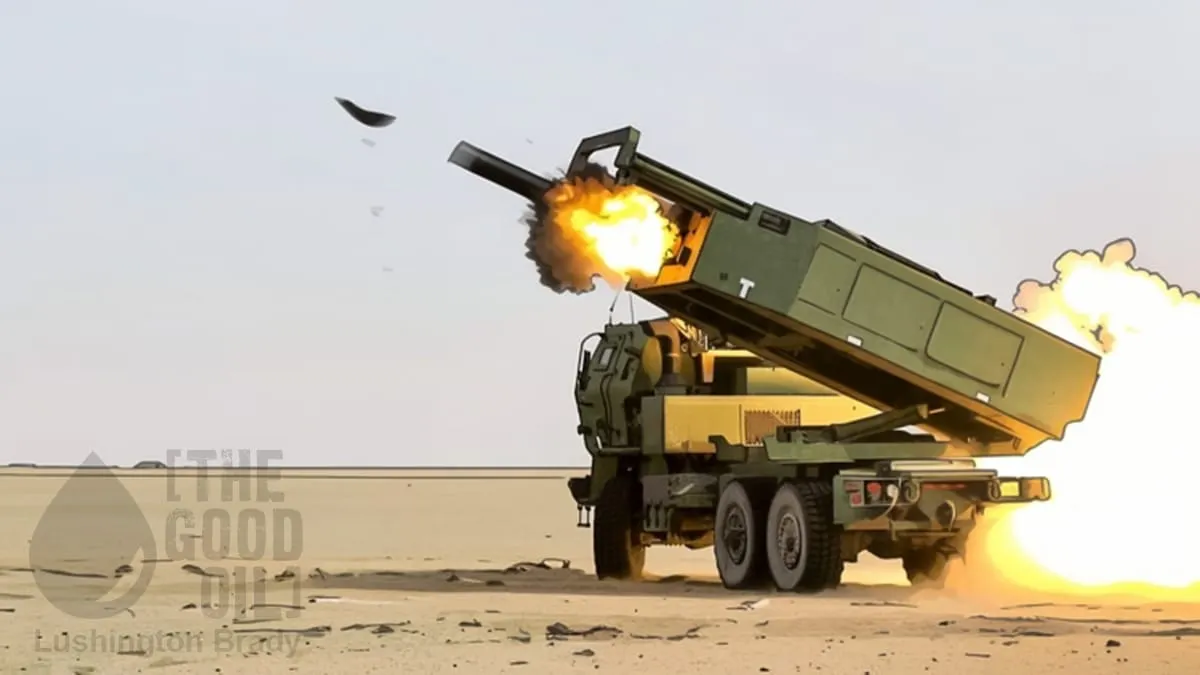
The Albanese government has announced the next plank in its missile defence strategy, putting $2.3bn into mobile rocket launchers and Precision Strike Missiles (PrSMs) – which it has long aspired to produce domestically amid a crunch on global demand for arms.
Well, it’s something, at least. Although it reeks of the sort of Labor approach to economics exemplified by Finance Minister Katy Gallagher, who apparently couldn’t understand the difference between net and gross amounts. Gallagher bragged, in the Senate Estimates, that the government had ‘saved $114 billion’: when it was pointed out that the government had, at the same time, spent far more than that, she was simply dumbfounded.
Similarly, coalition MP and former SAS officer Andrew Hastie pointed out in 2024 that, in just two years, the Albanese government had inflicted $81.6 billion in cuts and “reprioritisations” to Defence (“reprioritisations” meaning, Hastie said, “cuts to funding, delays to programs, and cannibalisation of capability”).
So, Australians should take today’s announcement with a Siberia-sized grain of salt.
Defence Minister Richard Marles will announce on Tuesday the investment into High Mobility Artillery Rocket System (HIMARS) vehicles and PrSMs, as part of a strategy to prevent “northern approaches and contribute to sea control and sea denial”.
It progresses an at-times sluggish missile strategy which aims to leave Australia less reliant on foreign arms supply. He also committed to training a second regiment tasked with operating HIMARS at the Edinburgh Defence Precinct in South Australia.
The investment comes out of the 2026 National Defence Strategy delivered earlier this month, which included a five-fold funding boost for missile defence systems as part of the 10-year weapons investment blueprint.
The only problem is that five times bugger-all is still bugger-all. And, going by Labor’s record, most of the spending will be pushed so far out to the future as to be essentially pointless, which is all-too obvious when Marles brags about “investing up to $37 billion over the next decade” – almost all of it left to the end of the decade, by which time it may well be too little, too late.
At least, though, Labor is, even if through a glass redly, looking kinda-sorta to the future. Strategists have been calling for Australia to develop its missile capability for years. Calls that were repeated earlier this year.
Former army chief Peter Leahy has called for the development of an “Aussie dome” missile protection system, as the Ukraine war brings the threat of bombardment into sharp relief.
The biggest issue is that Helen Clark’s “incredibly benign strategic environment” no longer exists – if it ever did. More pointedly, as China’s provocative sailing of an entire fleet around Australia last year showed, Australia and New Zealand can no longer rely on the tyranny of distance to protect us as it once did.
The defence leader and director of the National Security Institute at the University of Canberra said Australia could no longer “hide behind a Sea Air Gap”, the sprawling geography that previously insulated Australia from rocket attacks and has lost significance with technological advancement.
“The 2003 Defence Strategic Review placed an emphasis on strengthening and hardening northern bases. This is too narrow an approach. All of Australia is vulnerable to new missile, rocket and drone technologies,” he writes.
It’s also kind of pointless to strengthen northern bases, when past Australian governments so recklessly sold China a neat beachhead in the north, with the 99-year lease on the Port of Darwin. But that’s just the tip of the iceberg of strategic negligence.
“Existing and planned US and Australian military bases are legitimate targets. So too are a broad range of industrial, resource and civil infrastructure facilities across Australia,” he writes. “What thought are we giving to developing and deploying lasers to counter the enormous speeds of hypersonic missiles?
“No nation has yet to devise an effective solution to the technological conundrum that confronts us. In short, the problem is going to get worse before it gets better. Do something, Australia.”
That “broad range of industrial, resource and civil infrastructure facilities” includes the steel mills, aluminium refineries and oil, gas and coal infrastructure that the Albanese government have swung a big, watermelon-shaped wrecking ball through, with their demented ‘Net Zero’ policy lunacy. If Labor and the Greens had had their way, we’d have had no mills or refineries left. The Iran war has brought home the full wanton strategic negligence of Australia’s political class.
To damn them with faint praise, Labor are making the tiniest steps to rectifying it.
Australia received its first HIMARS in March last year through an agreement with the US. Three months later it announced a memorandum of understanding with the US for access to PrSMs, while aspiring to manufacture its own.
Labor has committed to support local manufacturing of components for both PrSMs and Guided Multiple Launch Rocket System missiles, both of which can be fired from HIMARS. Both HIMARS and PrSMs are primarily manufactured by US-based Lockheed Martin.
But will this be enough to make up for Labor’s wanton wrecking of defence? Marles prattles about ‘pumping an extra $52.8 billion over the next decade’ – which doesn’t even begin to make up for the nearly $90 billion they’ve cut in just the past four years.
We are no longer ruled by adults.