

Table of Contents
To defend a doctoral thesis in France is a particularly rigorous process. The candidate must publicly, in French, make a 45-minute presentation and undergo a gruelling question and answer session with a four- to eight-member jury. As well, two positive independent reports must be submitted two weeks before. But it’s the Q&A where the intellectual rubber hits the road. The juries are famously combative.
The process is designed to make sure that candidates really do know their stuff (even if it’s the pseudo-intellectual garbage that too often distinguishes ‘French intellectualism’).
As AI-cheating spreads through the higher education system like a cancer, some instructors in the US are turning to a similar system for even undergraduates.
The assignment involves no laptop, no chatbot and no technology of any kind. In fact, there’s no pen or paper, either.
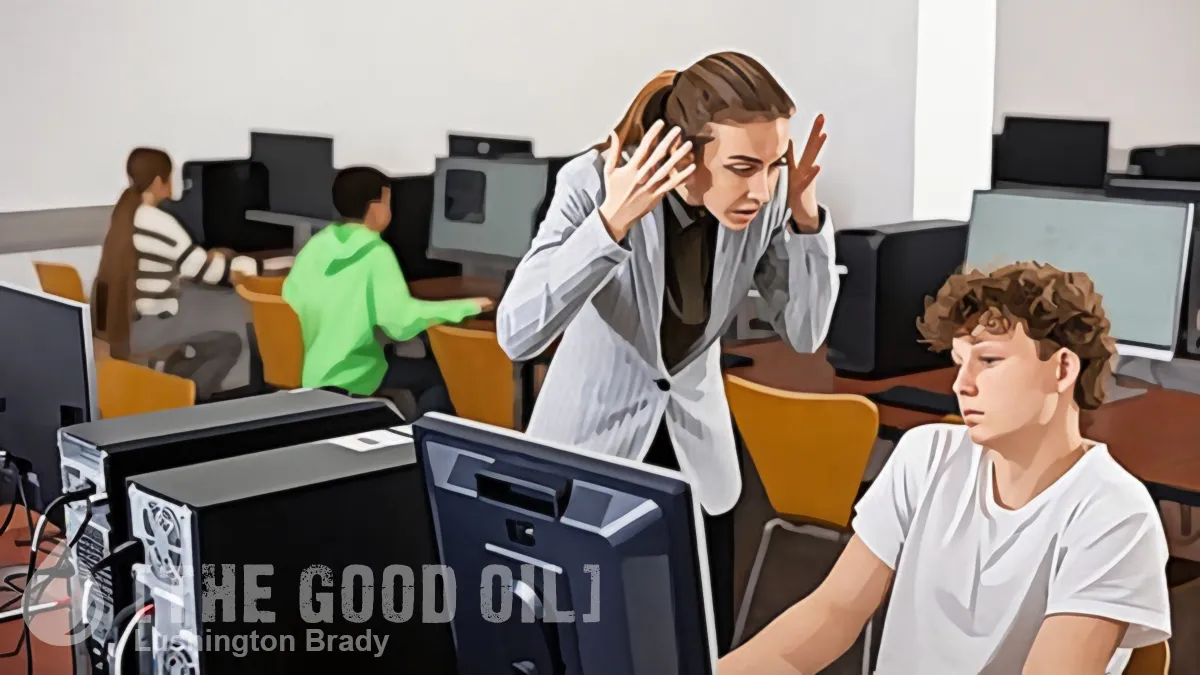
Instead, students in Chris Schaffer’s biomedical engineering class at Cornell University are required to speak directly to an instructor in what he calls an “oral defense.”
The system is older even than the French. Socrates made himself such a pain in the arse with his relentless questioning that even the Athenians had enough and made the annoying old bugger drink the famous cup of hemlock. That shut him up.
And having to even pretend you know something without relying on a computer is probably just as terrifying as drinking poison for modern uni students.
“You won’t be able to AI your way through an oral exam,” says Schaffer, who introduced the oral defense last semester.
Educators are no longer naively wondering if students will use generative AI to do their homework for them. A big question now is how to determine what students are actually learning.
College instructors across the US are noticing troubling new trends as generative artificial intelligence becomes more sophisticated. Take-home essays and other written assignments are coming back perfect. But when students are asked to explain their work, they can’t.
That’s because they don’t know.
The long-term impact of AI use on critical thinking remains to be seen, but educators worry students increasingly see the hard work of thinking as optional.
To be fair, the university system has been encouraging them in that for decades. The only change is that now they can’t even memorise the woke bullshit they’re indoctrinated with.
Oral exams are not traditionally part of the modern American undergraduate system, unlike certain European universities. For instance, in the Oxbridge tutorial system in England, students meet faculty for weekly discussions. Some US colleges saw a move toward oral exams during the Covid-19 pandemic to address concerns about online cheating, and interest has intensified since the launch of ChatGPT in 2022.
It doesn’t help that even the professors are relying on AI.
Panos Ipeirotis, a professor at NYU’s Stern School of Business, unveiled an AI-powered oral exam last semester for the final exam in a class on AI product management. He calls it “fighting fire with fire.”
I call it ‘being as lazy as your students’.
“I want oral exams everywhere now. I want to pair it with every single written assignment,” says Ipeirotis. “I don’t trust written assignments any more to be the result of actual thinking.”
But you trust an AI to be able to sniff out actual thinking from a voice input?
Just by way of example, I’ve submitted some of my own work, both non-fiction and fiction, which were definitely written with my own mental slog years before AI was even a thing. The ‘AI detectors’ regularly pinged my stuff. For instance, for showing clear logical progression in argument. Well… you don’t say.
Maybe I should just take it as a compliment.
Similarly, someone submitted the first paragraph of Mary Shelley’s Frankenstein to an AI detector. It concluded it was 100 per cent written by AI.
Skeptics point out oral exams can be unsettling for students who are shy or have serious anxiety.
Then how are they going to function in the workplace? Young graduates today are notorious for being completely unable to handle even the mildest correction from employers, or even turn up for a full week’s work without needing a ‘mental health’ day.




![[The Good Oil] Stuff Up of the Day](/content/images/size/w1304/format/webp/2024/09/Stuff-up-image-1.webp)


