Table of Contents
As I wrote recently, the key thing to bear in mind about any data coming from China is that it comes from China, which is to say, from the Chinese Communist Party. Who are not exactly known for their rigorous truthfulness.
Remember that Covid got the chance to sweep the world because Beijing hid the outbreak in Wuhan for months, which is the third or fourth time since the communist revolution that the CCP has concealed the existence of a respiratory disease outbreak, allowing it to become a worldwide pandemic.
When it comes to economic data, the communist giant is scarcely any more trustworthy. Most recently, economists noticed that, despite obvious signs of economic downturn in China, the CCP still announced that it had, surprise, surprise, hit its economic targets, exactly. For the third year running. Whodathunkit? In fact, some economists say, the entire size of the Chinese economy may be exaggerated by a third or more.

Why do they lie like this about their economy? Well, firstly, they’re a communist dictatorship and it’s what communist dictatorships do. More importantly, without the narrative of miraculous economic growth, the CCP is shorn of more of its remaining legitimacy. What’s the point of putting up with a communist dictatorship if it can’t even deliver on its promise of, ‘Well, at least you’re better off.’
There’s an old story to this effect, about a Western sympathiser touring Maoist China and visiting a dam project. Upon seeing tens of thousands of peasants toiling with baskets and picks, he asks why they don’t just get some bulldozers?
‘Because then we wouldn’t have full employment.’
The joke is acquiring bitter new relevance for the current generation of young Chinese.
The sign at the entrance sets an oddly aspirational tone: “Hold an ideal in your heart. Pretend to work.”
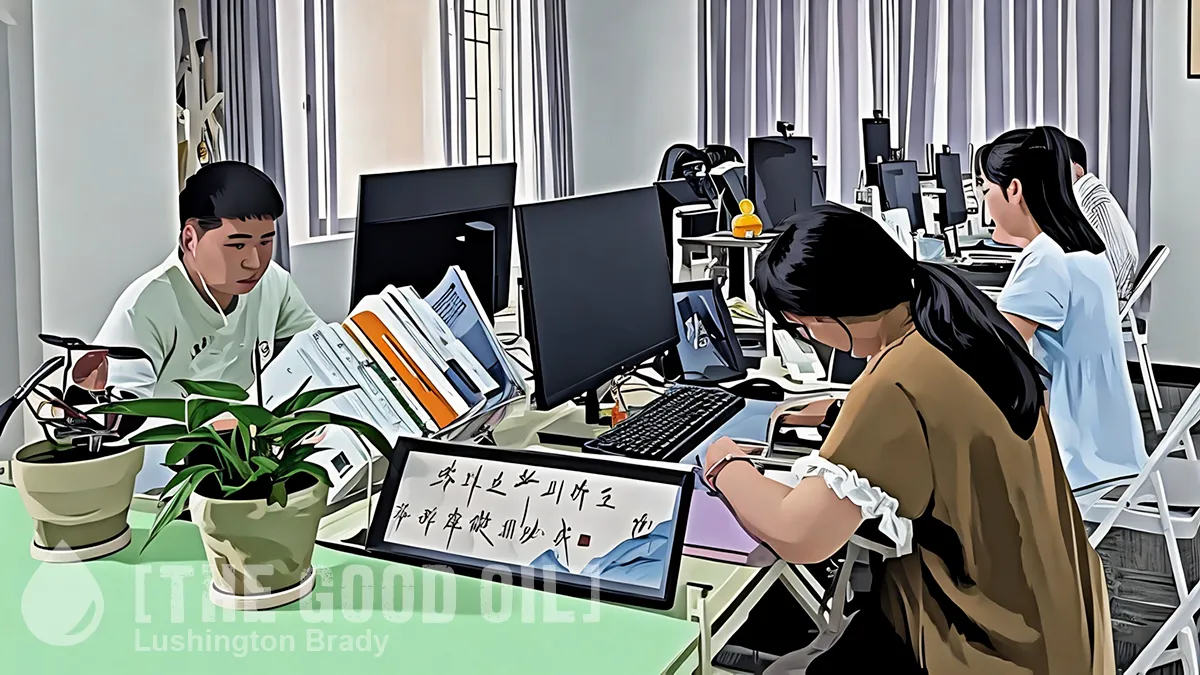
Inside a nondescript office tower on the outskirts of Beijing, nearly a dozen people sit hunched over laptops in a space that looks like any other co-working venue – rows of desks, a kitchenette, meeting rooms. But there’s one crucial difference: some of the people here have no actual job to do.
This is how China solves its chronic youth unemployment problem. Charge them a nominal fee to pretend to go to work.
For about $10 a day, the jobless can rent a desk, access wi-fi and meeting rooms, enjoy an abundance of snacks, and even interact with an overseer who will, if needed, play the role of a supervisor […]
Aptly named Pretend to Work, the company opened its doors last year and plans are afoot to expand to a second location. Similar ventures have sprung up in Shenzhen, Shanghai, Nanjing and other major cities, catering to young people caught between China’s roaring macroeconomic success and a stubbornly soft labour market.
China recently posted five per cent GDP growth and a record trade surplus topping $1 trillion, yet youth unemployment persists at 16.5 per cent, although it’s down from a record peak of 21.3 per cent in 2023.
We already know that the growth is almost certainly a fiction. So we can be forgiven for suspecting that youth unemployment is much worse than they’re letting on.
Like the CCP, the main motive for the pretend-workers is keeping face.
“If their parents ask what they’re doing, they can send a photo.”
Patrons have been known to turn up solely to snap photographs – proof for anxious relatives that they remain gainfully employed.
Yang Zhan, an associate professor of cultural anthropology at Hong Kong Polytechnic University, said family pressure is central to understanding the phenomenon.
“It’s critical,” she said. “The older generation have expectations for their children to be actively participating in the economy and be independent, to be self-reliant.”
Just like their masters in Beijing, the young unemployed are engaging in elaborate deceptions to try and hide the truth.
How long either of them can keep it up remains to be seen.