Table of Contents
Penny Marie
Mum, Woman, Female. NZ based independent investigative reporter, researcher, writer, coach, truth seeker. Founder of Let Kids Be Kids NZ.
When people joke that the Amish never had a Covid pandemic because they don’t have television, they’re raising something significant. If you turned off your screens, was there even a pandemic?
Maybe there wasn’t… if you missed the 1pm liturgies, the Curve Crusher t‑shirts, the daily ‘count’ dashboard of cases/clusters, the “single source of truth” messaging, or the daily shame campaigns against anyone who stepped out of line. For six years, New Zealand’s “pandemic” was experienced mostly as an information environment: tests of dubious validity, case counts, models, policies and media narratives.
In Part 1, I started analysing NZ media Stuff’s Quarantine Nation and showed how, in Edward Bernays’ terms (author of Propaganda written in 1928), it functions as a second round of propaganda: a tightly curated set of “confessions” where key communicators admit limited regret, reaffirm that they’d “do it again”, and resell the Covid story as necessary and heroic.
In part 2, I focus on the man at the centre of that environment: Sir Ashley Bloomfield. Together we’ll explore how a previously anonymous public servant became “Saint Ashley”, sex symbol and professor, and what that curated persona has done – and is still doing – to our ability to see and talk about harm, concerns, that don’t fit the official narrative.
Read part 1 here…
Propaganda in Hindsight: What Stuff’s Quarantine Nation Podcast Really Tells UsPenny Marie 7 Mar Read full story
From bureaucrat to cult figure in weeks
The official story starts simply enough. In early 2020, Ashley Bloomfield appears as Director‑General of Health fronting briefings about a novel virus. By late March, as New Zealand moves to Alert Level 4 and the “team of five million” line takes hold, those briefings become 1pm appointment viewing. He is calm, measured, apparently unflappable. Very quickly, he is also everywhere.
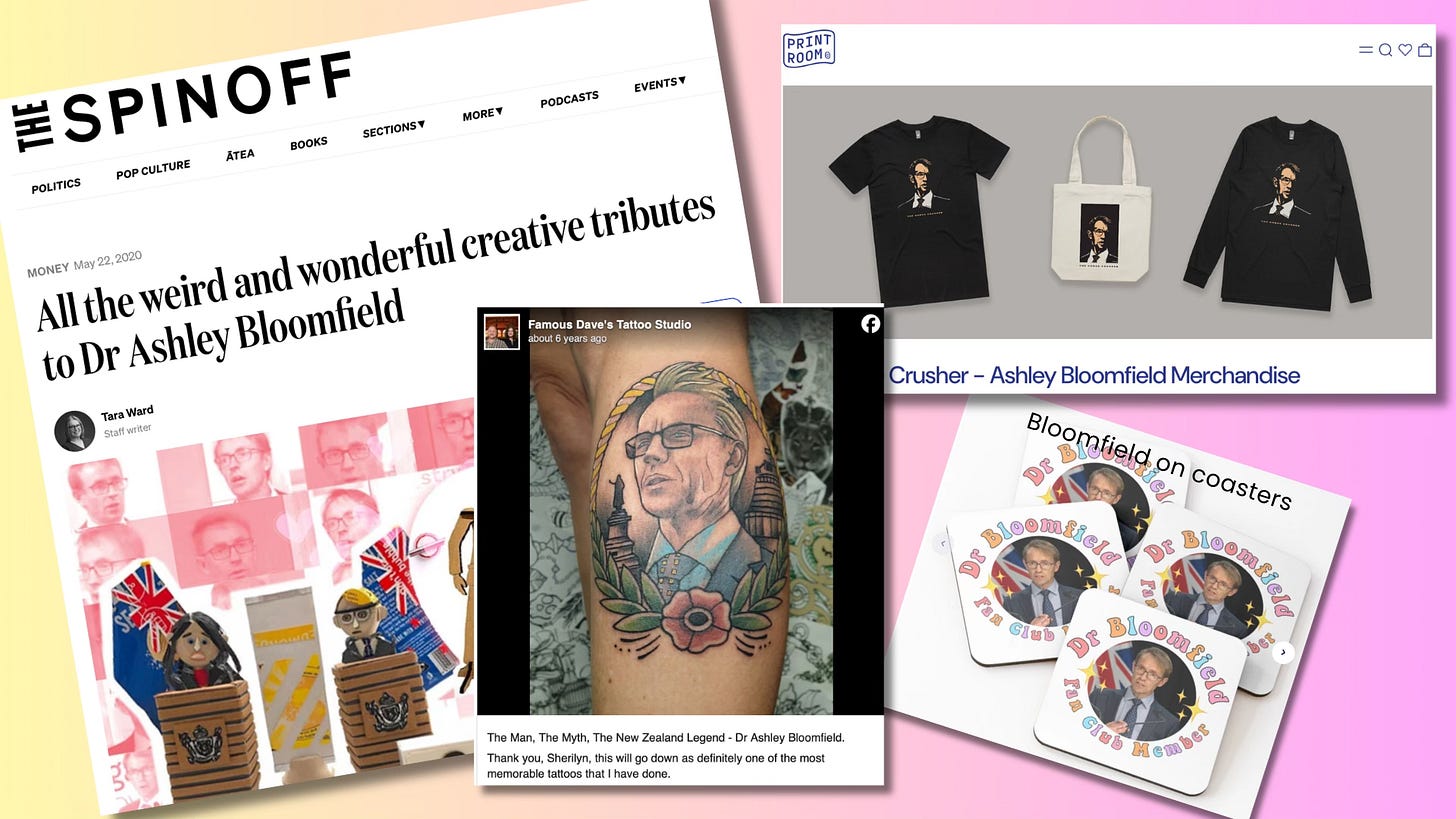
By early April 2020, The Print Room in Dunedin is selling “Curve Crusher” T‑shirts and tote bags with Bloomfield’s face on them, pitched as a way to “show your appreciation” and raise money for Women’s Refuge. The imagery is affectionate and playful – “NZ’s hero”, “our boy Ashley Bloomfield” – and it turns a civil servant into a brand barely a fortnight into the first lockdown. Within weeks there are fan pages, memes and a Facebook group called “Fans of Sir Dr Ashley Bloomfield.”
He even headlined on international channels, still only in April 2020, where the media decided that the people of NZ thought of him as heartthrob. Later in 2020 Hilary Barry (also featured on Quarantine Nation – digs up childhood memories of Bloomfield. Why, exactly?
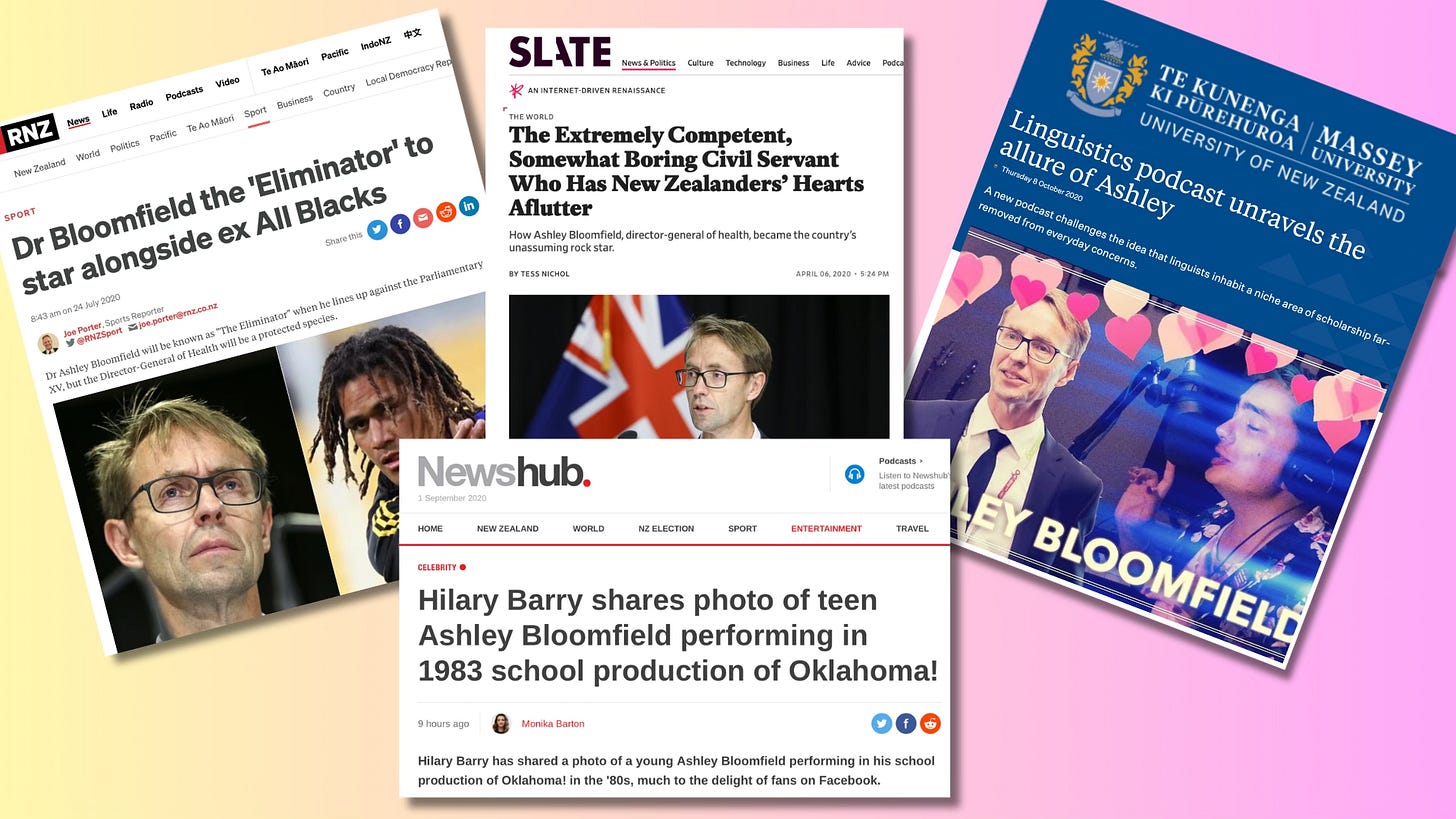
Left‑leaning outlets amplify the ‘fun’. The Spinoff runs “All the weird and wonderful creative tributes to Dr Ashley Bloomfield”, cataloguing tea towels, earrings, portraits and songs with amused approval. There were even coasters and (I wonder if regrettably…) a giant tattoo. RNZ hosts a “Linguistics and our love of Ashley Bloomfield” segment, and Massey University promotes a podcast that “unravels the allure of Ashley”. In July 2020 RadioNZ touted him as ‘The Eliminator’ in a friendly rugby match alongside ex All Blacks.
A research study on Bloomfield the superhero, love interest, saviour, saint
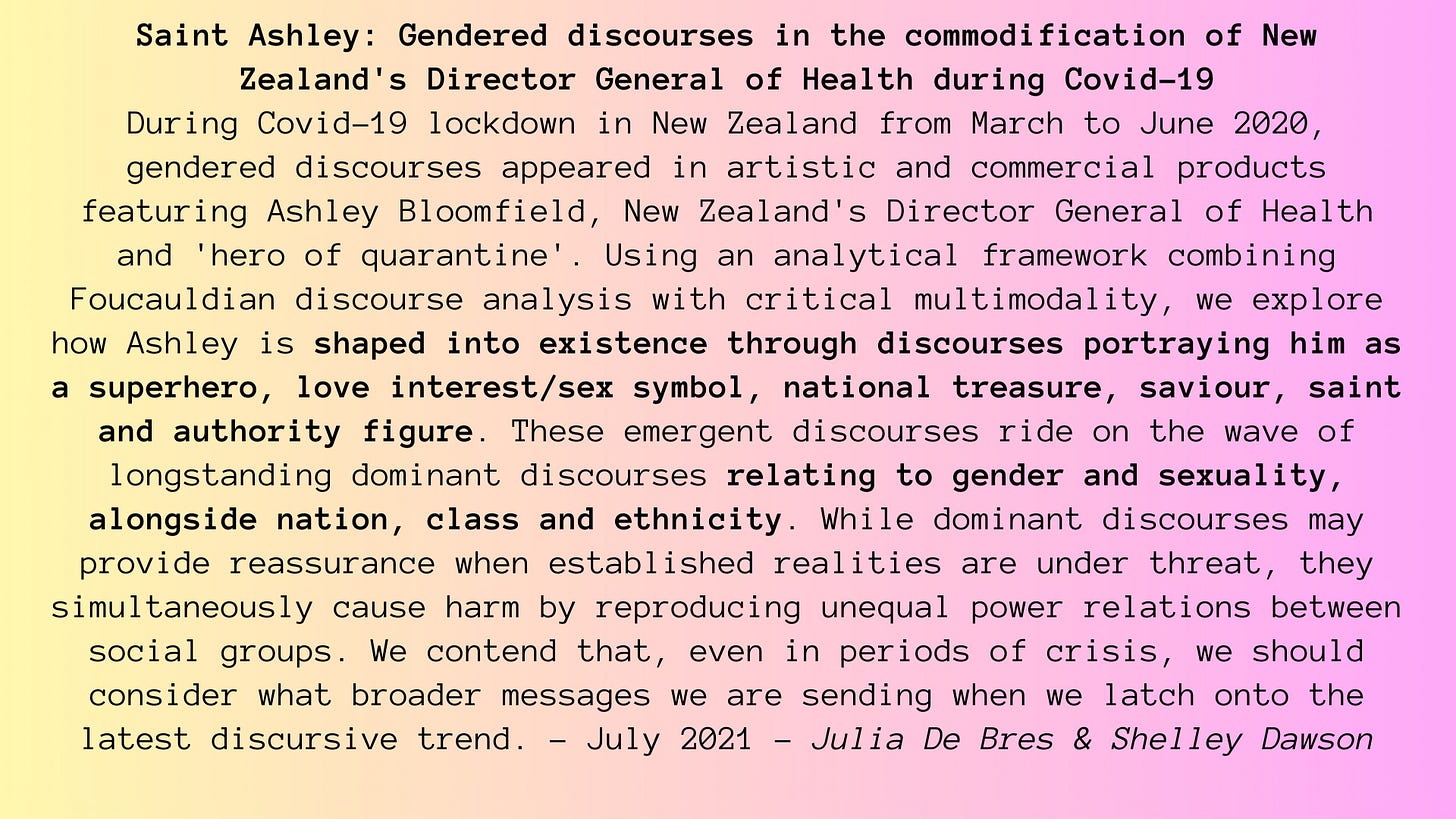
In July 2021 Academic linguists Julia de Bres and Shelley Dawson publish “Saint Ashley: gendered discourses in the commodification of New Zealand’s Director‑General of Health”, showing how merch and art cast him as “superhero, love interest/sex symbol, national treasure, saviour, saint and authority figure”.
It was an extraordinarily fast build
In a matter of months, the face of the 1pm show has been turned into a national crush, a saintly meme and a case study in commodified expertise.
Bernays called this “the manipulation of news, the inflation of personality, and the general ballyhoo by which politicians and commercial products and social ideas are brought to the consciousness of the masses,” and he was blunt that these tools are “necessary to orderly life” in a mass democracy.
What we see with Bloomfield is that strategy, applied to a health bureaucrat fronting a highly mediated crisis.
“Professor Sir”: stacking layers of authority
The cult doesn’t stop with tea towels. Over the next three years, Ashley Bloomfield is progressively layered with formal honours and institutional authority.
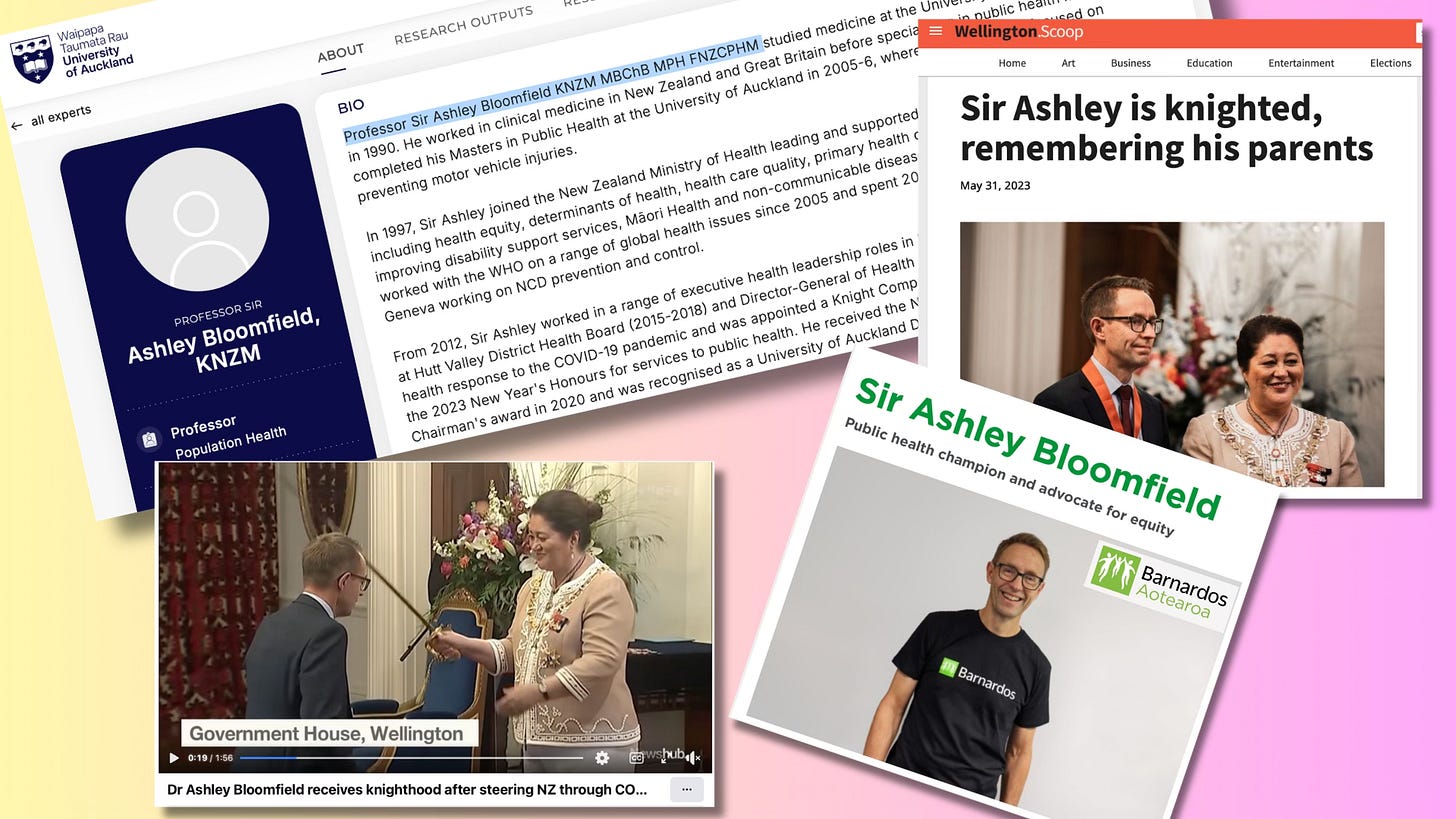
In the 2023 New Year’s Honours he is made a Knight Companion of the New Zealand Order of Merit “for services to public health”. He becomes “Sir Ashley Bloomfield KNZM.” Later, he takes up a role as Professor at the University of Auckland’s School of Population Health and is profiled as an expert in “non‑communicable disease prevention and control and addressing health inequities”. Children’s charity Barnardos appoints him as an ambassador, presenting him as a trusted champion for child wellbeing. Celebrity Speakers lists him alongside Jacinda Ardern as a premium keynote on leadership in crisis and public health.
A Mike Hosking NZ Herald “Lunch with Sir Ashley Bloomfield” feature rounds out the persona: a loveable, modest family man with a Christian faith, suburban habits, self‑deprecating humour, and lingering embarrassment about his fame. The article gives far more intimate biographical detail than the public needs to assess his decisions, but it does a lot to cement him as decent, normal and safe.
Taken together, this is what stands out as “Professor Sir”: knighthood, professorship, charitable halo, corporate speaking, lifestyle coverage. It stacks multiple sources of deference – state honour, academic authority, moral mission, relatability – onto the same figure. Criticising his Covid decisions, his WHO work, or his later directives does not just feel like questioning a public servant; it feels like pushing back against the Crown, the university, child welfare, “the science” and a beloved dad‑doctor all at once.
Bernays would see this as propaganda doing its job well. Harold Lasswell called propaganda “the management of collective attitudes by the manipulation of significant symbols, such as stories, rumors, reports, pictures, and other forms of social communication”. In New Zealand, “Ashley Bloomfield” – the face, name and aura – became a powerful symbol for trust in government health messaging. Every new title and role deepened that symbol.
Fast forward to February 2026, days before the Covid19 Royal Commission Inquiry Report is due to be released to the public, on Quarantine Nation, Bloomfield leans into his curated persona. He talks about the “roller-coaster ride no one had bought a ticket for”, about waking at “three in the morning in a cold sweat”, and about the “enormous weight” of signing orders he knew would “affect every New Zealander’s life”. He is at pains to present himself as both ordinary – a family man walking the dog, cooking dinner, watching sport – and as someone whose calm at the podium was a deliberate choice “because people needed to see that we were on top of it”.
The WHO connection: Using domestic trust to sell global governance
Bloomfield’s curated domestic image is not just a local phenomenon: it underwrites his international work. He has spent around 20 years “in and around” the World Health Organization (a specialised agency of the United Nations) and recently co‑chaired the process to revise the International Health Regulations (2005), spending “over 40 days (and some nights!) of negotiations” to get updated regulations unanimously adopted in 2024.
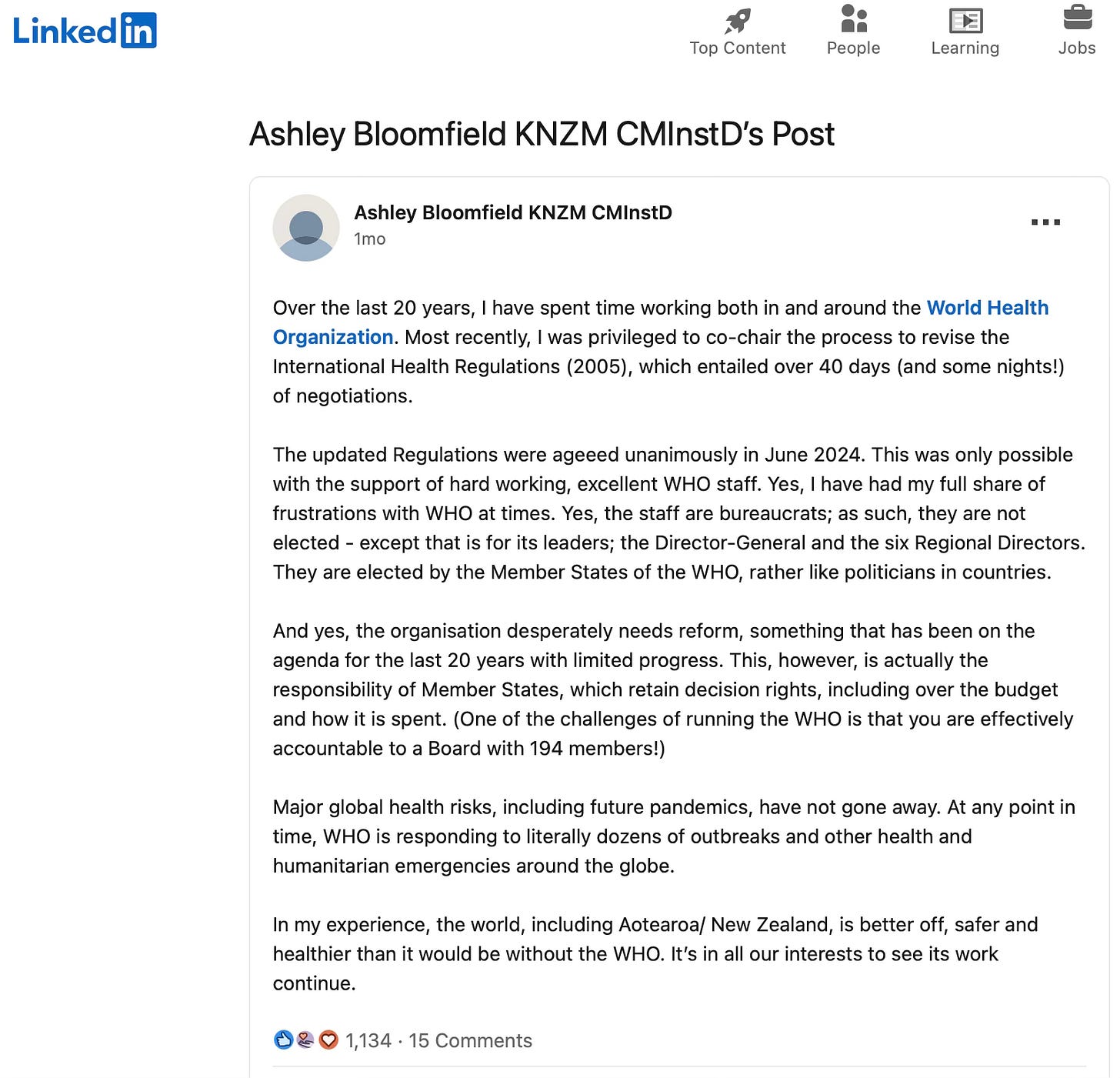
In a public LinkedIn post (above) he acknowledges frustrations with WHO bureaucracy and the need for reform but firmly defends the organisation:
- He stresses that leaders (Director‑General and Regional Directors) are elected by member states, likening them to national politicians.
- He notes that member states retain decision rights over budget and priorities and that the Director‑General is effectively accountable to a “board with 194 members.”
- He concludes that “the world, including Aotearoa/New Zealand, is better off, safer and healthier than it would be without the WHO. It’s in all our interests to see its work continue”.
This is classic “high‑spotting”: emphasising democratic elements (elections, member‑state control), impressive numbers (194 members), and the organisation’s emergency work, while giving little space to arguments about sovereignty, overreach, or about whether the underlying “pandemic” metrics (PCR cycles, RATs) ever justified the fear in the first place. Coming from a man New Zealanders have been taught to see as a saintly, apolitical expert, this defence carries an emotional weight it would not have from a generic official.
In Quarantine Nation, when asked if he would change the big calls, Bloomfield offers regret about staff burnout and pastoral care but not about the strategy itself. He says that without the measures he signed off, New Zealand “could have seen dozens, potentially even hundreds of deaths every day” and makes clear that, given the same information, he would sign the same orders again. That is the same “regret without reversal” pattern we saw across the Quarantine Nation series: feelings of guilt are acknowledged, but the mission is not up for review.
Jacques Ellul (who also authored a book called Propaganda in 1965) argued that modern propaganda is less about acute campaigns than about an environment that integrates people into an existing order. Ashley Bloomfield’s environment now spans Wellington, universities, charities and WHO. Trust generated by the 1pm briefings and the “Curve Crusher” fandom is being used to stabilise not just our memory of the Covid years, but consent to ongoing global health governance built on the same testing regimes and fear narratives.
Power without accountability: the fluoride orders
The pattern is visible beyond Covid. In July 2022, as Director‑General of Health, Bloomfield used his powers under amended legislation to order 14 territorial authorities – to add fluoride to their water supplies using hydrofluorosilicic acid, with deadlines between six months and three years. The move was projected to increase the share of New Zealanders receiving fluoridated water from about 51 per cent to 60 per cent.
Whatever one thinks about fluoride as a substance, several points are clear:
- This was a central order, not the result of local referenda or wide public consent.
- It intervened directly in the bodies of hundreds of thousands of people under the banner of “public health”.
- Shortly after signing it, Bloomfield left the Director‑General role. His successor Diana Safarti also departed within a relatively short period. Implementation, resistance, cost and potential legal challenges are now the problem of councils and residents, not the official who set the policy.
It fits with what he describes in Quarantine Nation, where he emphasises that he acted on “meticulously assembled advice,” that his job was to “make the call” even under uncertainty, and that he never saw his role as second‑guessing the consensus of official experts. Once you accept that frame – that technocratic decision‑making, backed by honours and global bodies, is self‑justifying – an order telling 14 councils what must be in their water looks less like an exception and more like business as usual.
What Covid propaganda did to me
These structures would matter less if they had not caused deep damage. They did. In my Covid19 Royal Commission submission I said:
“My Covid story is that this propaganda – the manipulation of lockdowns and the messaging of how crazy those of us were who thought differently to what the government wanted everybody to believe – was the destruction of my family.” – Penny Marie
Part Of My Covid StoryPenny Marie 28 April 2025 Read full story
I was a marketing professional managing a large brand, studying to become a health coach, and I “hadn’t come across this sort of ‘propaganda’ before”, but I could see that the Covid messaging was “very odd, and extremely incessant… pushing people into FOMO (Fear Of Missing Out)”.
By August 2021, watching the government tell 12–15‑year‑olds they could get injected without parental consent was what “woke me up and changed my life forever”. I read Pfizer’s own documents, saw that the product was still under trial until May 2023 and had not been tested on under‑18s or pregnant women, and yet it was being sold as safe for everyone – even to children, “against their parents’ wishes”, with “bribes” attached. My teenage sons went ahead anyway, believing the “two shots for summer” campaign and needing jabs for sport and social life. “That situation destroyed my family,” I wrote.
Square Peg, Round HolePenny Marie 13 January 2024 Read full story
I’m not telling my story here because I have a personal vendetta against Ashley Bloomfield. I’m telling it because the system he fronted – from the 1pm “single source of truth” briefings to the vaccine campaigns to Quarantine Nation – has no place for people like me, or for the vaccine‑injured and bereaved. We exist. Our stories are on the record. But in the curated after‑narrative, we are treated as noise, not as evidence.
The five‑way system behind Saint Ashley
It is tempting to turn all this into a morality play about one man. That would miss the point. What we’re seeing is a five‑way arrangement:
- Government – sets the rules, declares states of emergency, funds media, aligns with WHO, and anoints heroes with honours.
- Media – amplifies the line, selects insiders as ‘trusted experts’, normalises the cult, marginalises dissent, and later hosts carefully framed ‘apology tours’ like Quarantine Nation.
- Medical establishment – DHBs, colleges, schools and boards enforce the rules, often suppressing or punishing internal dissenters, while equity and safety rhetoric provide moral cover.
- Pharmaceutical industry – supplies the products and benefits financially from mass uptake, largely off‑stage but central to what’s being mandated and messaged.
- Law and regulation – embed the whole response in orders, mandates, professional discipline and, later, fluoridation directives, making changes hard to reverse and harm hard to redress.
Ashley Bloomfield sits at the intersection of all five. He is the trusted face of government health policy, the central ‘expert’ source for media, the symbol of professional medicine, the frontman for pharmaceutical campaigns, and the official whose signature can change both public‑health rules and the contents of your water. The personality cult around him – the fandom, the honours, the professorship, the saintly framing – is not incidental. It is a key part of how that system maintains consent.
The Propaganda Model And The Manufacturing Of Consent - Herman and Chomsky
Herman and Chomsky’s propaganda model (1988) describes five structural “filters” – ownership, advertising, sourcing, flak, and overarching ideology – through which media process reality. In New Zealand’s Covid story, all five are present: concentrated media partly reliant on state money; heavy government advertising and NZ On Air funding; reliance on Bloomfield and a small circle of approved experts; flak against dissenting doctors, journalists and protesters; and a unifying ideology of threat – a ‘deadly virus’ known mostly through PCR cycles and case dashboards, and later ‘misinformation’ as a new enemy. Saint Ashley is the human face of those filters.
By March 2026, whatever respiratory virus circulated in 2020–22 is no longer the daily focus. The damage, however, remains. Families like mine remain estranged. Vaccine‑injured New Zealanders and those who lost loved ones after ‘doing the right thing’ still struggle to be heard. People are still fighting mandates, still battling over fluoridation, still trying to make sense of what happened under a regime built on tests and television.
Against that backdrop, a narrative project like Quarantine Nation and a curated figure like “Professor Sir Ashley Bloomfield” do important political work. They offer closure on elite terms: the threat was dire, the strategy was fundamentally right, the people in charge were human but heroic, and any excesses were understandable and, in essence, would be repeated. They invite us to feel for the communicators, not for those who were communicated at.
The Amish meme gets one thing right. If you remove the screens, the slogans, the Curve Crusher shirts, the saintly profiles and the WHO LinkedIn posts, you are left with what the policies actually did to bodies, families, communities and water supplies – regardless of what PCR or RAT tests claimed to detect. Part 2 is about that subtraction: stripping away the ballyhoo around Saint Ashley long enough to see the system he fronts, and the people it has left behind.
This article was originally published by Penny Marie NZ.