Table of Contents
The barnstorming rise of One Nation in the polls is not without its challenges for the once-fringe party. For the first time in its 30-year history, One Nation is facing the prospect of being more than just a protest party for the disaffected centre-right. If the poll numbers hold, and the party makes a respectable showing in the upcoming South Australian state election and the federal by-election in Sussan Ley’s seat, One Nation has to be taken seriously as a contender for government.
Tellingly, leader Pauline Hanson, who just a couple of months ago was still touting her party as at best a handbrake on the government, is now openly talking up its chances at being the government.
This is as much a challenge as it is an opportunity. As the Greens found when they got their claws on the reins of power in the minority government agreement with Gillard Labor, carrying on like a bunch of student nutters is fine when you’ve got no hope of making policy – quite another when you have to face up to the judgement of the electorate.
So, the challenges for One Nation are to both develop a suite of credible policy alternatives to both Labor and the Liberals and start behaving like a serious political party.
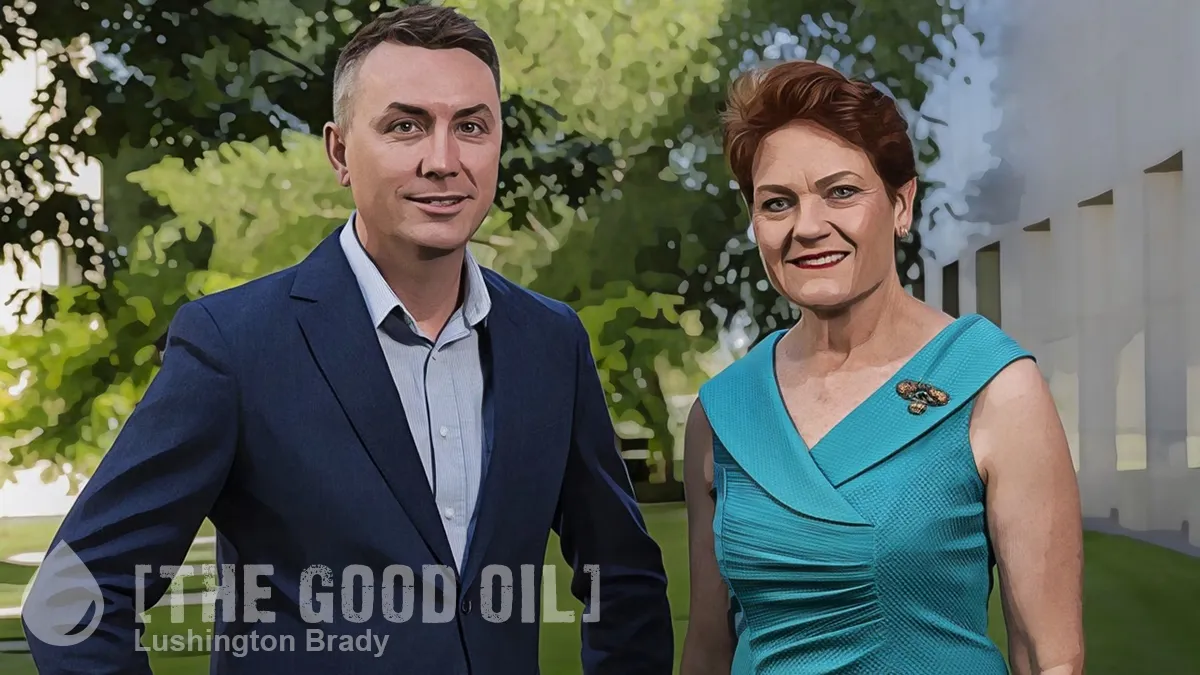
Discipline has been One Nation’s biggest Achilles’ heel in the past. Especially as leader Pauline Hanson ran afoul of a series of feckless male colleagues. But in long-term strategist James Ashby, Hanson has found a disciplined and reliable backroom partner. Veterans Barnaby Joyce and Cory Bernardi, leaving aside any other established conservative politicians who may yet defect, know how a government runs, from the inside.
Helped by the coalition turmoil, One Nation’s Pauline Hanson developed techniques and strategies that decimated the Liberal’s Sussan Ley.
She now plans to apply the same policies and techniques to new Liberal leader Angus Taylor. Prepare for a battle royal between the former fish shop proprietor and the Rhodes scholar to be the main challenger to Anthony Albanese […]
Hanson has surrounded herself with one of the best teams of political strategists in Canberra. They have devised one of the most detailed set of policies ever prepared by an opposition party since John Hewson’s Fightback in 1993. (Paul Keating beat Hewson partly because Hewson stumbled on the impact of the GST on a birthday cake).
Hewson was a policy wonk and was simply a lousy political pugilist. Keating ate him up for breakfast. Albanese may not find Hanson such easy pickings. Hanson’s apparent weaknesses – the quavering voice, the barely suppressed indignation – are her biggest strengths. Simply, she comes across as sincere. Albanese, by contrast, oozes slimy insincerity.
But the best performer is a hollow shell without a serious policy platform to stand on.
Many of One Nation’s policies would be perfect for the Liberals and were promoted to Liberal voters via social media and other avenues. The campaign worked. On the eve of Ley’s replacement, Newspoll had One Nation with 28 per cent support and the Liberals down to just 15 per cent (the coalition had 18 per cent) […]
Hanson also sets out how she will raise $90bn to fund the policies and repay debt.
And the Angus Taylor Liberals are left playing catch-up.
Taylor’s home ownership aim is “to re-establish home ownership as the centrepiece of the Australian dream”.
These are matching Hanson policies: a five-year GST moratorium on building materials used in new homes up to a value of $1m; a review of excessive government charges that make up to 44 per cent of the cost of new homes; allowing Australians to choose their home design “without unnecessary cost burdens”; and Australian apprentices will be subsidised.
Hanson has clearly listened to the building industry and Meriton’s Harry Triguboff. They should have been Liberal policies in 2025.
More importantly, though, One Nation is not afraid to put forward policies that terrify the two established parties, but which will be music to the ears of voters both on Struggle Street and in the country. Especially regarding Labor’s demented ‘Net Zero’ drive.
A One Nation policy in this area is banning renewable energy installations and transmission lines on agricultural land, or where they constitute negative impacts on native forests or animal species, or an increased bushfire risk.
That will reduce the use of high-cost renewables.
One Nation will further increase the cost of renewables by mandating that environmental rehabilitation bonds be required on all energy projects to address any impacts when equipment and infrastructure reach the end of their useful life.
This will be a big winner in regional seats where farming communities have been run roughshod over by a stampede of cowboys shamelessly grifting on the hundreds of billions that Albanese and Boofhead Bowen are throwing around. In the mortgage-belt suburbs, kitchen table economics – the skyrocketing power bills under Labor – will trump Climate Cult virtue-signalling.
High-cost renewables should be replaced with low-cost gas and coal, with nuclear generation an option.
One Nation casts doubt as to whether there is a link between carbon emissions and climate change, but Hanson does have a carbon-reduction policy and the beginnings of a bushfire strategy. It is that carbon emissions will be reduced by planting trees, which will be harvested, and the carbon stored in buildings built of Australian timber. A very restricted amount of native forest will be harvested, with carbon stored the same way. All trees harvested will be replaced to increase carbon absorption. She also helps more Australian households and small businesses to install solar panels and reduce their electricity costs.
Tax policy hasn’t been forgotten.
Five Hanson tax policies are: introduce income splitting and joint tax return filing for couples with dependent children; enable aged and veteran pensioners to earn more without penalty; raise the tax-free threshold to $35,000 for self-funded retirees; halve the fuel excise for three years; and remove the excise on beer and spirits in venues.
And, for the inevitable challenges of ‘how will you pay for it all?’ Slash government spending on the things everyone but the leaner class hates.
Then there are pages setting out how to raise $90bn to pay for the policy costs and reduce debt. The major items are these.
Abolishing the Department of Climate Change and related agencies, programs and regulations ($30bn annual saving).
Abolishing the National Indigenous Australians Agency and bypassing Aboriginal organisations by providing direct grant assistance to those in need ($12.5bn saving).
Conducting a review of the functions and costs of the federal departments of education and housing to eliminate duplication with state governments.
Returning the NDIS to its original purpose of providing reasonable and necessary support.
A policy of redirecting and reducing foreign aid spending ($3bn saving).
Reviewing and reducing funding for arts and multicultural programs.
Abolishing the Therapeutic Goods Administration and rolling its essential functions into the Department of Health.
Ending the “rort” on natural gas by levying royalties at the point of production, creating a domestic gas reserve, raising up to $13bn a year.
Now, all One Nation have to do is recruit an army of credible candidates and hope they don’t fish out too many loons.