
Table of Contents
It was “co-educational”, a school for both boys and girls, what used to be called a “mixed” school; some said it was not nearly so mixed as the minds of the people who ran it. These people had the idea that boys and girls should be allowed to do what they liked. And unfortunately what 10 or 15 of the biggest boys and girls liked best was bullying the others. All sorts of things, horrid things, went on which at an ordinary school would have been found out and stopped in half a term: but at this school they weren’t. Or even if they were, the people who did them were not expelled or punished. The head said they were interesting psychological cases and sent for them and talked to them for hours. And if you knew the right sort of things to say to the head, the main result was that you became rather a favourite than otherwise.
– C S Lewis, “The Silver Chair”
If you’ve had school-aged children in the past few decades, chances are at least one of them has experienced bullying – and you’ve experienced the standard school response – which is to punish the victim, while letting the perpetrators off practically scot-free. Even teachers complain that suspending, let alone expelling, even violent students is all but impossible.
Is it any surprise, then, that bullying is skyrocketing?
School bullying has reached devastating new peaks in Australia, with figures showing rising rates of children as young as 10 expressing serious emotional distress following online and in-person abuse.
Crisis counselling service Kids Helpline is sounding the alarm, with its data showing a rising proportion of calls from children aged 10 to 14 who are experiencing bullying and having thoughts of suicide.
For all the self-serving rhetoric from school administrations and education bureaucrats about ‘anti-bullying policies’, the lived reality is that bugger-all is being done to stop it.
It coincides with the latest release of data from the landmark Australian Child Maltreatment study that shows more than one in four (28.7 per cent) adults reported being bullied at school, and these rates were not improving for each new generation.
The new data is backed by figures from the office of the eSafety Commissioner, which show school-age cyberbullying complaints surged 456 per cent in the past five years – from 536 to 2,978 – and in 2024, nearly half of reports involved children under the age of 13.
Serena Ford, whose daughter Charlie was repeatedly bullied, experienced the typical response from schools.
Serena Ford said each time Charlie moved schools, the institutions’ investigations were slow and protracted, and their responses ineffective.
“They just kept putting it on Charlie as in, ‘she is the problem; she needs to be more resilient.’”
At one point, the family were threatened with breaking the law for not sending Charlie to school but were given no help to find her an alternative place.
While bullies are adapting to technology, and using social media and AI to torment their victims, schools are turning a blind eye.
“They told me that ‘it’s happening outside of school, so it’s not their problem.’” […]
The latest release of data from the Australian Child Maltreatment study also raised questions about the country's responses to school bullying.
The study of 8,500 Australians found that despite at least two decades of extensive anti-bullying policies in schools, there was “no meaningful change” in the number of people experiencing bullying in their childhood over the past five decades.
Perhaps the most important step is to be honest about what’s happening. But, note how the ABC’s infographic tries to frame the narrative:
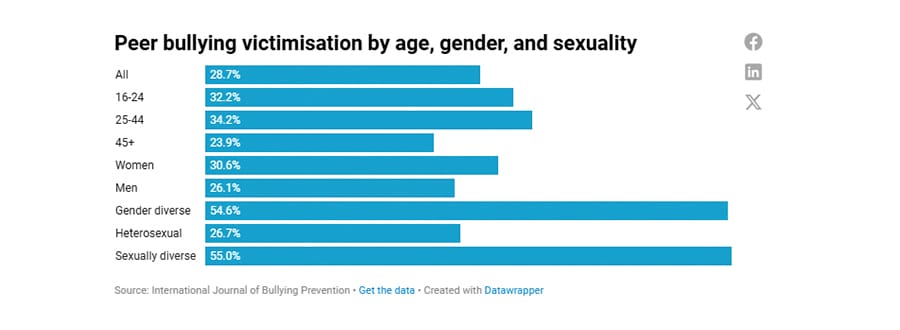
Looking at that graph, you’d conclude that gay and tranny kids are the biggest victims, which is certainly how government ‘anti-bullying’ programmes seem to think: churning out what are plainly Queer Theory indoctrination courses.
In fact, the data says quite differently:
The Australian Child Maltreatment Study found the main reason people were bullied was because of their height or weight, followed by race or ethnicity, disability, sexuality and gender identity.
So, sexuality and ‘gender identity’ rank last in the reasons for bullying. How far behind the other causes is unclear, because the ABC has made the sources of its highly selective data near-impossible to track down.
Notably, though, I can’t think of a single instance of a heavily funded government programme aimed at ‘fat kids’ or disabled kids. But bureaucrats and activists have trousered hundreds of millions of taxpayer dollars to ‘support queer and gender-diverse youth’.
It’s almost like they don’t really want to do anything about bullying at all.