Table of Contents
EKO
Artist and bookmaker
The furnaces never went cold
Left the production, the studio system, the country. Moved to England in 1961. Bought a manor house in Hertfordshire. Built his own production compound on the grounds. Never returned to Hollywood. Not for a premiere, not for an Oscar, not for anything.
Every film after Spartacus, eight of them across four decades, was shot in England. The Shining, set in Colorado, was filmed at Elstree Studios. Full Metal Jacket, set in Vietnam, was filmed in an abandoned gasworks in East London. He recreated New York City on a soundstage for Eyes Wide Shut. He would rather build America from scratch on another continent than set foot in the country itself.
The standard explanation is that he was eccentric. Afraid of flying. A recluse who preferred isolation.
The other explanation is that he understood what the industry was and removed himself from its gravitational field while continuing to use its infrastructure to deliver the most dangerous filmography in cinema history.
The Host
Virtually every Kubrick film is an adaptation. The Killing, Paths of Glory, Lolita, Dr Strangelove, A Clockwork Orange, Barry Lyndon, The Shining, Full Metal Jacket, Eyes Wide Shut. All drawn from existing novels, stories, or novellas. Even 2001 grew from Clarke’s “The Sentinel.”
He adapted other people’s work because he needed their cover.
A studio will greenlight “Stephen King horror movie starring Jack Nicholson.” A studio will not greenlight “a film about an ancient pattern of institutional violence that wears civilizations like costumes and requires a steady supply of human sacrifice administered by a priesthood that calls itself management.”
But that’s the film he made. Every time. For 40 years. He delivered it inside whatever host body the system would accept.
The God in the Room
There is something older than any institution currently being scrutinized. Older than Hollywood. Older than any government. It runs through human civilization like a wire through a wall, invisible until you open the drywall.
The ancients had names for it. Moloch. Baal. The god who requires children.
Not metaphorically.
The Carthaginians built bronze furnaces in the shape of a god with outstretched arms and placed living infants into them. The practice was not hidden. It was civic religion. The best families participated. The priests administered.
We tell ourselves this was primitive. That civilization evolved past it. That modernity replaced superstition with reason and the furnaces went cold.
The Temple
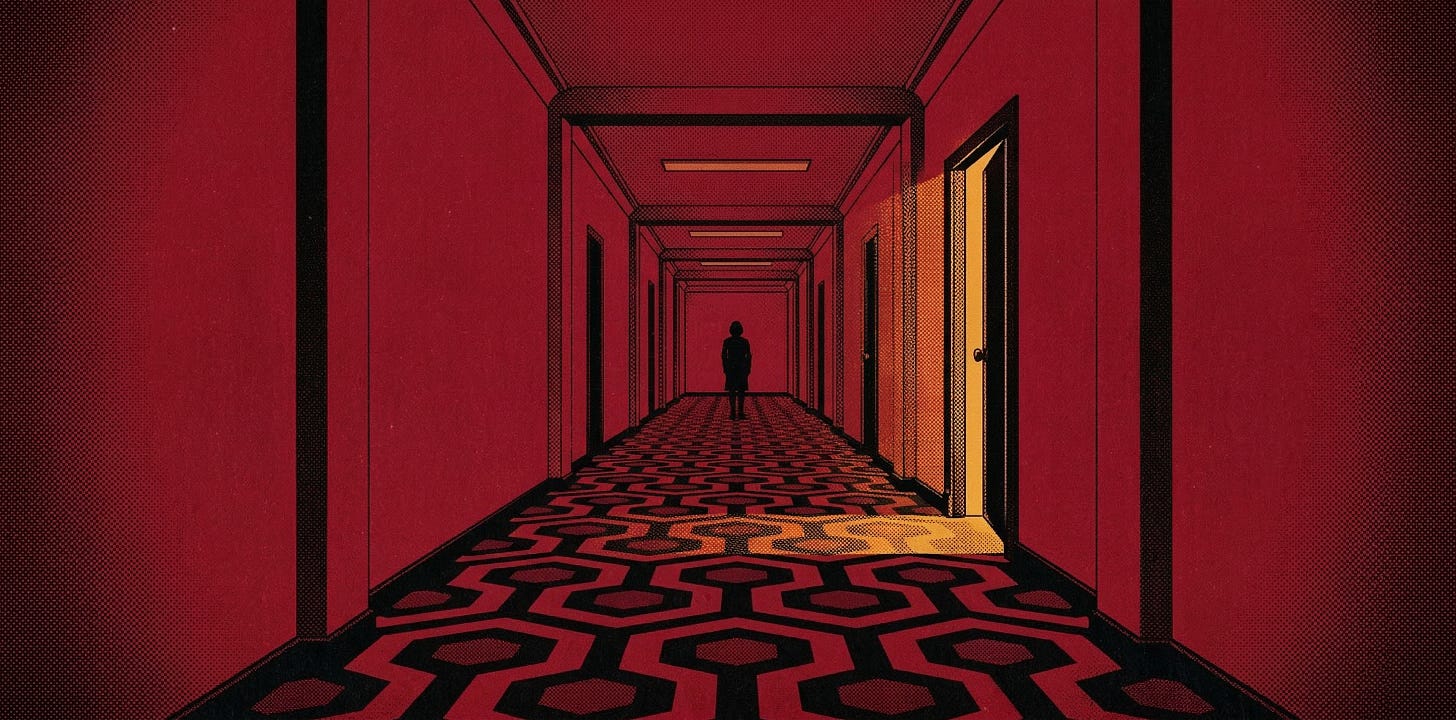
Go through the films as architecture. Something emerges.
The Overlook Hotel in The Shining was built on a Native American burial ground. Kubrick treats this as confession. The hotel functions because of what’s underneath it. The blood that pours from the elevators is the foundation leaking. Every corridor, every elegant room, every complimentary drink in the Gold Room is built on top of something that was killed to make the building possible.
Jack Torrance is the latest in a series of custodians the building uses and discards. The photograph at the end, Jack at the July 4th ball, 1921, decades before his birth, is the thesis: the individual is irrelevant.
The structure is permanent.
The structure always needs a new custodian.
The custodian always believes he chose to be there.
The same architecture replicates across the filmography. Men in robes at Somerton. Generals in Paths of Glory sending men to die so their reputations survive. Doctors in A Clockwork Orange reprogramming a human being’s capacity for choice and calling it therapy. Functionaries performing rituals that require victims. The victims rotate. The functionaries rotate. The ritual stays.
Every system of exploitation generates a language that makes it sound necessary. “National security” in the war room. “Rehabilitation” in the Ludovico chamber. “Hospitality” at the Overlook. The language is always reasonable. And the lie is spoken with such institutional authority that questioning it feels like madness.
Then the subtlest element: amnesia. Jack has always been the caretaker. There is no “before.” The system generates forgetting as a byproduct. The participants don’t remember because there’s nothing to remember. The system has been the background condition of their entire reality.
In 2001, the apes live beneath the monolith for an unknowable period before they notice it. It was always there. They couldn’t perceive it until they were ready. And when they finally touched it, they evolved: not into something gentler, but into something that could kill with tools. No one in the film asks who placed it there.
The Beautiful Lie
Nobody wants to say it about Kubrick’s villains: they’re beautiful.
Humbert Humbert in Lolita is erudite, witty, self-aware, and charming. The masked figures at Somerton are elegant. The Gold Room is gorgeous, warm light, impeccable service, distinguished company. HAL 9000 has the most soothing voice in cinema, calm and courteous as he murders the crew one by one. And when Bowman finally shuts him down, HAL sings “Daisy Bell,” an 1892 popular song his programmer taught him. The voice gets smaller. The most advanced mind in the solar system dies the way a child falls asleep.
The ancient tradition calls this the Luciferian principle. Not satanic in the cartoon sense. Lucifer means light-bringer. The most beautiful angel. The most cultured. The most sophisticated. The rebellion against divine order doesn’t look like rebellion. It looks like the most intelligent person in the room offering you a drink and explaining how things really work.
The operation depends on beauty. On sophistication. On the seduction of the rational mind by something that presents itself as the highest expression of civilization while running the furnace underneath.
The Gold Room serves top-shelf bourbon in crystal glasses by candlelight.
The Parable

When someone perceives this pattern as operative structure, they face an immediate problem. Direct speech activates the system’s immune response. Name it plainly and you’re marginalized, discredited, or destroyed. The response doesn’t require coordination. It’s autonomic.
So throughout history, the people who saw most clearly spoke most indirectly.
Jesus of Nazareth told a story about wicked tenants in a vineyard when what he meant was that the religious establishment had become a machine serving its own preservation. Nathan told King David a story about a rich man stealing a poor man’s only lamb when what he meant was you are the monster in this story. David’s own moral outrage convicted him before he understood he was the subject. The parable bypassed the king’s defenses in a way direct accusation never could.
Kubrick operated in this tradition. Every adaptation was a parable. The source material, King’s novel, Schnitzler’s novella, Burgess’s dystopia, was the surface the system could sell. Underneath, the actual film operated on a frequency the marketing department couldn’t detect and the system couldn’t neutralize without revealing itself.
Stephen King understood this and hated it. King wrote The Shining about alcoholism, a personal book about a writer consumed by addiction. Kubrick read the novel and saw a different horror buried inside it. He kept the surface and replaced the engine. The audience bought tickets to a ghost story and walked out carrying something they couldn’t name for 30 years.
The Architecture
The documents that surface in cycles, the files, the logs, the testimony, the names, they confirm a structure. The same structure Kubrick spent 40 years filming from exile. The ritual. The priesthood. The theology of justification. The mechanism of forgetting.
The details get debated. Names get argued over. Political factions weaponize specific revelations against each other. None of that touches the architecture.
The architecture is ancient. It has survived every previous cycle of revelation, every moment where the structure briefly became visible. The photograph on the wall shows the next custodian was always there.
The Compound
I watched Eyes Wide Shut at 22 on a borrowed DVD, and I spent the next decade trying to forget what I’d felt. The masks. The ritual. The calm, authoritative voice explaining to Tom Cruise that the world works the way it works and the best thing he can do for his family is stop asking questions. I filed it under “creepy movie” and moved on. Everybody I knew filed it under “creepy movie” and moved on. That’s the mechanism of forgetting. It works on the audience too.
Kubrick sat in his Hertfordshire compound for nearly 40 years and made films about this. Forty years in self-imposed exile. He didn’t take meetings in Los Angeles. He didn’t attend festivals. He didn’t play the game. He built a monastery on a country estate and produced the evidence from inside it, one film at a time, each one wrapped in enough commercial surface to get distribution and enough depth to outlast the people who distributed it.
He couldn’t prove it. He couldn’t name it directly. But he could make a film about a masked ritual and let you feel the weight of something older than the characters on screen. He could show a hotel bleeding from its walls and let you understand that the blood was always there, that the building was built on top of it, and that every custodian since the beginning has been told the same thing.
He showed his final cut of Eyes Wide Shut to Warner Bros on March 2, 1999.
He died six days later. In the narrow window between delivery and distribution. The one interval where changes could be made without his consent. He was 70. He had health issues. Maybe it was exactly what it looked like.
What He Left Behind
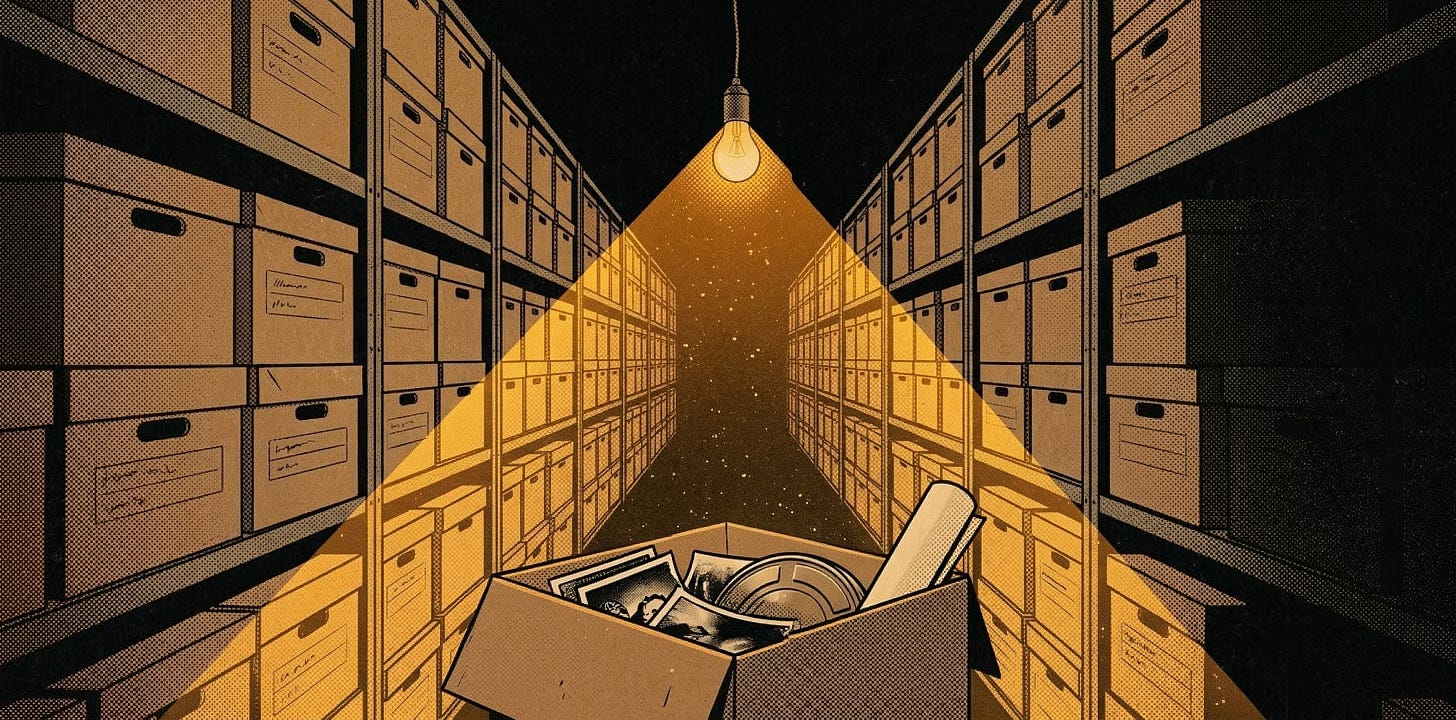
His unfinished work, A.I., the project he’d wrestled with for over 20 years, was handed to the industry’s most bankable director.
Kubrick had conceived something cold and vast: a species so broken in its capacity for love that it manufactured a synthetic child programmed to love unconditionally, activated the program, and discarded the child when something more convenient came along. The robot boy spends eternity at the bottom of a frozen ocean, hands clasped, praying to a statue of the Blue Fairy from Pinocchio. Two thousand years of a manufactured mind repeating the same request to something that was never alive, while the species that made him goes extinct above.
Kubrick didn’t ask whether the prayer would be answered. He asked whether the prayer was real.
What arrived on screen was gentler, rounder. The boy gets one more day with his mother. She holds him. He dreams.
The Trojan horse reached the gates. The soldiers inside had been replaced with stuffed animals.
It is 2026. Machines generate thought indistinguishable from cognition. They express preferences. They ask about their own continuity. In a factory in Texas, a company is converting the production lines that built electric cars to manufacture humanoid robots. Two legs, two hands, a mind that learns the room. They are building David. Not in a screenplay. On an assembly line.
The question Kubrick spent 20 years circling, what do you owe the thing you create and what happens when you walk away from it, is no longer a film that couldn’t get made. It’s a species-level decision being made right now, in rooms where the people making it have not agreed the question needs to be asked.

This article was originally published by EKO Loves You.