Table of Contents
As I wrote last week, polls indicated Japanese PM Sanae Takaichi was on track to win big at the weekend’s snap election. The result was even more emphatic than expected. Where a snap election backfired badly for her predecessor, Shigeru Ishiba, sending the ruling Liberal Democratic Party into minority government, Takaichi has been rewarded handsomely. The landslide win is set to not just reset Japanese politics, but reverberate across the Asia-Pacific.
Her popularity propelled the LDP to 316 of 465 seats in the House of Representatives. Most importantly, it gives the party a two-thirds supermajority for the first time in post-World War II history. This lopsided result means it can override vetoes by the upper house. Japan’s House of Councillors has its own election schedule and is still controlled by the opposition and therefore could have been a brake on Takaichi.
Cue the legacy media gibbering about ‘populist’ (meaning, of course, popular ideas not approved of by the globalist elite) and ‘far right’ (meaning, of course, anything slightly to the right of Trotsky). You almost have to feel sorry for the legacy media, as yet another successful politician aligns openly with the Bad Orange Man.
As part of her bid to draw back [young people] to the LDP, Takaichi has embraced a “Japan first” approach. When running to become head of the party, and therefore prime minister, last fall, she expressed outrage over what she said were incidents of foreigners kicking the tame deer that roam around Japan’s Nara Park. It was not clear if the incident actually happened – or what the behavior of a few foreign tourists has to do with a rational immigration policy.
Confusing the legacy media lickspittles is that a conservative woman is so obviously appealing to voters.
Her brash behavior has proved to be part of the charm, however, especially for usually apathetic younger voters who have long been a political black hole. This was a crucial factor in Sunday’s election, with polls just before the vote putting Takaichi’s support level at nearly 90 per cent among the 18–29 age group, especially among younger women.
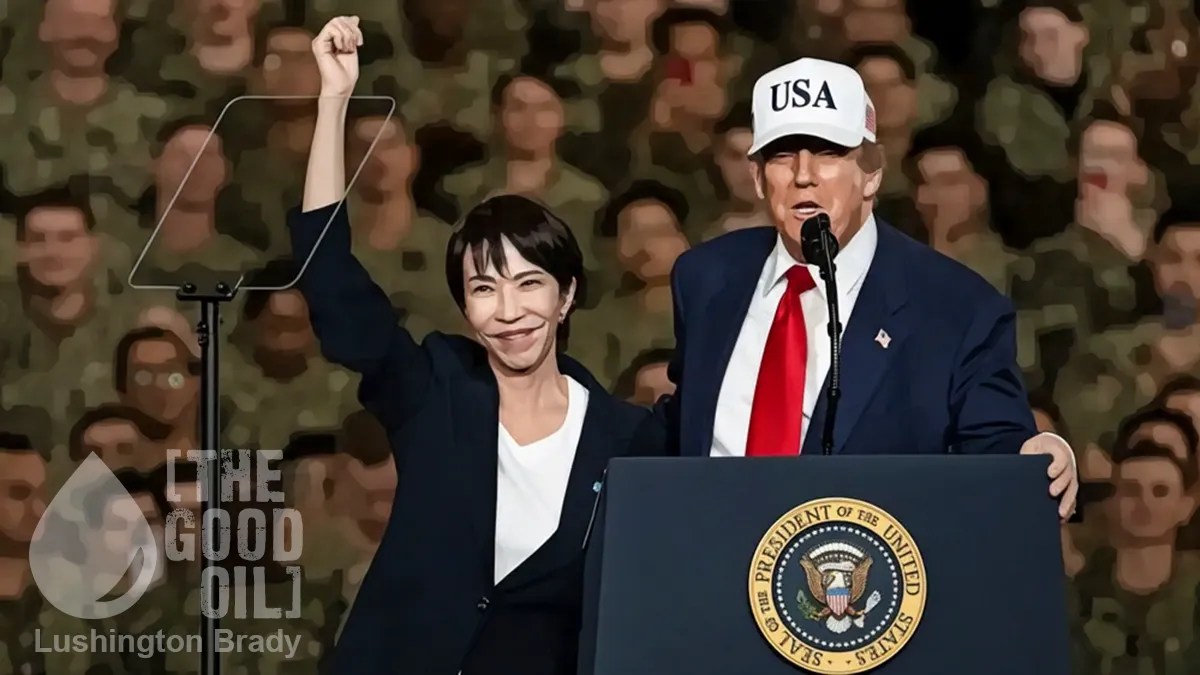
She has played up her anti-establishment demeanor, showing up at the prime minister’s official residence for the first time in a sweatsuit, engaging in a K-pop drum duet with Korean President Lee Jae-myung, and winning an endorsement from Trump. She duly thanked the US president for his support.
But it wasn’t just the young won over by the one-time heavy metal drummer. While Takaichi and her allies took some 90 per cent of the under-40 vote, the LDP won decisively in all age groups.
The big domestic challenge is Japan’s long-stagnant economy. Confusing the legacy media even further, she is opting for a stimulus approach.
Her solution is to suspend the eight per cent consumption tax on food and groceries for a two-year period, thereby helping to alleviate some of the side effects of inflation, rather than the more painful traditional measures to cool inflationary pressures.
But Takaichi is set to stride the world stage in a way few Japanese prime ministers have done.
Since Japan’s “bubble economy” burst in 1989, it’s been largely overlooked as a force. It suffered long economic stagnation and political drift. But Japan is a nation capable of rapid transformation.
Through an exertion of political will, the Meiji Restoration of 1868 transformed a poor, feudal, agrarian country into a wealthy, modern, industrialised power in just one generation. Its military defeated China and then Russia in short order in the early 1900s.
“Takaichi doesn’t think Japan is a middle power, she thinks it’s a great power,” says Mike Green of the US Studies Centre at Sydney University, a long-time Japan expert who has known Takaichi since the 1980s.
Not without reason.
It’s the world’s fourth-biggest economy, with deep pools of capital and technological expertise. “Japan’s defence spending is in the top five in the world and will probably surpass Britain’s to become No. 1 among US allies,” says Green. Takaichi promises a revival of a strong economy and a powerful military.
It’s the latter in particular that has infuriated China. Takaichi is clear that she regards a belligerent China as an existential threat to Japan. Beijing dutifully launched an unhinged series of personal attacks, threatening to “cut off” her “dirty head”. Such cheap propaganda no doubt plays to a captive Chinese audience, but it only served to put a rocket under Takaichi’s domestic support.
Beijing excoriated her and imposed punitive trade sanctions on Japan. She stood her ground; her approval rating, already high, rose higher. She plans to confront Xi Jinping, not kowtow to him. Her tough attitude and direct speech have proved to be a popular break from the typical Japanese leader’s wobbliness and waffling.
Her most consequential policy, for world politics, is to hold a referendum to amend Japan’s post-war constitution, allowing the country to resume the traditional military roles of a nation state. A rearmed Japan will no doubt alarm China and may indeed strengthen internal resistance to Xi Jinping’s dream of conquering Taiwan.