
Tom Hunter
No Minister

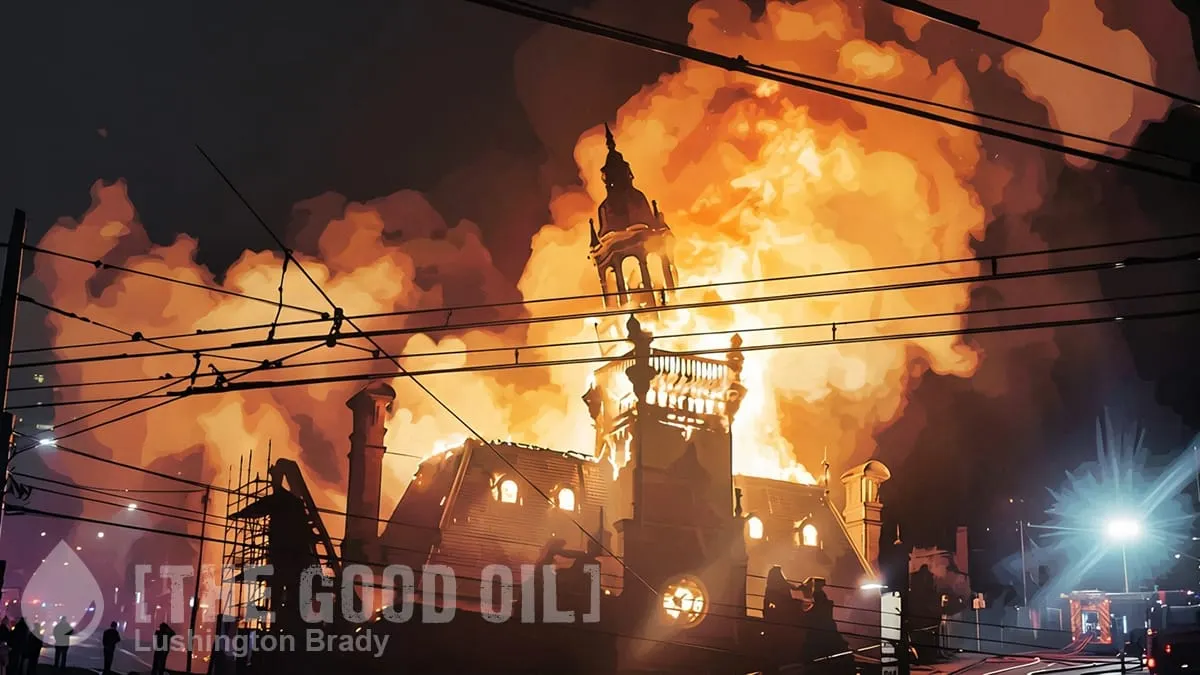
That image is of the burning pile of wreckage containing the body of Iranian General Qassem Soleimani after he was killed by a Predator drone strike in Iraq six years ago, on the order of President Trump.
Trump repeated the process in early March of this year, this time taking out the Ayatollah himself and a good bunch of his top goons, followed by a couple of weeks of air strikes that killed more of them. This was in accord with what I said in June 2025, that although the common wisdom is that you can’t change a regime via air power alone, killing all the Mullahs, plus the upper five levels of the IRGC would go a long way towards that goal in Iran.
It’s been quite clear for some time that Trump also doesn’t believe the regime-change-via-airstrike theory either.
Unfortunately he still believes in an even more outlandish theory: that he can cut a solid and enduring deal with the remaining bits and pieces of the regime. The following article makes it clear why that is not possible.
The TLDR version is that the regime is dedicated towards a religious project far in excess of even the standard Islamic desire for Dar al Islam across the entire world (as if that aim is not crazy enough):
That project rests on a specific theological architecture, one that begins with Twelver Shia Islam’s singular orientation toward the end of history. The entire tradition converges on Akhir az-Zaman, when the hidden Twelfth Imam, Muhammad al-Mahdi, emerges from his divine occultation. He remains in concealment, awaiting the appointed hour.
When that hour arrives, the Mahdi emerges to confront and defeat the Dajjal (The False Messiah) and the Sufyani, a tyrant from the Levant whose wars and massacres figure among the major signs of Qiyamah. The tradition holds something considerably more nuanced, for the Mahdi arrives at the lowest point of the human condition, summoned by the world’s complete exhaustion of its capacity for suffering.
Four decades ago it was not uncommon to read fearful commentary arguing that the reason that Evangelical Christians supported Ronald Reagan and his Cold War arms buildup, was they wanted a literal Armageddon, and end-of-days when Christ will judge the living and the dead, and that nuclear war between the USA and USSR was the obvious method. As it happens I don’t recall them actually quoting any such Christians making exactly that argument – it was implied from the rest of their beliefs. At best a logical extrapolation: at worst the usual smear job from the left against yet another right-wing opponent.
And yet that is exactly what we have in Iran today, yet I’ve not yet read any such commentary from that quarter about Iran’s project, even though one of the great Western historians of Islam, Bernard Lewis, made it clear 20 years ago:
There is a radical difference between the Islamic Republic of Iran and other governments with nuclear weapons. This difference is expressed in what can only be described as the apocalyptic worldview of Iran’s present rulers. This worldview and expectation, vividly expressed in speeches, articles, and even schoolbooks, clearly shape the perception and therefore the policies of Ahmadinejad and his disciples.
Even for non-leftists this seems a little too much to swallow. It’s simply not believable, it’s insane: they cannot possibly actually think that. The article addresses that point:
A normal Western politician carefully weighs risks and adapts to changing circumstances. But the true committed IRGC revolutionary, driven by this unshakable faith, inhabits an entirely different relationship with time. For him, the final victory is already secured. The present does not create the future, and merely confirms what was always destined to occur. Raymond Aron once observed that “foreknowledge of the future makes it possible to manipulate both enemies and supporters”. The IRGC not only believes in its eschatological vision, but it also uses it, and the difference matters enormously.
Trump is one of those Western politicians, which is why all this deal-making is not going to work:
We all are products of our background. Heredity, environment, lessons and experience from both successes and failures, all shape our outlook and inform our actions in times of stress. President Trump’s background is in deal-making. He is master of the deal. His ability to make the best deal is a major part of his self-image. He has even written a best-seller about how to succeed in making the best deal. But The Art of the Deal is not a military strategy. And however valid Mr Trump’s lessons in negotiating may be, he is no Clausewitz or Sun Tzu. And his seemingly constant quest for a “deal” undermines any acceptable goal in the ongoing war.
Even less so when it’s becoming clear that the Islamic Guard has taken full control of Iran, though I think the claim that they’ve seized power from the ‘moderates’ is a continuing sick joke. They’re simply the only semi-competent organisers left alive, and since they’re as religiously fanatical as the Mullahs – the IRGC was created specifically to defend the revolution – and have the added driver of greed via all the businesses they control I see no deal making success possible with them either.

One of the few good pieces of news out of this is that the rest of the Islamic world itself, the 80 per cent majority Sunnis, don’t believe this crap either but importantly, they don’t accept it from a theological point of view:
But this orientation collides at every point with the mainstream Sunni worldview, which treats Judgment Day as a matter of divine concealment rather than political schedule. Sunni tradition forbids the forcing of providence and regards any state organized around accelerating the end of history as a deviation from Islam rather than its fulfillment. The Arab world reads the IRGC through this very lens, and what it sees is not a pious republic being tested, but a heterodox project masquerading as the fulfillment of faith, structurally incapable of assessing its strategic failures.
Iran’s leaders have always been well aware of this, which is why their relations with the Gulf Arabs were cold and tense from the start, even before the latter egged on Saddam Hussein to attack Iran in 1980 and supported him throughout the course of the Iran-Iraq war (while Israel quietly supported Iran). The Persian-Arab antagonism is the cherry on top.
And that was before Iran started attacking all of them, seemingly at random. The first article I linked contains two pieces from Arab TV channels, but with a transcript in English: one is an interview with Iraqi researcher Ghaith al-Tamimi, a former Shia cleric who had met Khamenei several times; the second a panel debate between Arab intellectuals and analysts. Just this one quote shows how crazy the regime is:
The Iranians, the Revolutionary Guard, are committing suicide without any vision. Can you imagine them attacking Iraq? I cannot understand this. The Revolutionary Guard is attacking oil in Majnoon, meaning in Qurna, Basra. This is the strategic depth of the Shia who are linked to the Guardianship of the Islamic Jurist, who have been smuggling oil to Khamenei for 20 years and funding the Revolutionary Guard.
If your theology is that all your suffering and destruction is good because it leads to the End-Of-Days, while those Arab countries pour hundreds of billions into modernising their cities and nations with a view to a prosperous future, then that’s going to add another reason why the Arabs would be happy to see the end of the regime:
Something unprecedented is stirring in the Arab world. Beyond the expected discussion of the war and of Iran’s long record as an aggressor, one now hears a different register altogether, a growing conviction that the regime itself may actually fall because its revolutionary aim is being exhausted. I believe this shift has no precedent in living memory.
That’s the only deal I’m interested in seeing made.
======================
As an addendum this Tablet magazine article is an excellent read on the situation, Seven Myths About the Iran War. Detail at the link, but it keys off of a recent interview with Biden’s National Security Adviser Jake Sullivan, where he predictably placed the blame for this situation on Trump. The myths are:
- This was a “war of choice.”
- The Joint Comprehensive Plan of Action had moderated Iran and stabilized the Middle East before Trump broke it.
- Biden extracted America from wars in the Middle East.
- Tehran was ready to compromise.
- Israel dragged America into the war.
- Confronting Iran distracts from China.
It’s Myths 2 and 5 that I’m interested in:
Myth 2: The Joint Comprehensive Plan of Action had moderated Iran and stabilized the Middle East before Trump broke it.
The timeline doesn’t work. Trump withdrew from the nuclear deal in May 2018. Tehran did not begin enriching its uranium to 60%, a major threshold that dramatically shortens the path to a nuclear weapon, until April 2021. In other words, Tehran made this crucial leap toward weaponization on Biden’s watch, not Trump’s.
And how did Biden respond? With conciliation. The administration stopped enforcing sanctions, especially against Chinese buyers. Iranian oil exports surged, and with them regime revenues. As Iran’s breakout time shrank to a matter of weeks, Biden and his team painted the increasing threat it had created as Trump’s fault. Every Iranian nuclear advance became, in their telling, not only a consequence of the 2018 withdrawal but also a justification for further conciliation. ...
Biden restored the core logic of the JCPOA unilaterally. Sanctions relief flowed while nuclear constraints collapsed. Tehran blew past the restrictions on the size of its uranium stockpiles and levels of enrichment while Washington relaxed pressure and pursued diplomacy on Iran’s terms.
Not mentioned here is that members of his own party, including Senator Chuck Schumer, went against Obama’s original JCPOA deal back in 2015, making much the same arguments that Trump and company have made, including that it was not enforceable, which is why Obama never even bothered submitting it to the Senate.
Myth 5: Israel dragged America into the war.
In the interview with Stewart, Sullivan distanced himself from the crude conspiracy theory that the Israeli tail is wagging the American dog. “I never bought that,” he said. But he then quickly revealed his alignment with progressive anti-imperialism, in which America is eternally the Great Satan: “I feel like [the Israelis] are a convenient scapegoat for the United States to continue our imperialistic adventures in that part of the world.”
This article was originally published by No Minister.


![[The Good Oil] Stuff Up of the Day](https://storage.ghost.io/c/31/f4/31f4e20a-0315-499e-83ff-139e8eab53bf/content/images/size/w1304/format/webp/2024/09/Stuff-up-image-1.webp)