Table of Contents
Greg Bouwer
IINZ
On 14 December 2025, Jews gathered at Bondi Beach to celebrate the first night of Chanukah – a festival of light, survival, and religious freedom. Instead, they were met with bullets. Fifteen people were murdered in a targeted terrorist attack. Dozens more were wounded. The victims were families, children, elders, and community members attending a religious celebration in a public space.
Authorities were unequivocal: this was a deliberate antisemitic attack. Yet the full meaning of Bondi Beach cannot be understood by examining the act or perpetrators alone. The deeper story lies in what followed – in the digital aftermath, the ideological justifications, and the social reflexes that emerged almost immediately after the blood had dried.
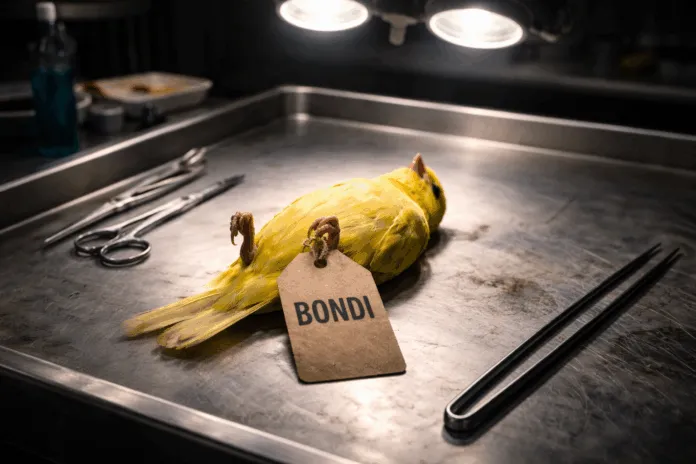
The Online Hate Prevention Institute’s (OHPI) report on the Bondi Beach Chanukah Massacre is not simply a record of online abuse. It is a forensic examination of a moral failure. As the report itself suggests, it functions as an autopsy of a canary – a warning sign ignored until it was too late.
Atrocity-Related Antisemitism
One of the report’s most significant contributions is its identification of what it terms “atrocity-related antisemitism”. This is not merely hatred expressed after violence: it is hatred that responds to violence by justifying it, celebrating it, denying it, or reassigning blame to the victims themselves.
In the weeks following the attack, OHPI documented more than 650 items of hateful online content. Nearly four out of five were antisemitic. These were not limited to slurs or abuse. They included:
- Glorification of the murders;
- Justification, portraying the victims as deserving targets;
- Minimisation, downplaying the scale or significance of the massacre;
- Denial, claiming the attack was staged or fabricated; and
- Distortion, alleging Jewish or Israeli orchestration.
These patterns are not novel. They mirror the rhetorical strategies of Holocaust denial and, more recently, the denial and distortion surrounding the Hamas atrocities of October 7. What changes is the event, but the logic remains the same. Jewish suffering is treated as inherently suspect, politically inconvenient, or morally reversible.
This matters because it reveals a critical shift – antisemitism is no longer confined to prejudice against Jews as people. It increasingly operates as a framework for interpreting reality, one in which Jewish victimhood is systematically erased or inverted.
Racist Antizionism and the Collapse of Moral Boundaries
A central finding of the report is the role played by what it describes as Racist Antizionism. This is not disagreement with Israeli policy or opposition to a particular government. It is an ideology that treats “Zionist” as a proxy for “Jew”, and uses that label to strip individuals of civilian status and moral protection.
In the aftermath of the Bondi massacre, victims were routinely referred to as “Zionists”, as though this alone rendered their murder comprehensible – even justified. Jews attending a Chanukah celebration were framed not as civilians, but as representatives of a global enemy.
This is the logic of collective guilt. It is the logic that dissolves the distinction between combatant and non-combatant, between ideology and identity. When applied consistently, it leads not to political critique, but to the moral authorisation of violence.
The OHPI report is clear – when violence against Jews is reframed as resistance, antisemitism has crossed a critical threshold. It has become an enabling ideology.
Normalisation, Not Radicalisation
Perhaps the most unsettling conclusion of the report is that the attitudes documented were not confined to fringe extremists. The density of hate in comment sections responding to Jewish community posts was comparable to that found on content explicitly designed to provoke hatred.
In other words, antisemitism did not surge only where one might expect it. It appeared as a default response, embedded in mainstream discourse, amplified by algorithms, and repeated with little resistance.
This is what makes the canary metaphor so apt. The danger was not hidden. It was visible, audible, and measurable. Yet repeated warnings about rising antisemitism were often dismissed as exaggeration, bad faith, or attempts to silence debate.
The result was not merely a hostile environment, but a permissive one – in which the psychological barrier to violence was steadily eroded.
Disinformation and the Machinery of Denial
The report also documents the growing role of disinformation, including the use of generative artificial intelligence, in shaping post-atrocity narratives. False claims about the attack circulated rapidly. In some cases, AI systems themselves reproduced denialist content, reinforcing confusion and distrust.
This phenomenon – described in the report as “algorithmic gaslighting” – is particularly dangerous. It undermines shared reality at precisely the moment when moral clarity is most needed. When atrocities can be instantly denied, reframed, or relativised at scale, accountability dissolves.
The consequences extend beyond any single event. A society unable to agree on what happened cannot meaningfully debate why it happened – or how to prevent it from happening again.
Rejecting False Moral Equivalence
The OHPI report does not ignore the rise in Islamophobia following the attack, nor does it excuse it. Anti-Muslim hatred is real and must be confronted. But the report firmly rejects the practice of collapsing distinct forms of hatred into a single moral blur, or of minimising antisemitism by invoking potential backlash against others.
This is not solidarity. It is deflection.
Moral clarity requires holding more than one truth at once – condemning antisemitism without hesitation, while also condemning collective blame against Muslims. The presence of one injustice does not nullify another.
The Canary Has Died. The Warning Remains.
The Bondi Beach Chanukah Massacre did not emerge from nowhere. It was preceded by years of rhetorical escalation, ideological distortion, and institutional reluctance to name antisemitism clearly when it appeared.
The OHPI report does not ask readers to be shocked. It asks them to recognise patterns – and to understand that how societies respond to violence matters as much as the violence itself.
When mass murder of Jews is met not with universal moral revulsion, but with justification, denial, or applause, something fundamental has broken.
The canary is dead. The air is poisoned. The question the report leaves us with is not whether warnings existed, but whether they will continue to be ignored – until the next autopsy is required.
This article was originally published by the Israel Institute of New Zealand.