Table of Contents
Yvonne van Dongen
Veteran NZ journo incredulous gender ideology escaped the lab. Won’t rest until reality makes a comeback.
I attended the Block the Ban rally in Auckland, despite not agreeing with a single thing they stand for.
Why, you ask? Because, number one, I wanted to see how many people would turn up and number two, see who they were – and a distant third, listen to how they would frame medicalising and sterilising children.
That’s because Block The Ban is a protest against the government’s decision to ban new prescriptions of puberty blockers from December 19 except for early onset puberty, endometriosis or prostate cancer. This, in itself, is remarkable. To my knowledge, there has never been a local protest about the availability of medication before.
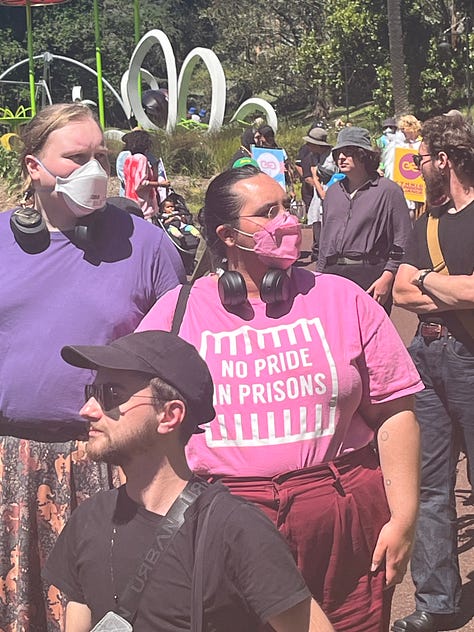
So let us begin with the who. Five hundred young people, most in their 20s, wandered into Myers Park on a sweltering Auckland Sunday morning, one of those mornings that are so brilliantly sunny, everything looks shiny and new.
That should have included the sun-kissed young people around me. It usually does. Since my own youth is long gone, I’m inevitably struck by the sheer casual loveliness of the bloom of youth. All of them. Every single one. Just gorgeous.
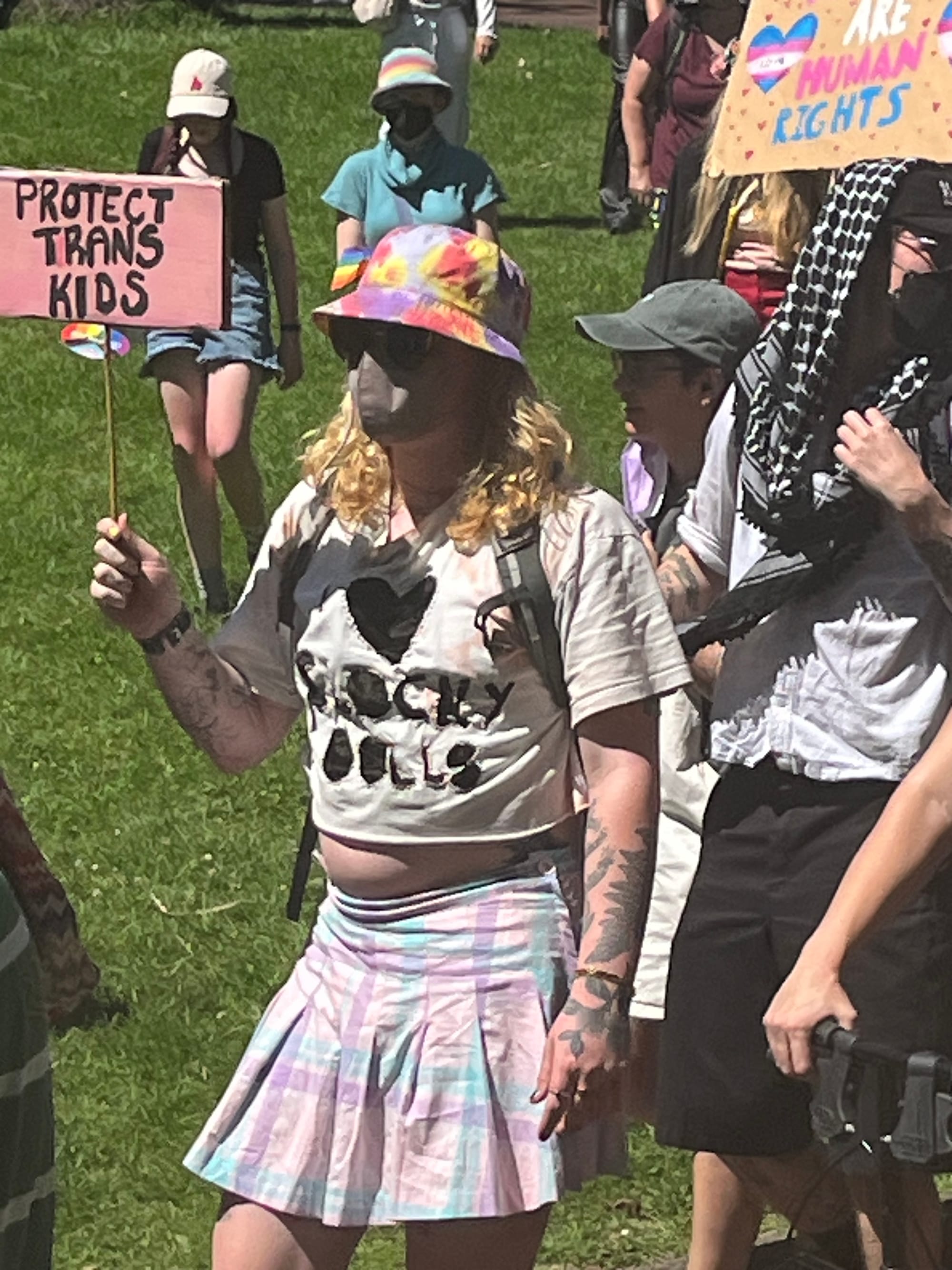
But not here. Not at the Block The Ban gathering. Here was a motley collection of the plain and the plump. The unlovely ends of the bell curve of beauty, made unlovelier still by a preponderance of grim hair styles and acid-coloured locks.
To be expected I suppose from a group dedicated to ‘queering’ gender norms. That’s not to say some hadn’t dressed up for the occasion. A creature with huge feathery angel wings and trailing a golden cape made quite the entrance, accompanied by someone wearing a sparkly black hijab. The former was recognisable as Eliana Rubashkyn, the tomato-juice thrower at the Posie Parker event two years ago. The latter is said to be a disabled, neuro-diverse, Muslim trans woman. Also asexual.
Actually there was a noticeable number of young people with walking sticks, which may be a sign that the movement attracts the disabled or that these individuals need a cane as a result of puberty blockers weakening their bones.
So to the plain and the plump, we can add the confusing. Honestly, if the continuation of the species depended on this lot, we’d be doomed. Extinction Rebellion indeed.
One last observation about the demographics of Block the Ban to add to the plain, the plump and the confusing and that is the white. So white. The gathering was remarkably white for a city that is at best half white, a third Asian, 16 per cent Pacific, 12 per cent Māori and the rest Middle Eastern, Latin American and African.
Of course, the organisers made sure they referenced tangata whenua as best they could. People advertised as kaiāwhina (helpers) watched over us and the day began with a lengthy welcome in te reo I’m guessing barely anyone understood. But, you know, box ticked. Very good.

Really, the Block the Ban organisers had thought of everything. Water, sunblock, masks and leaflets with catchy chants (pictured above) were handed out. Their Facebook pages recommended bringing personal medication, stim toys and ear plugs (“tools you need to feel safe”). Stim toys, in case you don’t know, are also called fidget toys or objects designed to help individuals self-regulate their emotions and manage sensory input. Thoughtful. It might as well have been a children’s outing. A special needs children’s outing.
The therapeutic model of protest extended to the language of the speeches. The Rainbow Youth speaker declared she had been “crying for our community” since the news broke but all was not lost. She recommended they alchemise their pain towards justice.
Various speakers talked about witnessing the relief puberty blockers had brought individuals, claiming that blockers had been used safely and cautiously for decades but, thanks to Winston Peters and ‘imported culture wars’, that was now lost. They listed all the medical organisations that supported the use of these drugs and, to be fair, it was depressingly long.
Several trans women and an executive member of the Professional Association for Transgender Health Aotearoa (PATHA) spoke. Despite the BTB Facebook page saying they are not politically affiliated, Green MP Ricardo Menendez March was allowed to speak.
Speakers listed multiple systems of oppression because, you know, inter-sectionality – so begone racist, white supremacist and colonial rule that has no place in whenua Māori. “You can’t be anti-racist if you’re not committed to taking down the heteronormative patriarchy.” “No one is free until everyone is free.” “Be in solidarity with one another.”
Probably the most inflammatory speaker was the pink-haired, disabled transexual (his definition) in a wheelchair who called for “revolution at any cost”. And “fight back in the face of fascism until we win”.
After all the rousing speeches, the 500 rose to march into the city. By then my friend and I had had enough and decided it was time for lunch. We remarked that they had had a good turnout. If we weren’t sure that puberty blockers would remain banned, we might have been downcast.
There was also this. At one point in the proceedings an Indian family wandered into this hellscape, their speed increasing as they saw what surrounded them. What was most notable about this family wasn’t the colour of their skin, it was their sheer normalcy. A couple! Male and female! Two children! Dressed normally!
My friend nudged me. That’s the future, he said. People like that family would never stand for their children to be taught this nonsense.
Hallelujah. Demographics are destiny.


This article was originally published on the author’s Substack.