Ani O’Brien
Politics, news, and culture from New Zealand and beyond. I share opinions, but am prepared to change my mind. Postmodernism sucks.
Of all the crises we argue are confronting our world (climate change, artificial intelligence, political instability, war, etc) the one most likely to shape the fate of our species is the one no one wants to talk about. It won’t arrive with smoke or sirens, but with silence. Fewer cries in maternity wards. Empty classrooms. Dying small towns. And backs turned as aged populations suffer in societies unable to care for them.
This is the crisis of population collapse. Not a sudden extinction, but a slow, predictable, and largely self-inflicted decline. While headlines obsess over the planet’s eight billion people, the deeper story is that almost everywhere, birth rates are falling far below replacement level. Demographer Paul Morland’s No One Left argues that this quiet demographic implosion will define the next century more than any other force, reshaping economies, geopolitics, and even the meaning of life itself.
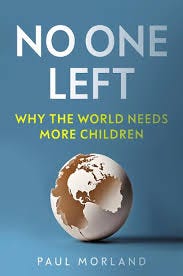
Before we can talk about this looming catastrophe, we need to be clear about what “population collapse” actually means. It doesn’t mean there are suddenly no people left. It means that for decades, birth rates fall so far below replacement that societies start to buckle under the weight of their own ageing population. You end up with too few workers to keep hospitals running, not enough taxpayers to fund pensions and welfare nor pay down debt, and political systems obsessed with maintaining the past instead of building the future. It’s not an apocalypse, but it is a slow, grinding decline.
“But, Ani, the world just hit eight billion, how is that collapse?”
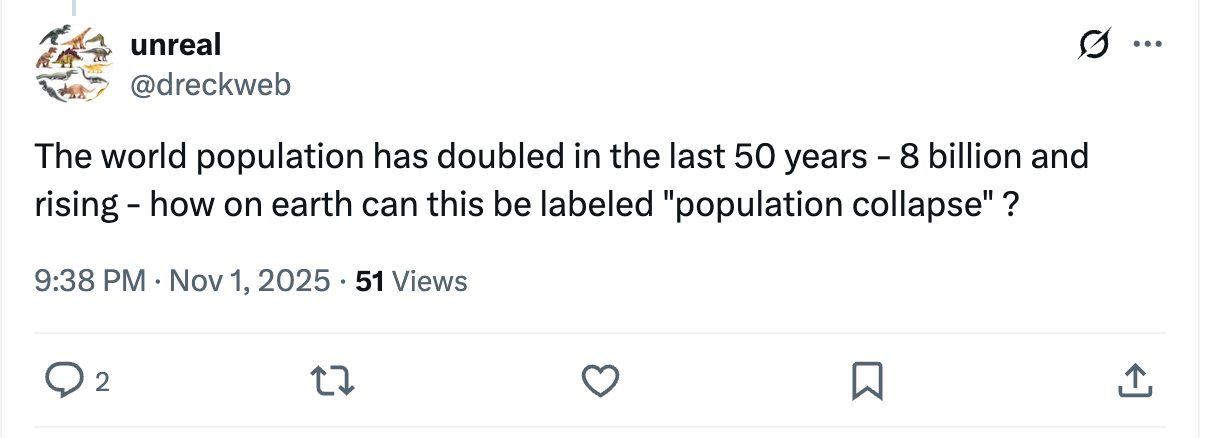
Two things can be true at once. Yes, the world’s population is still growing, but that’s mostly overflow from the big birth waves of the last century. Beneath that, the engine’s already stalling. Fertility has fallen below the replacement rate of 2.1 children per woman in most of the world, and UN projections show it dropping to around 2.1 by the 2040s and closer to 1.8 by the end of the century.
Morland’s point is brutally simple: once fertility collapses, it’s stubborn. It doesn’t bounce back. Governments have thrown everything at the problem, for example, baby bonuses, tax tweaks, and childcare subsidies, and still, very few have managed to lift fertility back to sustainable levels.
South Korea is the cautionary tale. Its fertility rate hovers around 0.7, the lowest in the world, despite years of government effort and billions spent trying to reverse it. A small uptick this year was treated like a national victory, but in truth, South Korea is still ageing faster than almost any society in history.

Why is this a problem? (the abbreviated answer)
First of all, when population decline hits, the first thing to crack is the money and once it goes, everything else follows. Every modern welfare state rests on an implicit bargain between generations: a fragile handshake agreeing that the young pay for the old, trusting there’ll be someone behind them to do the same. But when the workforce shrinks and the retiree pool explodes, that deal falls apart fast. The maths just ain’t mathing.
Fewer workers means fewer taxpayers. Fewer taxpayers means less money for everything like hospitals, schools, roads, pensions, and welfare. Governments are then left holding a fiscal grenade with the pin already out. They either hammer younger workers with higher taxes, gut the services everyone depends on, or rack up debt that’ll crush the next generation. None of those are real great choices. They’re slow death sentences for any country. Unless we face the numbers now, we’ll be left fighting over scraps later.
Remember, the old people I’m talking about aren’t the “bloody boomers” ageing out now. They are us. If we don’t set society up to support us in old age we will be in for a very rough time.
The squeeze doesn’t just show up in Treasury spreadsheets either. It spills straight into politics. As the average voter gets older, governments stop looking forward and start looking inward. Budgets tilt toward pensions, subsidies, and handouts instead of education, innovation, or infrastructure. The young end up footing the bill for systems that may not exist by the time we need them. The old, meanwhile, feel under siege as they’re told that what they’ve worked for is suddenly “unsustainable.” You can’t build unity on resentment, but that’s exactly where ageing societies end up. We do not want to be stuck in a tug-of-war between generations, arguing over who deserves what instead of asking how to build something worth inheriting.

And ambition slows too. When a society ages, it loses its edge. Growth depends on risk-takers, the people willing to start businesses, invent new things, and bet on tomorrow. Younger nations tend to do that instinctively. Older ones play it safe. As the median age climbs, more people are drawing pensions than starting companies. Spending drifts from innovation to healthcare, from investment to insurance. Industries stall because there aren’t enough young workers, and leaders delay big decisions because they’re terrified of upsetting an older voting bloc that demands comfort over change.
Culturally, it’s even more corrosive. When most people are old enough to reminisce “how things used to be”, politics becomes about preservation, not progress. The boldness that once built nations gives way to small thinking and soft decline. It’s not dramatic, it’s just the slow surrender of the excitement of possibility.
Furthermore, demography redraws the geopolitical map. When a country’s working-age population collapses, its influence inevitably fades. Fewer young people means fewer soldiers, engineers, and innovators. Tax bases shrink, military budgets tighten, and the nation’s ability to project power wanes just as its need for imported labour and energy grows.
We’re already watching this play out. Japan, long a global economic powerhouse, has struggled to maintain growth and military capacity amid rapid ageing. China’s population is now shrinking, and with it, the foundation of its manufacturing dominance. And Europe faces a massive strategic dilemma of vast welfare states, shrinking workforces, and a growing reliance on younger, more populous neighbours for both labour and defence cooperation.
Some countries are trying to fight the demographic tide with quick fixes: more automation, more migrants, more outsourcing. It looks clever on paper, but reality catches up fast. Automation can patch labour shortages, sure, but robots don’t pay taxes, buy houses, or raise kids. Yet, I guess. Migration can refresh a workforce, but it’s not a limitless resource either. Every country facing collapse is competing for the same shrinking pool of young people, and integration is hard even in the best of times. Get it wrong, and social cohesion cracks as fast as the economy.
At the end of the day, demographic strength is the quiet engine of national power. It’s what funds your hospitals, fills your classrooms, defends your borders, and keeps your culture alive. Nations that stop replenishing themselves eventually find out the hard way that the world stage is no place for a country in retreat.
In No One Left, Paul Morland talks about what he calls the “triangle of demographic strength” which is the balance between fertility, prosperity, and social cohesion. A society holds steady when all three sides are strong because people can afford to raise families, they believe their culture is worth continuing, and they share a sense of belonging to something bigger than themselves. When one side buckles, birth rates tumble and so does confidence in the future.
Across much of the developed world, that triangle has already fractured. We’ve had the prosperity, but it’s detached from purpose. Wealth has brought comfort and autonomy, but it’s also delayed family life and dulled the instinct to build for what comes next. As countries grow more fragmented, helped along by rapid, unmanaged immigration and the erosion of shared identity, fewer people feel any obligation to “pass something on”. Morland isn’t pining for sameness or endorsing some kind of ethnonationalism. He’s pointing out a truth that when people no longer feel part of a continuing story, they stop writing new chapters. The paradox is that the richer, freer, and more self-focused we become, the fewer of us there are to inherit it all.
Morland also draws a sharp line between two futures. The first is the high-fertility prosperity model in which nations stay rich and raise their own children, creating confident, cohesive societies with deep trust and natural continuity. The second is the low-fertility immigration model where governments try to paper over demographic collapse by importing enough new people to keep the GDP charts looking healthy. That strategy might work for a while, but it’s brittle. Integration gets harder, politics turns nasty, and the sense of shared direction starts to fray. Immigration can top up a population, but it can’t replace the will to reproduce. As Morland puts it, the countries that thrive won’t be the ones buying their future, they’ll be the ones raising it.
What’s driving the baby bust?
The reasons people aren’t having kids aren’t mysterious. They’re painfully ordinary. It’s housing that costs too much, childcare that’s impossible to find and fund, jobs that feel too unstable to plan a future around, and relationships delayed because everyone’s just trying to stay afloat. The United Nations calls it a “crisis in reproductive agency”, which is a polite way of saying people still want kids, but they just don’t see how they can afford them.
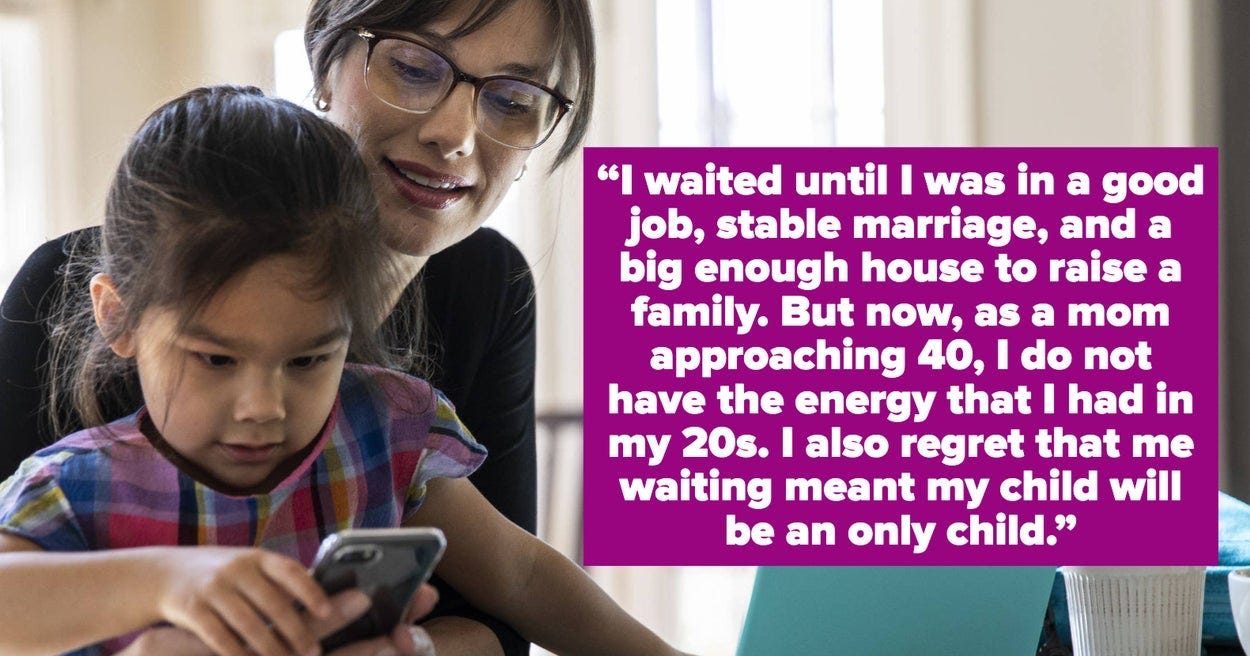
This is about policy rather than biology. When governments ignore the basic conditions that make family life possible, they don’t just lower birth rates, they lock them there. The more expensive and uncertain life becomes, the further the gap grows between how many children people wish they could have and how many they actually do. Fix the constraints, and you give families room to breathe. Ignore them, and you entrench a demographic death spiral.
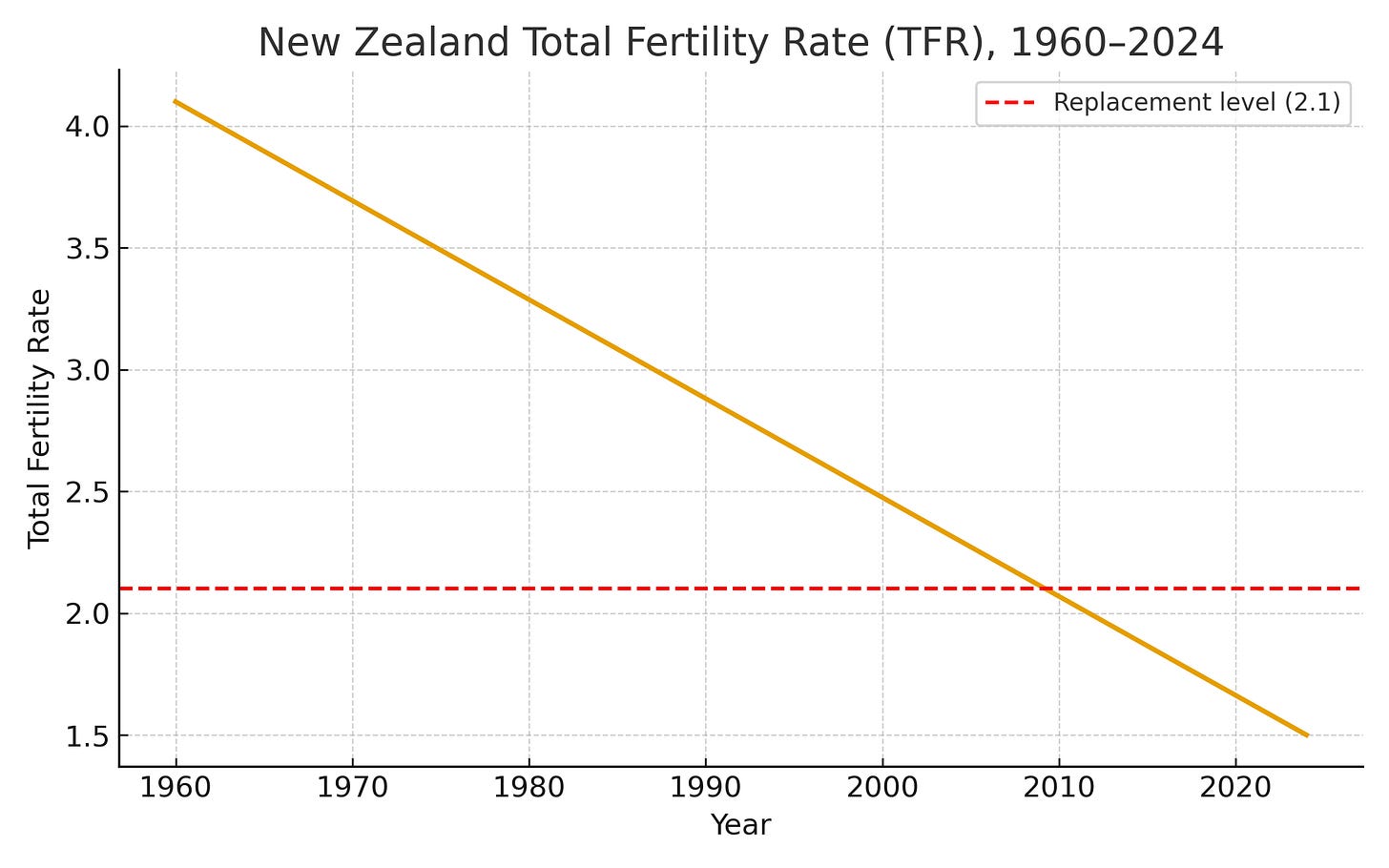
New Zealand isn’t immune to what’s happening elsewhere. As per usual, we’re just a few steps behind. We slipped below the replacement rate (2.1 babies per female) about a decade ago and haven’t bounced back since. Stats NZ puts our total fertility rate around 1.6. Births keep falling, deaths keep climbing, and while the country as a whole still records a small natural increase, more and more regions are already seeing the tipping point. More coffins than cots.
Immigration has been our band-aid. It’s masked the trend, numbed any concern, and let politicians pretend the problem isn’t urgent. But make no mistake, it’s a mask, not a cure. Strip out the inflows, and New Zealand’s population would already be on the verge of shrinking. The long-term trajectory is clear: fewer babies, more funerals, and a country quietly growing older while telling itself it’s still young.
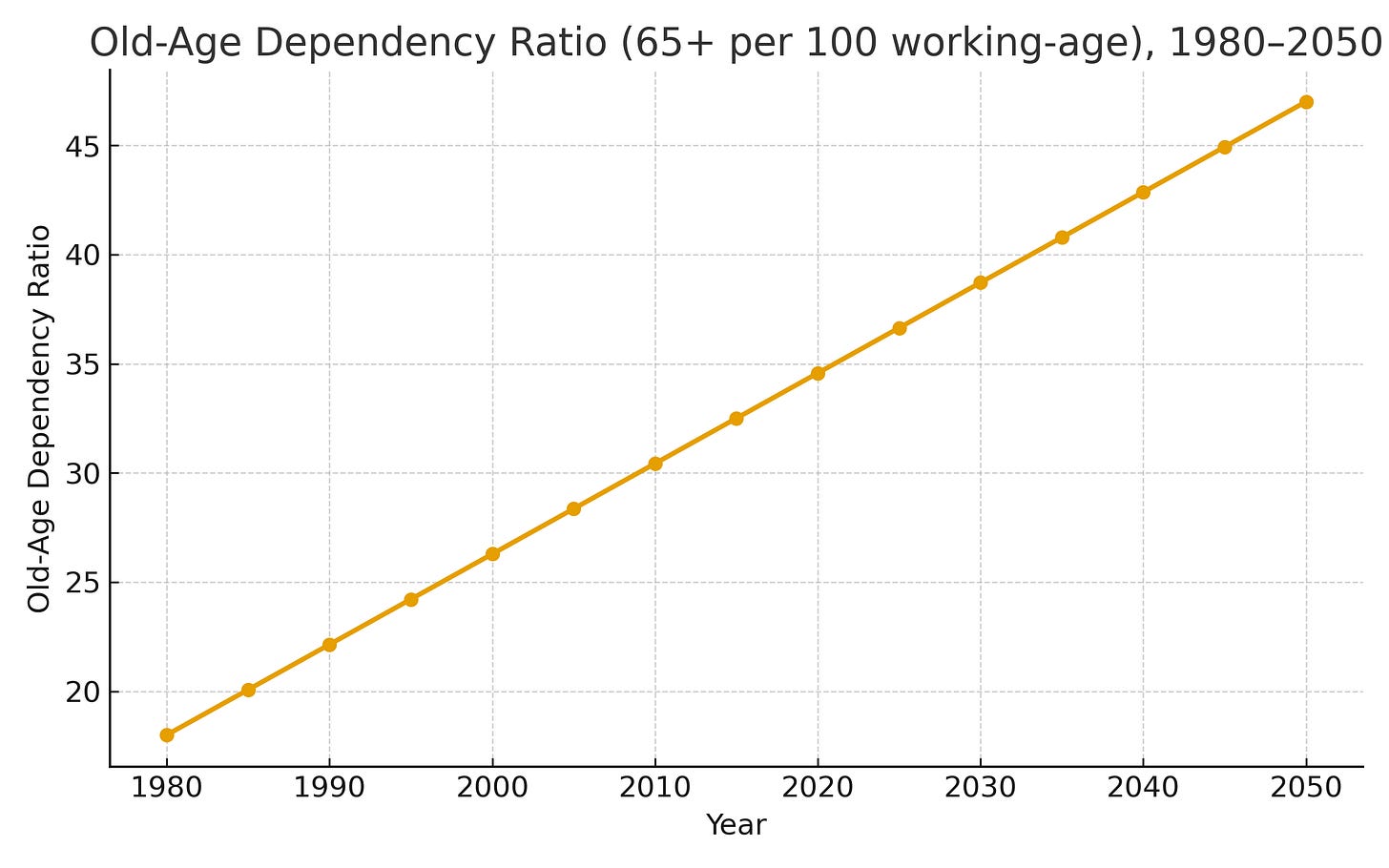
Ageing isn’t something that might happen, it’s already locked in. Our total-age-dependency ratio (the number of children and retirees compared to people of working age) is sitting at 55–56 dependents per 100 workers now and climbing fast. The old-age dependency ratio on its own (people aged 65+ per 100 working-age people) sits around 26–28. By the late 2040s, the number of New Zealanders aged 85 and over will have nearly tripled. Treasury and independent analysts are already running the numbers, trying to figure out what that means for superannuation, healthcare, and productivity. Spoiler alert: it is pretty dire.
Morland argues for making it easier and less costly to have the children people already say they want earlier. The evidence base isn’t perfect, no country has cracked the code, but a handful of levers consistently show promise when combined and sustained.
I want to be clear that this piece isn’t about prescribing solutions. It’s about defining the problem clearly, soberly, and without political filters. Before anyone can meaningfully debate how to respond to population collapse, we have to understand what it is, what drives it, and what it means for the kind of societies we want to build. Too often, the conversation jumps straight to ideology, like arguments about women’s choices, immigration, or the environment, without ever acknowledging the underlying arithmetic.
That’s why we can’t afford to let this become a left-versus-right issue. Both sides have blind spots, and both have something valuable to contribute if they can move past their reflexes. The left tends to see population decline as either a non-issue or even a quiet victory because they think it means fewer people consuming resources and less strain on the planet. The right, meanwhile, often frames it in moral or cultural terms such as the decline of family, faith, and tradition. But neither view captures the full picture. Falling fertility is not a morality tale or an environmental win. It’s a structural shift that will test every assumption we’ve built modern society on.

For those on the left, the challenge is to reconcile social progress with sustainability. If equality, freedom, and opportunity are the goals, then we need a society capable of supporting them. One that invests in children, families, and intergenerational stability rather than assuming the market or the state will fill in the gaps. Economic justice, affordable housing, and accessible childcare are not just social policies; they are demographic imperatives.
For those on the right, the challenge is to look beyond nostalgia and moral panic. Defending family life means more than sermonising about it. It means building the material conditions of stable work, liveable wages, affordable homes, that make it possible. If conservatives want strong families, they must also want an economy and culture that reward them. Family policy cannot just be about values: it has to be about viability.
In the end, the future belongs to societies that can have an honest, cross-partisan conversation about renewal. The population question sits upstream of every other debate about the economy, the environment, identity, and national purpose. Solving it starts with recognising that it isn’t “their” issue. It’s everyone’s.
Ultimately, population collapse is not a Hollywood overnight disaster. It’s a slow-motion squeeze that, once it gets going, is brutally hard to reverse. The world still feels crowded because of demographic momentum, but the maths under the surface says we’re running out of young people. Morland calls it a calamity in plain sight. New Zealand can choose to treat families as core infrastructure or find out, a decade too late, what happens when we don’t.
Sources and further reading
- Paul Morland, No One Left (Swift Press, 2024/25).
- UN, World Fertility 2024 (updated 2025)
- UN “Population” overview: declining fertility and rising longevity dynamics.
- Our World in Data, Global TFR ~2.3 in 2023.
- The Economist, “Don’t panic about the global fertility crash”
- Stats NZ: births/deaths and TFR releases (2024–25); national projections; age-dependency and regional natural decrease.
- NZ Treasury Analytical Note 24/08 on the fertility slide to ~1.53 in year to June 2024.
- Environmental Health Intelligence New Zealand, Age Profile: the age structure of Aotearoa New Zealand’s population
- Business and Economic Research Ltd, Migration: The engine driving New Zealand’s population growth
This article was originally published by Thought Crimes.