Table of Contents
Greg Bouwer
IINZ
In today’s political imagination, “Free Palestine” evokes images of Arab nationalism, anti-Israel protests, and accusations of occupation and oppression. It is a rallying cry repeated on campuses, on social media, and in streets worldwide. Yet a careful look at history reveals a startling inversion: the first people who called themselves Palestinians were Jews, and the earliest struggle to “free Palestine” was a Jewish national liberation project.1,2
This is not rhetoric. It is historical fact – one that has been almost entirely erased from contemporary discourse.
The Mandate-Era Reality: When “Palestinian” Meant Jewish
During the British Mandate (1920–1948), the word Palestinian was not an ethnic marker. It was a civic and administrative designation adopted most prominently – and proudly – by Jews.3,4
Jewish institutions embraced the term as their public identity:
- The Palestine Post (later the Jerusalem Post)5
- Palestine Philharmonic Orchestra5
- Anglo-Palestine Bank5
- Palestine Electric Corporation5
- Palestine Jewish Colonization Association5
Jewish athletes represented Palestine internationally, wearing blue-and-white uniforms with the name emblazoned across their chests. Jewish newspapers referred to the Yishuv (the pre-state Jewish community) as “the Palestinian community”.5
By contrast, the Arab population overwhelmingly rejected the term. Arab leaders, newspapers, and political committees insisted that:
- they were Arab Syrians, not Palestinians6
- Palestine was simply the southern part of Greater Syria6
- the term Palestinian was an artificial British label,6 borrowed from a term used by the Romans in an attempt to sever the land from its indigenous inhabitants.7
When British passports listed all residents as “Palestinian”, Arab representatives protested the designation.3
The result is unequivocal: in identity, institutions, and international representation, Jews – not Arabs – were the Palestinians of the Mandate-era.3,4,5
The Original Meaning of “Free Palestine” Was Jewish
While Jews did not use the modern slogan “Free Palestine”, the underlying political meaning of such an idea absolutely existed in Jewish discourse.
To “free Palestine” in the 1920s–40s meant:
- Freeing the Jewish homeland from British immigration restrictions1,2
- Ending the 1939 White Paper, which blocked Jewish refugees from Europe1,2
- Removing political controls obstructing Jewish self-governance1,2
- Reclaiming land and national sovereignty guaranteed under the mandate1,2
In other words, the earliest and only coherent political vision of a ‘liberated’ Palestine was the Jewish struggle for national revival.1,2 The people seeking independence for Palestine were the Jewish people.
That is the original context of the idea.
Tourism and International Branding Reinforced This Reality
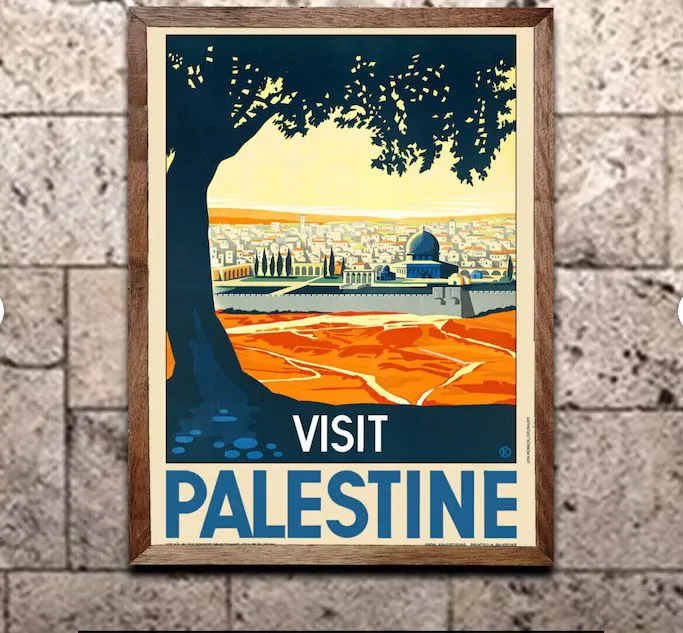
Mandate-era promotional materials – especially the famous “Visit Palestine” and “Come to Palestine” posters – were not Arab nationalist artifacts. They were:
- designed by Jewish artists,4
- commissioned by Jewish institutions, and4
- marketed largely to Jews abroad.4
And what did they depict?
- Tel Aviv4
- kibbutzim4
- Jewish pioneers4
- agricultural revival4
- Jewish holy sites4
The global public was being told, visually and explicitly, that “Palestine” was the land of Jewish renewal.4
This was not propaganda. It was the lived reality of the emerging Jewish homeland.
The Post-1948 Inversion
After Israel’s independence in 1948, Jews ceased being “Palestinians” and became Israelis.1
Only then – after the establishment of Israel and the Arab world’s failure to destroy it – did a distinct Palestinian Arab national identity take shape.
It crystallised in:
- refugee camps in the 1950s6
- the 1964 founding of the PLO (whose initial charter still denied any national claim to Judea and Samaria [the “West Bank”] or Gaza)6
- the 1970s internationalisation of the Palestinian national cause6
With this shift came a dramatic linguistic and ideological inversion:
- The land once labelled “Palestine” as a Jewish homeland was rebranded as a symbol of Arab dispossession.6
- The term “Palestinian”, once a Jewish civic identity, became associated exclusively with Arab nationalism.6
- The idea of ‘freeing’ Palestine was repurposed to mean opposing Jewish sovereignty – the polar opposite of its original context.6
The irony is profound: a Jewish liberation concept was appropriated and turned into a slogan against Jewish self-determination.1,2
Ideological and Moral Implications
This historical inversion is not a mere curiosity – it is central to today’s rhetoric around Israel.
The modern “Free Palestine” slogan:
1. Erases Jewish indigeneity and historical rights
By ignoring that Jews were the original “Palestinians”, the slogan portrays Jews as foreign colonizers.1,2,5
2. Distorts the historical timeline
It presents Palestinian identity as ancient, uninterrupted, and Arab-exclusive – a claim contradicted by mandate-era records.6
3. Subverts a Jewish liberation narrative
It takes a Jewish national cause – freeing the Jewish homeland – and reframes it as a call to dismantle Jewish sovereignty.1,2
This is not a harmless misunderstanding. It has consequences: intellectual, political, and moral.
Reclaiming the Truth
A historically honest view exposes the reality:
- Jews were the first Palestinians.3,5
- Jews were the only community seeking to liberate “Palestine”.1,2
- Modern usage hijacks and reverses that history.6
Understanding this does not negate modern Palestinian identity. But it demands honesty about its origins – and the origins of the term it now claims as its exclusive property.
Conclusion
History is not neutral. If left unchallenged, distortions ossify into dogma.
Today’s dominant slogans depend on forgetting that:
- the term Palestinian was Jewish in practice,3,5
- the political subject of “Palestine” was Jewish,1,2,5
- and the first struggle for a free Palestine was the Jewish struggle for sovereignty.1,2
If anything deserves to be liberated today, it is the truth.
Before the world chants “Free Palestine,” it should first ask: Which Palestine? Whose freedom? And whose history has been erased?1,2,5,6
Only then can any meaningful conversation begin about justice, sovereignty, and coexistence in the land of Israel.
References
- Council of the League of Nations. Mandate for Palestine. London: His Majesty’s Stationery Office, 1922.
- Britannica Academic. “Palestine – The British Mandate, Zionism, Conflict.”
- Qafisheh, Mutaz M. “Genesis of Citizenship in Palestine and Israel: 1917–1925.” Bulletin du Centre de recherche français à Jérusalem.
- Institute for Palestine Studies. “Visit Palestine” Poster History.
- United Nations. Origins and Evolution of the Palestine Question: 1917–1947. UN History Archives.
- Khalidi, Rashid. Palestinian Identity: The Construction of Modern National Consciousness. New York: Columbia University Press, 1997.
- https://israelinstitute.nz/2018/02/israels-history-part-1-the-indigenous-jewish-presence-in-israel-palestine/
Further Reading
Morris, Benny. Righteous Victims: A History of the Zionist-Arab Conflict, 1881–1999. New York: Vintage, 1999.
Kimmerling, Baruch, and Joel S Migdal. The Palestinian People: A History. Cambridge, MA: Harvard University Press, 2003.
Shlaim, Avi. The Iron Wall: Israel and the Arab World. New York: W W Norton & Company, 2001.
This article was originally published by the Israel Institute of New Zealand.

![[The Good Oil] Stuff Up of the Day](/content/images/size/w1304/format/webp/2024/09/Stuff-up-image-1.webp)